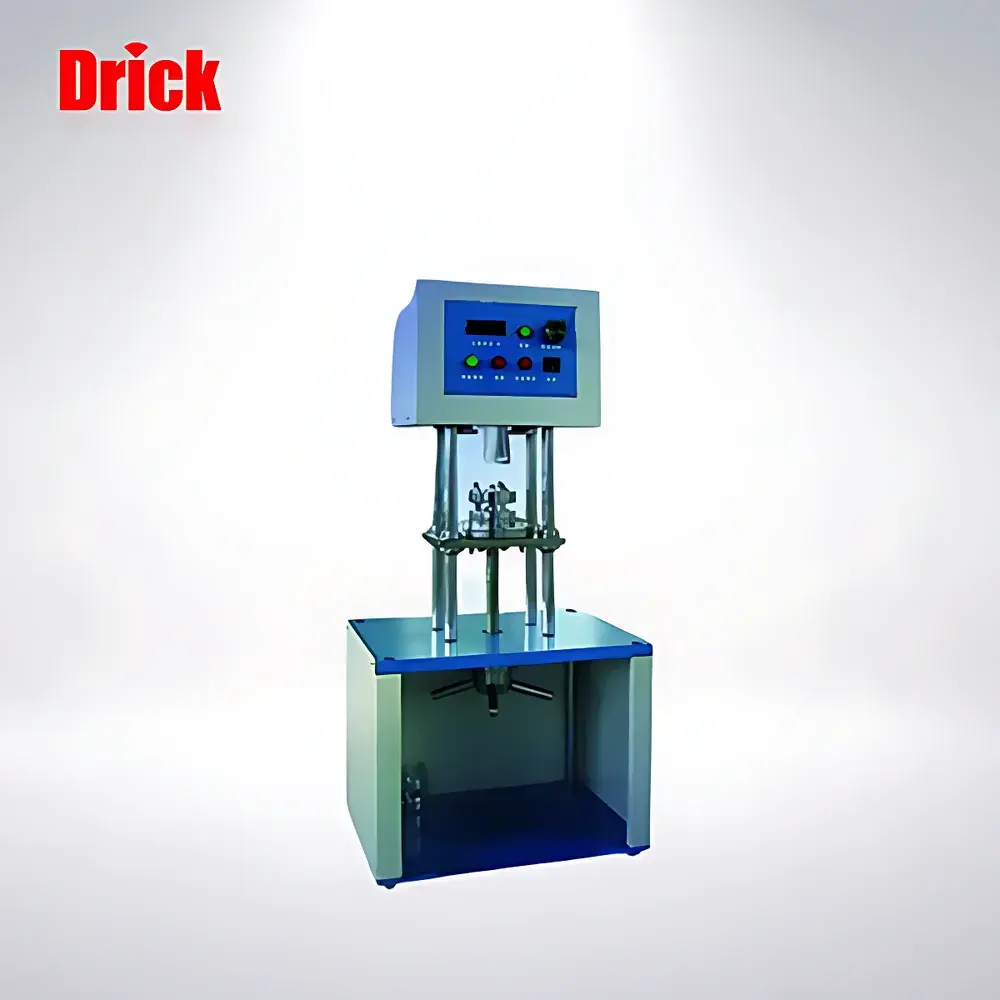
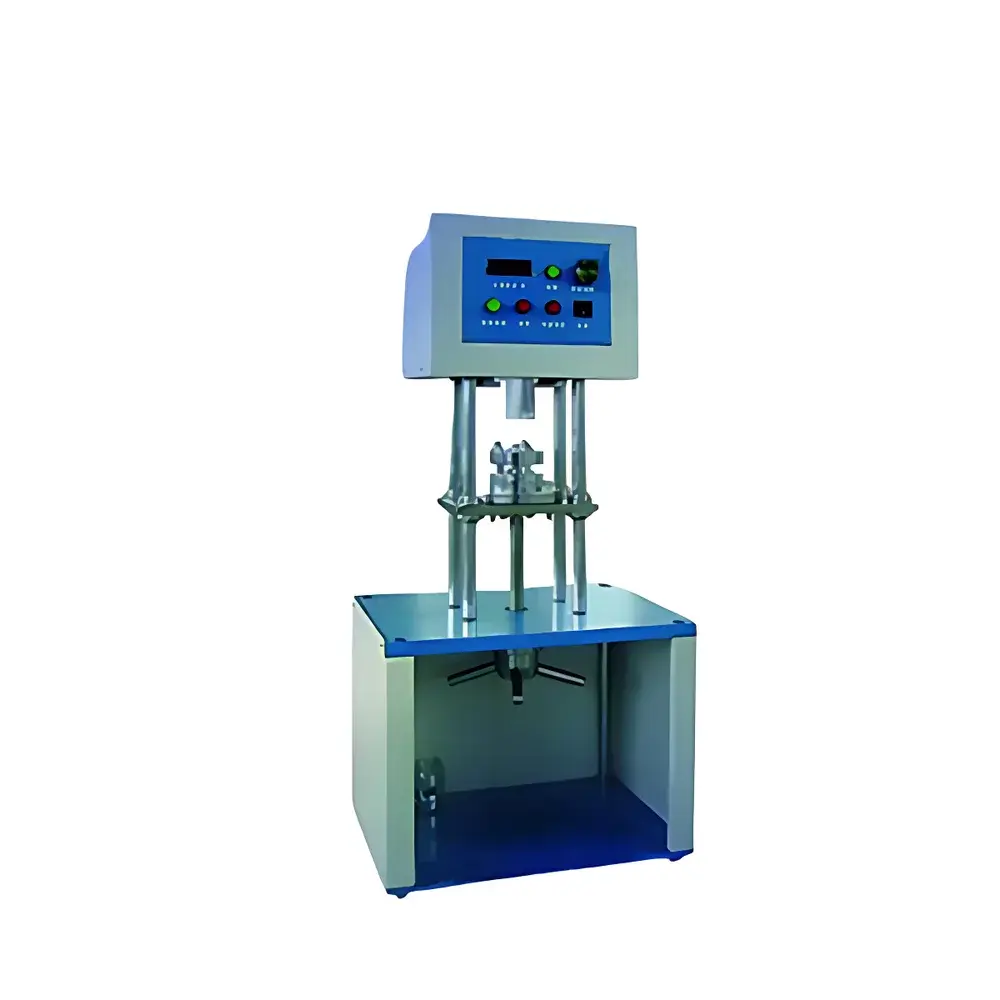
Drick ZWS-0200 Compression Stress Relaxation Tester for Vulcanized Rubber per GB/T 13643
| Brand | Drick |
|---|---|
| Origin | Shandong, China |
| Manufacturer Type | Direct Manufacturer |
| Model | ZWS-0200 |
| Force Sensor Range | 2500 N |
| Force Accuracy | ±1% (typical ±0.5%) |
| Power Supply | AC 220 V ±10%, 50 Hz |
| Dimensions (W×D×H) | 300 × 174 × 600 mm |
| Weight | ~35 kg |
Overview
The Drick ZWS-0200 Compression Stress Relaxation Tester is a precision-engineered instrument designed to quantify the time-dependent decay of compressive stress in vulcanized rubber and thermoplastic elastomers under constant strain conditions. Operating on the fundamental principle of constrained uniaxial compression, the system maintains a fixed geometric deformation (typically 25% or specified compression ratio) while measuring the progressive reduction in reaction force over time at controlled thermal environments—either in ambient air or within temperature-regulated liquid media. This methodology directly aligns with the physical definition of stress relaxation in viscoelastic solids, where internal molecular rearrangement and network chain slippage lead to measurable force decay. The ZWS-0200 is explicitly configured to comply with Chinese national standards GB/T 13643 (“Determination of Compression Stress Relaxation of Vulcanized or Thermoplastic Rubber – Annular Specimens”) and GB/T 1685 (“Determination of Compression Stress Relaxation of Vulcanized Rubber at Ambient and Elevated Temperatures”), making it a validated tool for R&D laboratories, quality control departments, and materials certification bodies serving the sealing, automotive, aerospace, and industrial gasket sectors.
Key Features
- Robust mechanical architecture featuring manually actuated lever-driven loading mechanism with tactile feedback and repeatable displacement control;
- Digital force readout via high-stability load cell (2500 N full-scale range), providing real-time compression force values with ≤1% linearity error (±0.5% typical);
- Integrated contact detection circuit with visual LED indicator—ensures precise initiation timing of stress relaxation measurement upon specimen engagement;
- Modular fixture system accommodating annular specimens per GB/T 13643, including interchangeable restrictors and calibrated compression platens;
- Compact benchtop footprint (300 × 174 × 600 mm) and lightweight design (~35 kg) enabling flexible placement in ISO 17025-accredited labs or production QC areas;
- Zero-reset functionality with hold-and-release activation, minimizing operator-induced baseline drift during sequential multi-specimen testing.
Sample Compatibility & Compliance
The ZWS-0200 is optimized for annular test specimens prepared according to GB/T 13643 specifications, typically cut from molded or extruded rubber stock. It supports both air-cured and liquid-medium testing protocols—when evaluating performance in oils, coolants, or hydraulic fluids, specimens must be sealed in hermetic containers prior to thermal conditioning. All mechanical and electrical components conform to GB 4793.1 (Safety Requirements for Electrical Equipment for Measurement, Control, and Laboratory Use). While not inherently 21 CFR Part 11 compliant due to its analog-digital hybrid architecture, the instrument’s deterministic mechanical operation and manual data recording workflow are fully compatible with GLP and GMP documentation practices when paired with standardized SOPs and audit-trail-enabled lab notebooks.
Software & Data Management
The ZWS-0200 operates as a standalone hardware platform without embedded firmware or proprietary software. Force values are displayed numerically on an integrated digital panel; users record initial compression force (F₀) and post-conditioning residual force (Fₜ) manually. Stress relaxation coefficient (R) and percentage relaxation (%R) are calculated per GB/T 13643 using the equations: R = Fₜ / F₀ and %R = (1 − Fₜ / F₀) × 100. For traceable data management, laboratories commonly integrate the instrument into LIMS workflows by logging timestamps, environmental chamber parameters (temperature, duration), and raw force readings into structured Excel templates or validated electronic lab notebooks. Optional external USB data loggers may be connected via analog output (0–5 V) for continuous waveform capture, though such configurations require user-defined calibration against the built-in display.
Applications
- Development and qualification of static sealing compounds (e.g., O-rings, gaskets, bushings) where long-term compression set resistance dictates service life;
- Comparative evaluation of filler systems (carbon black, silica), curatives (sulfur vs. peroxide), and plasticizers on network stability under sustained load;
- Accelerated aging studies correlating stress relaxation behavior with thermal exposure history (e.g., 70 °C/72 h, 100 °C/24 h);
- Supplier qualification testing for Tier-1 automotive component manufacturers requiring conformance to OEM-specific material specifications (e.g., GMW15635, Ford WSS-M99P1111-A);
- Educational use in polymer science and rubber engineering curricula to demonstrate time-temperature superposition and Boltzmann superposition principles.
FAQ
What specimen geometry does the ZWS-0200 support?
The instrument is configured exclusively for annular specimens as defined in GB/T 13643, with inner and outer diameters specified per standard tables—custom geometries require mechanical adaptation and revalidation.
Can the ZWS-0200 perform tests at sub-ambient temperatures?
No—the system lacks active cooling capability. Testing below ambient requires integration with an externally controlled low-temperature environmental chamber and appropriate cryogenic fixture modifications.
Is force calibration traceable to national standards?
Yes; the load cell is factory-calibrated against CNAS-accredited reference standards, and users may perform periodic verification using certified dead-weight test kits traceable to NIM (National Institute of Metrology, China).
How is thermal conditioning synchronized with mechanical measurement?
Thermal exposure occurs offline in a separate, validated oven or liquid bath; the ZWS-0200 performs only the pre- and post-conditioning force measurements—timing accuracy relies on laboratory chronometers meeting ISO 9001 requirements.
Does the instrument meet ASTM D1054 or ISO 3384 requirements?
While functionally similar, the ZWS-0200 is specifically validated for GB/T 13643 and GB/T 1685. Cross-standard applicability requires empirical correlation studies and documented equivalence justification per ISO/IEC 17025 Clause 7.2.2.