
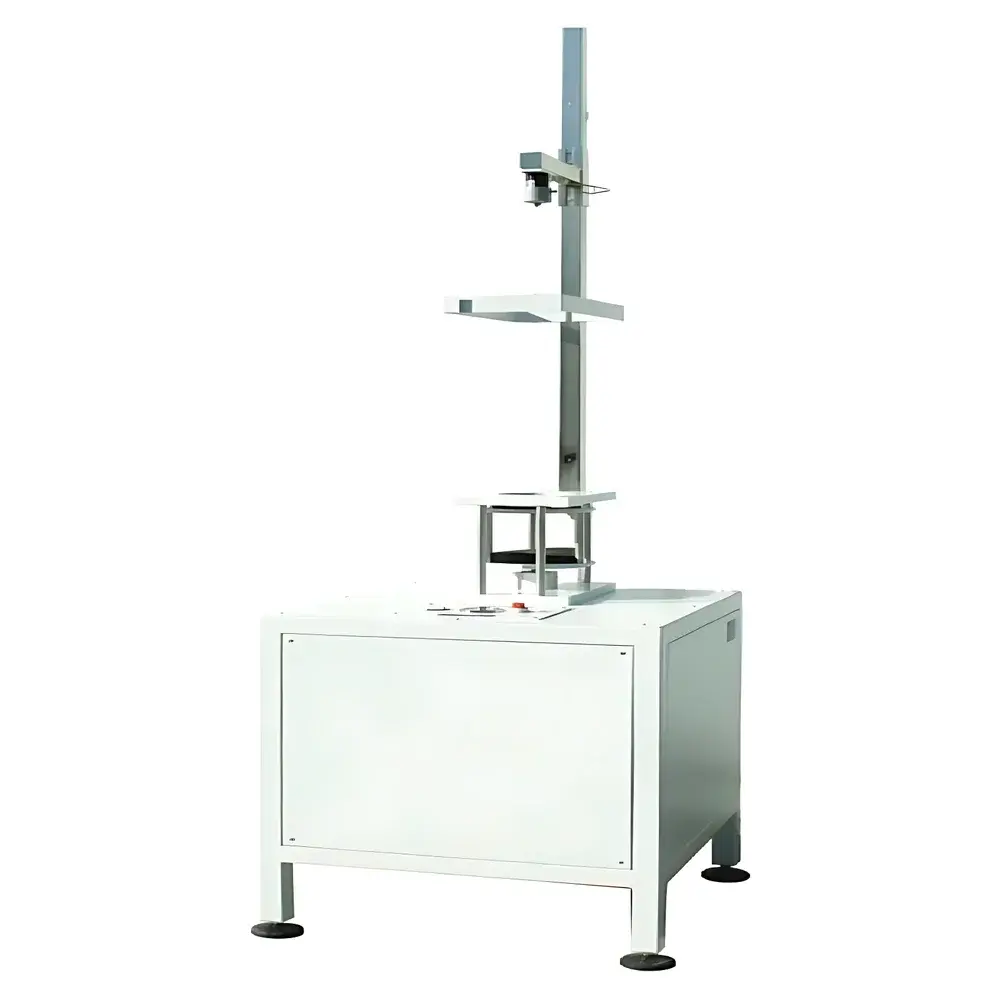
Drop Impact Tester – NOSELAB ATS Model Drop Impact
| Key | Brand: NOSELAB ATS |
|---|---|
| Origin | Italy |
| Type | Import Instrument |
| Standard Compliance | ASTM D1709 Methods A & B |
| Drop Height Range | 650–1530 mm |
| Clamp Ring Diameter (Outer) | 127 mm |
| Inner Ring Diameter | 125 mm ± 2 mm |
| Actuation | Electromagnetic Release |
| Clamping | Pneumatic Dual-Ring Fixture |
| Safety Enclosure | Acrylic Cylindrical Guard with Dart Recovery System |
| Leveling | Adjustable Horizontal Feet and Vertical Position Control |
| Calibration Tool | Conical Metal Plumb Bob with Suspension Cord and Magnetic Tip |
| Accessories Included | Standard Dart Assembly, Weight Sets, and Optional Test Fixtures |
Overview
The NOSELAB ATS Drop Impact Tester (Model Drop Impact) is a precision-engineered instrument designed to quantify the impact resistance of thin flexible packaging films and laminates. It operates on the principle of free-fall impact energy measurement, where a standardized dart is released from a controlled height onto a horizontally clamped test specimen. The energy required to cause 50% failure (i.e., puncture or tear) across a statistically representative sample set is determined via the stair-case method—commonly referred to as the “50% failure energy” or “impact strength at 50% probability of failure.” This methodology is rigorously defined in ASTM D1709 (Methods A and B), which specifies two distinct dart configurations (A: 38 mm diameter, 50 g mass; B: 50 mm diameter, 50 g mass) and corresponding drop-height protocols for evaluating low-density polyethylene (LDPE), linear low-density polyethylene (LLDPE), and other thermoplastic films used in food, pharmaceutical, and industrial packaging applications.
Key Features
- Electromagnetically actuated dart release mechanism ensures precise, zero-jerk initiation with sub-millisecond timing repeatability—critical for minimizing pre-impact oscillation and maximizing inter-laboratory reproducibility.
- Dual-pneumatic ring clamping system: outer ring (127 mm ID) and inner ring (125 mm ± 2 mm ID) apply uniform radial pressure to eliminate specimen slippage and edge distortion during impact.
- Adjustable drop height range from 650 mm to 1530 mm in 10-mm increments, calibrated traceably to NIST-traceable standards via integrated digital height encoder.
- Acrylic cylindrical safety enclosure fully surrounds the drop zone, incorporating an integrated dart recovery chamber and impact-absorbing base liner to prevent ricochet and ensure operator compliance with ISO 13857 and ANSI/RIA R15.06 safety guidelines.
- Three-point adjustable leveling system—comprising dual front horizontal feet and rear vertical position screw—guarantees specimen plane orthogonality within ±0.1°, essential for valid ASTM D1709 alignment requirements.
- Included calibration plumb bob (conical metal tip, magnetic suction cup, and nylon suspension cord) enables rapid verification of dart trajectory centering relative to the clamped specimen’s geometric center.
Sample Compatibility & Compliance
The Drop Impact Tester accommodates flat, non-stretchable specimens measuring ≥150 mm × 150 mm, including mono-layer films (e.g., LDPE, PP, PET), coextruded structures, metallized laminates, and paper-plastic composites. Specimen thickness shall not exceed 1.0 mm to maintain adherence to ASTM D1709 boundary conditions. All mechanical and control subsystems conform to CE marking directives (2006/42/EC Machinery Directive, 2014/30/EU EMC Directive). The instrument supports full audit readiness for GLP and GMP environments through optional firmware-enabled event logging (timestamped release commands, height settings, and pass/fail annotations), aligning with FDA 21 CFR Part 11 data integrity expectations when paired with validated software.
Software & Data Management
While the base model operates via manual height setting and visual failure assessment, the optional ATS-DI Connect Module enables USB-based integration with NOSELAB’s certified ImpactSuite™ v3.2 software. This platform automates stair-case sequence execution per ASTM D1709 Annex A2, calculates median impact energy (in mJ) using probit analysis, generates ASTM-compliant test reports (PDF/CSV), and stores raw event logs with user authentication, electronic signatures, and change history tracking—fully compliant with ALCOA+ principles for data reliability.
Applications
- Quality control of blown and cast polyolefin films in converter and end-user packaging facilities.
- Development validation of barrier-coated or nanocomposite films intended for high-speed form-fill-seal (FFS) lines.
- Comparative evaluation of seal integrity under impact stress in pouch and sachet designs.
- Regulatory submission support for medical device packaging per ISO 11607-1, where impact resistance correlates with sterile barrier system robustness.
- R&D benchmarking of recyclable mono-material alternatives against conventional multilayer laminates.
FAQ
What ASTM standards does this instrument directly support?
ASTM D1709 Methods A and B are natively implemented; optional firmware upgrades extend support to ISO 7765-1 and JIS Z 1707.
Is calibration certification included with shipment?
Yes—a factory-issued calibration certificate (traceable to Italian National Metrology Institute INRIM) is supplied, covering height encoder, pneumatic pressure regulation, and clamp force uniformity.
Can the tester accommodate non-circular specimens?
No—ASTM D1709 mandates circular clamping geometry; rectangular or irregular samples require alternative methods such as instrumented falling-weight impact (e.g., ISO 6603-2).
What maintenance intervals are recommended?
Electromagnetic release coil inspection every 12 months; pneumatic filter replacement every 6 months; annual verification of dart mass and dimensional tolerances per ASTM D1709 Section 6.2.
Is remote diagnostics available?
Via optional Ethernet-enabled ATS-DI Connect Module, enabling secure OEM-level firmware updates and real-time sensor health monitoring through encrypted TLS 1.2 communication.






