
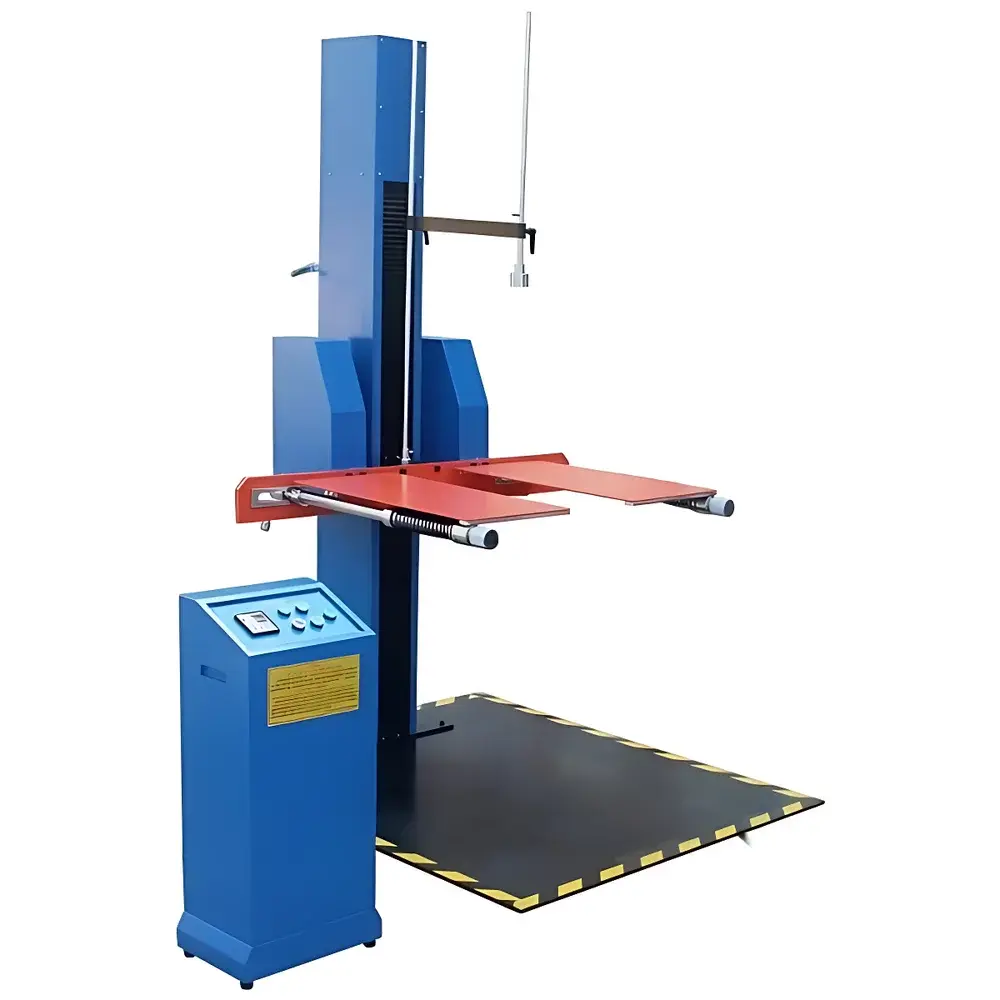
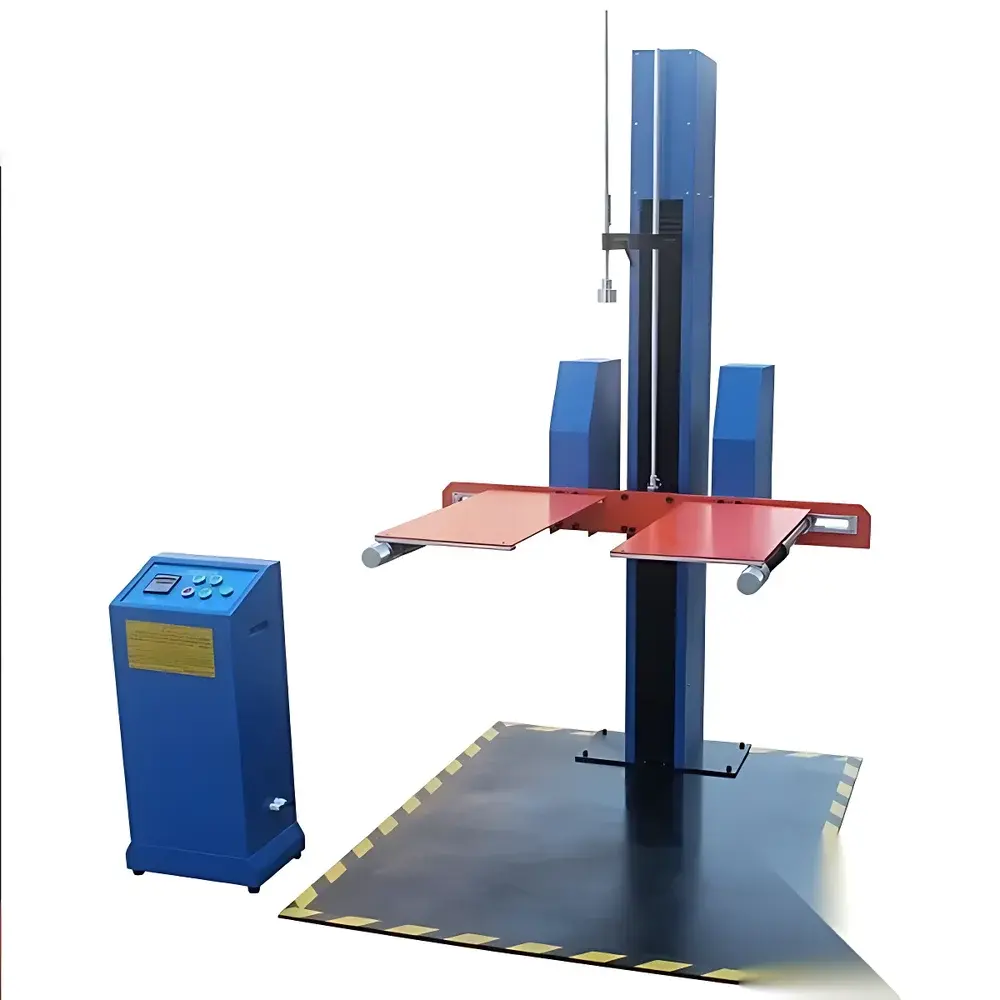
Drop Testing Machine – Standard Vertical Impact Drop Tester for Packaging Integrity Validation
| Key | Brand: OEM/Third-Party Manufacturer |
|---|---|
| Origin | Imported |
| Supplier Type | Authorized Distributor |
| Price | USD 1,700 (FOB) |
| Compliance | GB/T 4857.5, ISO 2248:1985, GB/T 4857.1–4857.18 |
Overview
The Drop Testing Machine is an electromechanically controlled vertical impact testing system engineered to evaluate the structural integrity and shock resistance of packaged products under simulated real-world handling conditions. It operates on the principle of free-fall impact dynamics, where a standardized test specimen—fully assembled and loaded in its final shipping configuration—is elevated to a precisely defined height and released onto a rigid, non-resilient horizontal impact surface. This replicates common logistics events such as accidental drops during manual handling, conveyor transfers, or pallet unloading. The machine enables repeatable assessment of package performance across three critical impact orientations: flat face, edge, and corner—each representing distinct stress concentration modes that govern failure mechanisms in corrugated boxes, plastic containers, foam inserts, and composite secondary packaging. Designed for laboratory and QC environments, it supports deterministic validation of packaging robustness prior to distribution, directly informing design iteration, material selection, and compliance documentation.
Key Features
- Structural frame fabricated from precision-ground, chromium-plated high-tensile steel columns—optimized for dimensional stability, minimal deflection under load, and long-term corrosion resistance.
- Custom-engineered Taiwan-made ST-grade roller chain drive system for smooth, low-backlash lifting and positioning of the drop carriage.
- Triple-mode orientation mechanism enabling true face-down, edge-first, and corner-first drop configurations without manual repositioning of the test specimen.
- Fully motorized lift, release, and reset functions controlled via integrated push-button panel—eliminating manual hoisting and reducing operator variability.
- Independent carrier-release mechanism ensures clean separation between the support platform and test unit at the moment of release, minimizing pre-impact constraint and ensuring true free-fall kinematics.
- Digital height display with optical encoder feedback provides real-time, traceable elevation readout with ≤2% or ±10 mm absolute accuracy relative to setpoint—meeting metrological requirements for ISO/IEC 17025-aligned testing labs.
Sample Compatibility & Compliance
The system accommodates standard shipping units up to 60 kg and 600 × 600 × 600 mm (W × D × H), with adjustable clamping fixtures for secure specimen retention across diverse geometries. Test specimens must conform to GB/T 4857.1 for standardized labeling of faces, edges, and corners, and undergo preconditioning per GB/T 4857.2 (temperature/humidity stabilization) where applicable. The instrument satisfies mandatory requirements of GB/T 4857.5 (Chinese National Standard for Vertical Impact Drop Testing) and its international counterpart ISO 2248:1985. It further supports full traceability within GLP-compliant workflows through documented height calibration records, operator ID logging, and test sequence timestamps—enabling audit readiness for FDA-regulated medical device packaging or IEC 60601-certified equipment shipments.
Software & Data Management
While the base configuration operates via standalone electro-mechanical controls, optional RS-232 or USB interface modules enable integration with external data acquisition systems. Height setpoints, drop count, orientation mode, and timestamped pass/fail observations can be exported in CSV format for inclusion in LIMS or statistical process control (SPC) platforms. For regulated environments, the optional software add-on provides 21 CFR Part 11-compliant electronic signatures, audit trail generation, and user-access tiering—supporting GMP documentation requirements for pharmaceutical primary packaging validation.
Applications
- Validation of e-commerce fulfillment packaging against Amazon ISTA 3A and similar accelerated distribution protocols.
- Comparative evaluation of cushioning materials (e.g., molded pulp vs. EPS vs. air-filled pillows) under standardized impact energy inputs.
- Root-cause analysis of field failures by correlating lab-induced damage patterns (crush, seam rupture, lid detachment) with actual shipment incident reports.
- Pre-certification testing for UN Dangerous Goods packaging (UN 4G, 4GV) per UN Manual of Tests and Criteria, Part III, Section 38.3.
- Supporting Design for Logistics (DfL) initiatives by quantifying drop-height thresholds before catastrophic failure across product SKUs.
FAQ
What standards does this drop tester fully comply with?
It meets the mechanical and procedural requirements of GB/T 4857.5–2008 and ISO 2248:1985, and supports implementation of GB/T 4857.1, GB/T 4857.2, GB/T 4857.17, and GB/T 4857.18 for comprehensive test planning and reporting.
Is calibration certification included with delivery?
A factory-issued height verification report is provided; third-party accredited calibration (e.g., CNAS or A2LA) is available upon request with lead-time scheduling.
Can the machine perform sequential multi-drop tests on a single specimen?
Yes—the controller supports programmable sequences of up to 99 drops, each with independent height, orientation, and dwell time settings.
What maintenance intervals are recommended?
Lubrication of chain and guide rails every 200 operational hours; annual verification of encoder linearity and release timing tolerance per internal SOP-DRP-003.



