
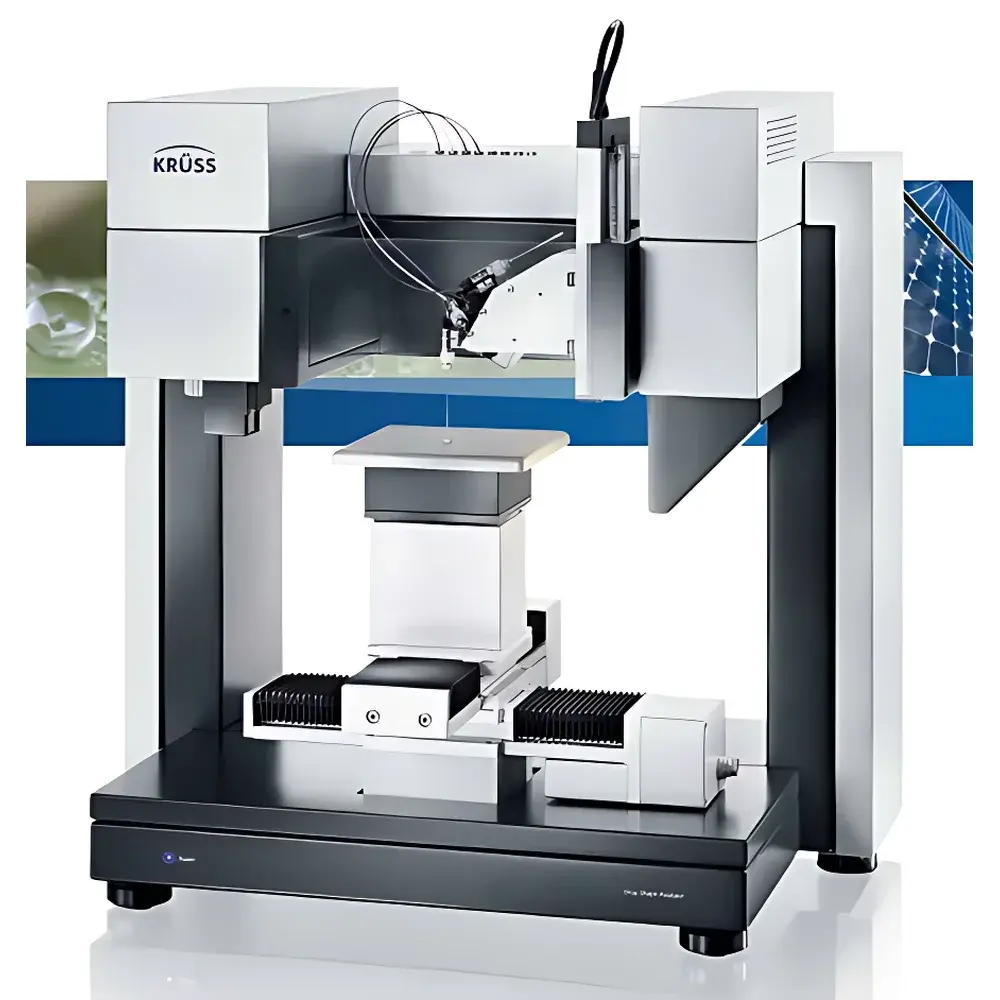
DSA100 Advanced Drop Shape Analyzer by KRÜSS
| Origin | Germany |
|---|---|
| Manufacturer Type | Authorized Distributor |
| Origin Category | Imported |
| Model | DSA100 |
| Price Range | USD 68,000 – 136,000 |
| Instrument Class | Dynamic Contact Angle Analyzer |
| Form Factor | Benchtop Laboratory System |
| Contact Angle Measurement Range | 0–180° |
| Contact Angle Accuracy | ±0.1° |
| Sample Stage Dimensions | 100 × 100 mm (adjustable height) |
| Optical Magnification | 0.7–4.5× (motorized zoom lens) |
| Surface/Interfacial Tension Range | 0.01–2000 mN/m |
| Surface/Interfacial Tension Accuracy | ±0.01 mN/m |
| Temperature Control Range | −30 to +400 °C (with optional thermostatted stages) |
| Humidity Control | Integrated chamber (10–95% RH, ±2% RH stability) |
| Imaging System | High-speed monochrome CMOS camera (1024 × 1024 px, 12-bit dynamic range, up to 300 fps) |
| Software Platform | ADVANCE v4.x with audit trail, user management, and 21 CFR Part 11 compliance modules |
Overview
The DSA100 Advanced Drop Shape Analyzer is a high-precision benchtop instrument engineered for quantitative characterization of solid–liquid and liquid–liquid interfacial phenomena. Based on the optical analysis of sessile and pendant droplets using high-resolution silhouette imaging, the system applies rigorous geometric and physical models—including Young–Laplace fitting, circle/ellipse fitting, and axisymmetric drop shape analysis (ADSA)—to determine contact angles, surface free energy components, interfacial tension, and dynamic wetting behavior. Designed for rigorous laboratory environments, the DSA100 integrates motorized stage positioning, temperature- and humidity-controlled sample chambers, and real-time image acquisition synchronized with automated dispensing. Its architecture supports both static and dynamic measurements—such as advancing/receding contact angles, roll-off angles on superhydrophobic surfaces, and time-resolved spreading kinetics—making it suitable for R&D, quality assurance, and regulatory-compliant testing in materials science, pharmaceuticals, microelectronics, and surface engineering.
Key Features
- Motorized, software-controlled XYZ stage with fine-height adjustment (±0.1 µm resolution) and integrated tilt mechanism for precise sample alignment and roll-angle quantification.
- Dual-optics path: Independent illumination and imaging axes ensure consistent backlight contrast and minimal glare across diverse substrate reflectivities and transparency levels.
- Thermostatted sample stage and environmental chamber enable controlled measurements from −30 °C to +400 °C and 10–95% RH, supporting thermal stability studies and hygroscopic surface evaluation.
- High-speed CMOS camera (up to 300 fps) coupled with adaptive exposure control captures rapid wetting transitions, droplet oscillation, and capillary-driven spreading with sub-millisecond temporal resolution.
- Modular dispensing unit with syringe pump and piezoelectric dispenser allows programmable deposition of volumes from 10 nL to 100 µL, minimizing operator-induced variability.
- Robust aluminum alloy chassis with vibration-damping feet and internal thermal shielding ensures mechanical stability during long-duration measurements and multi-cycle repeatability.
Sample Compatibility & Compliance
The DSA100 accommodates rigid and flexible substrates up to 100 × 100 mm, including silicon wafers, polymer films, coated metals, porous ceramics, textiles, and biological membranes. Its non-contact optical methodology preserves sample integrity without mechanical loading or surface contamination. The system complies with multiple international test standards, including ASTM D7334 (surface energy of plastic films), ISO 15989 (contact angle measurement), ISO 1409 (interfacial tension of polymer solutions), and USP <1058> (analytical instrument qualification). ADVANCE software includes full 21 CFR Part 11 compliance features—electronic signatures, role-based access control, immutable audit trails, and data integrity validation—supporting GLP and GMP workflows in regulated industries.
Software & Data Management
ADVANCE v4.x provides an integrated environment for experiment design, real-time visualization, model selection, and statistical reporting. Users can define multi-step protocols—including sequential droplet deposition, timed aging, temperature ramps, and humidity cycling—with automatic parameter logging. All raw images, metadata, and calculation logs are stored in a relational database with configurable backup and export options (CSV, PDF, XML, HDF5). Batch processing enables comparative analysis across sample sets, while scripting interfaces (Python API) support custom algorithm integration and automated report generation aligned with internal SOPs or regulatory submission requirements.
Applications
- Quantitative assessment of plasma, corona, flame, or chemical surface treatments on polymers and composites.
- Adhesion prediction via surface energy component analysis (Lifshitz–van der Waals, acid–base, polar–dispersive) for adhesive bonding, inkjet printing, and thin-film coating development.
- Wettability mapping of semiconductor wafers and MEMS devices to detect localized contamination or cleaning inefficiencies.
- Dynamic contact angle hysteresis profiling for hydrophobic/hydrophilic gradient surfaces used in lab-on-chip platforms.
- Interfacial rheology analysis via pendant drop oscillation damping, enabling viscoelastic modulus extraction at oil–water and polymer–solvent interfaces.
- Stability evaluation of functional coatings under accelerated aging conditions (temperature/humidity cycling).
FAQ
What contact angle models are supported in ADVANCE software?
Young–Laplace fitting, Circle/Ellipse fitting, Spline fitting, and Axisymmetric Drop Shape Analysis (ADSA) — all with uncertainty estimation and residual diagnostics.
Can the DSA100 measure interfacial tension between two immiscible liquids?
Yes — using the pendant drop method with dual-liquid phase imaging and density calibration; supports organic–aqueous, polymer–melt, and surfactant-laden systems.
Is humidity control mandatory for standard operation?
No — the environmental chamber is optional; however, it is required for ISO 15989-compliant measurements and hygroscopic material studies.
How does the system ensure measurement reproducibility across operators?
Through automated focus, lighting, dispensing, and analysis workflows — combined with electronic signature-locked SOPs and version-controlled method templates.
Does the DSA100 support automated surface energy mapping?
Yes — via motorized X–Y stage scanning with programmable droplet placement and batch analysis; spatial resolution limited only by dispensing precision and optical magnification.



