
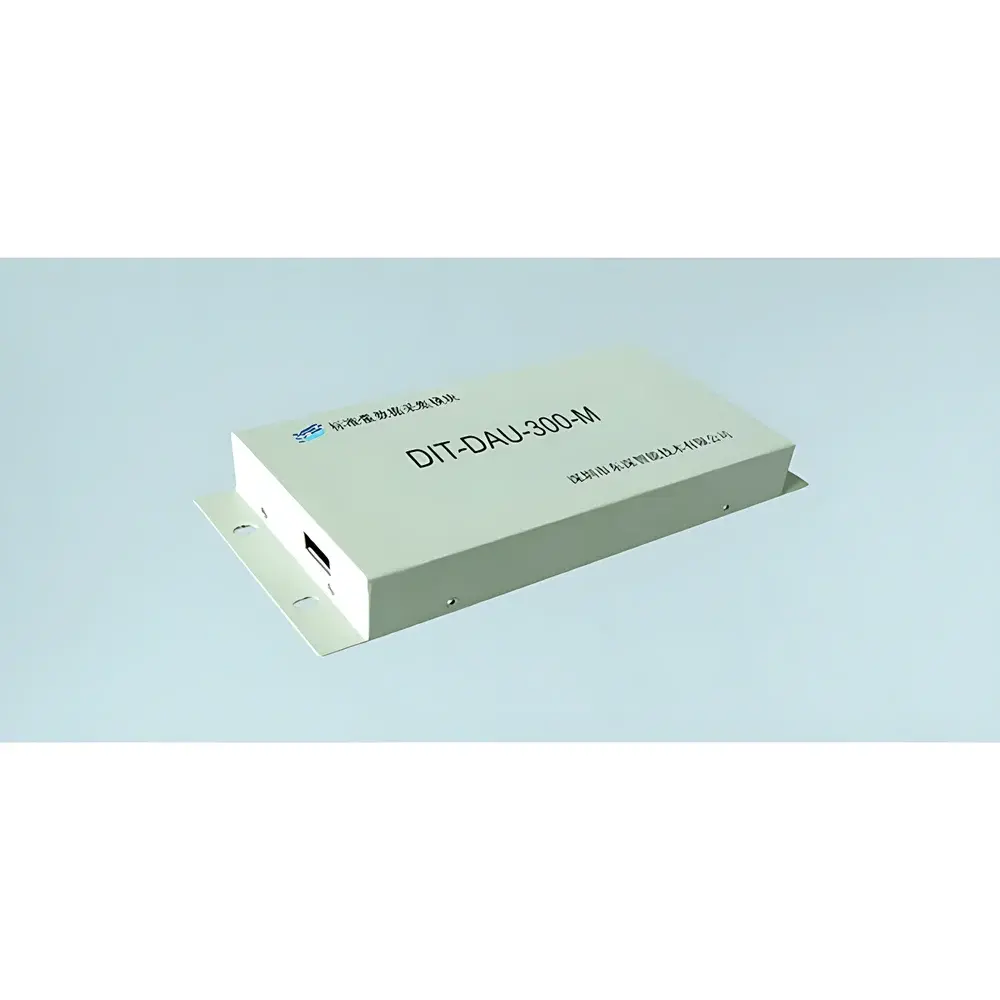
DSE DIT-DAU-300 Standard Signal Data Acquisition Unit
| Brand | DSE |
|---|---|
| Origin | Shenzhen, China |
| Manufacturer Type | Authorized Distributor |
| Region of Manufacture | Domestic (China) |
| Model | DIT-DAU-300 |
| Pricing | Available Upon Request |
Overview
The DSE DIT-DAU-300 Standard Signal Data Acquisition Unit is an industrial-grade, embedded data acquisition system engineered for long-term structural health and geotechnical monitoring in harsh environmental conditions. Built around a high-efficiency 32-bit ARM microcontroller, the unit integrates precision analog signal conditioning, high-stability ADC conversion, non-volatile memory management, real-time clock (RTC) synchronization, and multi-protocol communication interfaces into a single ruggedized hardware platform. Its core measurement architecture supports standardized analog input signals—specifically 0–5 V, 0–10 V, 4–20 mA, and 0–20 mA—enabling direct interfacing with industrial transducers including piezoresistive pressure sensors, ceramic capacitive pressure transducers, hydraulic settlement gauges, fixed-in-place inclinometers, and other civil infrastructure instrumentation. Designed for deployment in remote or unattended locations—including dam embankments, reservoir perimeters, tunnel portals, bridge foundations, high-cut slopes, and road substructures—the DIT-DAU-300 complies with IEC 61000-4 electromagnetic immunity standards and operates reliably across -20 °C to +70 °C ambient ranges.
Key Features
- Configurable analog input channels: 1-, 8-, 16-, or 32-channel variants support simultaneous acquisition from standard voltage/current-output sensors
- Programmable acquisition modes: cyclic scanning (sequential channel polling), selective channel readout (user-defined point selection), scheduled time-triggered acquisition (up to six daily time points), and interval-based continuous monitoring (start time, end time, and sampling interval configurable)
- Non-volatile internal storage with power-loss protection: retains timestamped sensor readings using FIFO overwrite policy; supports optional industrial-grade SD card (FAT32 file system) for high-density archival storage
- Multi-interface connectivity: RS-232 (local configuration/debug), RS-485 (multi-drop serial networks up to 1200 m), and 10/100 Mbps Ethernet (TCP/IP stack compliant with Modbus TCP and DSE proprietary protocols)
- Expandable wireless telemetry: optional GPRS/3G/4G cellular module, licensed UHF/VHF radio modem, or LoRaWAN gateway interface for off-grid deployments
- Embedded real-time clock with automatic NTP synchronization (via Ethernet) or manual calibration via serial command
- Low-power design: typical standby current <15 mA; active acquisition current <80 mA; supports solar-battery hybrid power systems
Sample Compatibility & Compliance
The DIT-DAU-300 is optimized for use with calibrated civil engineering sensors delivering standardized analog outputs. It accepts inputs from two-wire and four-wire transmitters meeting IEC 60770 and GB/T 18403.1 specifications. Input isolation (1500 VDC channel-to-ground) and built-in surge suppression (IEC 61000-4-5 Level 3) ensure stable operation in lightning-prone or high-noise environments common in dam and tunnel monitoring sites. The unit conforms to GB/T 2423 (Chinese national environmental testing standards) and supports traceable calibration documentation required under ISO/IEC 17025-accredited monitoring programs. While not certified for SIL or ATEX applications, its architecture meets functional safety prerequisites for Class II monitoring systems as defined in DL/T 5211–2019 (Chinese Code for Safety Monitoring of Concrete Dams).
Software & Data Management
The DIT-DAU-300 operates with DSE’s unified Central Monitoring System (CMS) software suite, which provides configuration management, remote firmware updates, automated data retrieval, and alarm thresholding. All communications are logged with full audit trails—including command origin (IP address or serial port), timestamp, and payload checksum—supporting GLP-aligned operational integrity. Data export formats include CSV, XML, and JSON; integration with SCADA platforms (e.g., Ignition, Siemens Desigo CC) is achieved via OPC UA or Modbus TCP gateways. Optional CMS modules support 21 CFR Part 11-compliant electronic signatures and role-based access control for regulated infrastructure projects.
Applications
- Real-time deformation monitoring of concrete and earth-fill dams, including pore pressure, uplift, and seepage analysis
- Long-term stability assessment of deep excavations, cut slopes, and retaining structures
- Structural response tracking for bridges, viaducts, and railway embankments under dynamic loading
- Subsurface movement detection using inclinometer strings and extensometer arrays
- Environmental parameter logging (temperature-compensated pressure, groundwater level, rainfall intensity) in hydrological observatories
- Integration into national or provincial geotechnical early-warning systems compliant with SL 551–2012 (Technical Specifications for Safety Monitoring Information Systems)
FAQ
What types of sensors can be directly connected to the DIT-DAU-300?
It supports any analog-output sensor conforming to 0–5 V, 0–10 V, 4–20 mA, or 0–20 mA standards—including piezoresistive, capacitive, vibrating-wire (with optional conditioner), and potentiometric transducers.
Does the unit support synchronized sampling across all channels?
No—channel scanning is sequential with programmable inter-channel delay; true simultaneous sampling requires external multiplexer synchronization or model-specific hardware revision.
Can historical data be retrieved remotely without physical access?
Yes—via Ethernet or RS-485 using CMS software or custom HTTP/Modbus TCP scripts; SD card data requires local retrieval unless paired with a cellular-enabled gateway.
Is firmware update possible over-the-air?
Yes—Ethernet-connected units support secure OTA firmware upgrades signed with DSE’s X.509 certificate chain.
What is the maximum recommended cable length for RS-485 communication?
Up to 1200 meters at 9600 bps with proper termination and twisted-pair shielding; shorter distances apply at higher baud rates per TIA/EIA-485-A specification.
Related Products







