
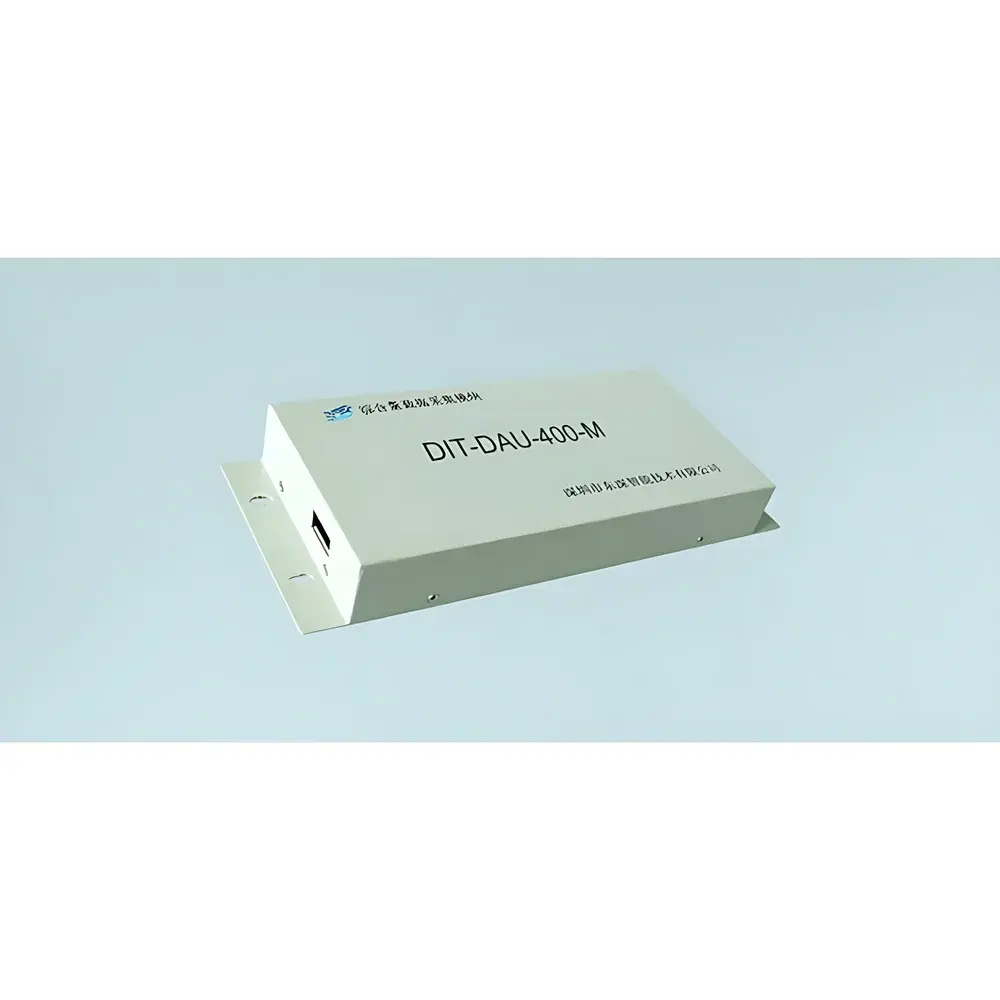
DSE DIT-DAU-400 Integrated Multi-Channel Data Acquisition Unit
| Brand | DSE |
|---|---|
| Origin | Shenzhen, China |
| Manufacturer Type | Authorized Distributor |
| Country of Origin | China |
| Model | DIT-DAU-400 |
| Pricing | Upon Request |
Overview
The DSE DIT-DAU-400 Integrated Multi-Channel Data Acquisition Unit is an industrial-grade, low-power embedded data logger engineered for long-term structural and environmental monitoring in geotechnical, hydraulic, and civil infrastructure applications. Built around a high-efficiency 32-bit ARM microcontroller, the unit integrates precision analog signal conditioning, synchronized multi-sensor measurement, non-volatile data storage, real-time clock (RTC) functionality, and dual-mode communication interfaces. It operates on the principle of deterministic time-synchronized sampling of resistive, pulse-counting, and potentiometric sensor outputs—specifically optimized for differential resistance (4-wire or 5-wire) transducers, float-type water level sensors, and tipping-bucket rain gauges. Designed for deployment in remote, unattended, and electromagnetically noisy environments—including dam abutments, reservoir perimeters, tunnel portals, high-cut slopes, and bridge foundations—the DIT-DAU-400 meets the operational robustness requirements of ISO 14644-1 Class 8 cleanroom-adjacent industrial enclosures and complies with IEC 61000-4 immunity standards for electrostatic discharge (ESD), surge, and fast transient burst.
Key Features
- Multi-modal acquisition logic: supports scheduled polling (up to 6 fixed daily timestamps), time-windowed continuous scanning (configurable start/end times and interval), selective channel readout, and on-demand point measurement via host command.
- Integrated sensor interface: accommodates up to 2 float-type water level sensors, 1 tipping-bucket rain gauge, and 8 differential resistance instruments (4-wire or 5-wire configuration) with automatic lead-wire resistance compensation.
- Non-volatile memory architecture: onboard EEPROM retains critical calibration coefficients and system parameters during power loss; measured data stored in FIFO-managed flash memory with timestamped records (YYYY-MM-DD HH:MM:SS).
- Expandable storage: optional industrial-grade SD card (FAT32 formatted) enables file-based logging for high-density archival—supporting CSV or binary formats compatible with MATLAB, Python pandas, and SQL-based ingestion pipelines.
- Dual communication topology: primary RS-485 (MODBUS RTU/ASCII compliant) and Ethernet (TCP/IP stack with static/DHCP addressing); optional GPRS, LoRaWAN, or UHF radio modules available via standardized UART expansion header.
- Environmental resilience: operating temperature range –20 °C to +70 °C; IP65-rated enclosure; conformal coating on PCB; 1500 VDC isolation between sensor inputs and communication buses.
Sample Compatibility & Compliance
The DIT-DAU-400 is validated for use with standard civil engineering transducers including but not limited to: vibrating-wire strain gauges (per ASTM E1876), piezoresistive pore pressure cells (per ISO 17892-9), float displacement sensors (per GB/T 22583–2018), and calibrated tipping-bucket rain gauges (per WMO No. 8 guidelines). All firmware and hardware design adhere to IEC 61508 SIL-2 functional safety principles for data integrity assurance. The device supports audit-trail-enabled data retrieval protocols required under GLP-compliant monitoring programs and is configurable to generate CRC-16 checksums for every transmitted dataset—enabling traceability and tamper detection in regulatory submissions.
Software & Data Management
The unit interfaces natively with DSE’s DAU Manager v4.x desktop application (Windows/Linux) for configuration, firmware updates, and local data extraction. Remote access is enabled via secure HTTP(S) API endpoints or MODBUS TCP mapping tables, allowing integration into SCADA platforms such as Ignition, Siemens Desigo CC, or Schneider EcoStruxure. All stored datasets include embedded metadata: sensor ID, channel index, acquisition mode, UTC timestamp, battery voltage, internal temperature, and error flags. Firmware supports over-the-air (OTA) updates via signed binary packages—ensuring cryptographic authenticity and rollback capability. Data export conforms to ISO/IEC 11172-3 (MPEG-1 Audio Layer III) metadata tagging conventions for time-series annotation.
Applications
- Hydrological monitoring networks: real-time reservoir level tracking, inflow/outflow balance calculation, and flood warning threshold triggering.
- Civil infrastructure health monitoring: deformation analysis of concrete dams using distributed resistance thermometers and joint meters.
- Geotechnical stability assessment: long-term creep behavior evaluation of landslide-prone slopes via inclinometer and extensometer arrays.
- Tunnel convergence surveillance: synchronized measurement of radial displacement across multiple ring sections under dynamic loading conditions.
- Transportation asset management: bridge deck settlement monitoring, rail track geometry drift detection, and pavement strain profiling.
- Smart city water network supervision: pressure transient analysis, leak localization via acoustic emission correlation, and pump station efficiency benchmarking.
FAQ
What sensor types are natively supported without external signal conditioners?
Float-type water level sensors (0–10 m range), tipping-bucket rain gauges (0.2 mm resolution), and 4-wire/5-wire differential resistance transducers (e.g., VW gauges, resistance thermometers, and strain bridges) — all with built-in excitation, filtering, and linearization.
Does the DIT-DAU-400 support time synchronization across distributed nodes?
Yes — via NTP over Ethernet or GPS-disciplined RTC when paired with optional GNSS module; sub-second alignment accuracy across >100-node deployments is achievable under typical WAN latency conditions.
Is the firmware upgrade process validated for field deployment in safety-critical systems?
All firmware binaries undergo SHA-256 signature verification prior to execution; update rollback is automatic upon checksum mismatch or power interruption — certified per IEC 62443-3-3 Annex A requirements.
Can historical data be exported in a format compatible with statistical process control (SPC) software?
Yes — CSV exports include ISO 8601 timestamps, channel-specific units (e.g., “m”, “mm/h”, “Ω”), and confidence indicators; direct ODBC connectivity is supported via optional database gateway add-on.
What is the maximum recommended cable length between the DIT-DAU-400 and a differential resistance sensor?
For 4-wire configurations, up to 1,000 m at 24 AWG twisted-pair shielded cable (with 120 Ω characteristic impedance); for 5-wire, up to 500 m with active line driver compensation enabled in firmware.
Related Products







