
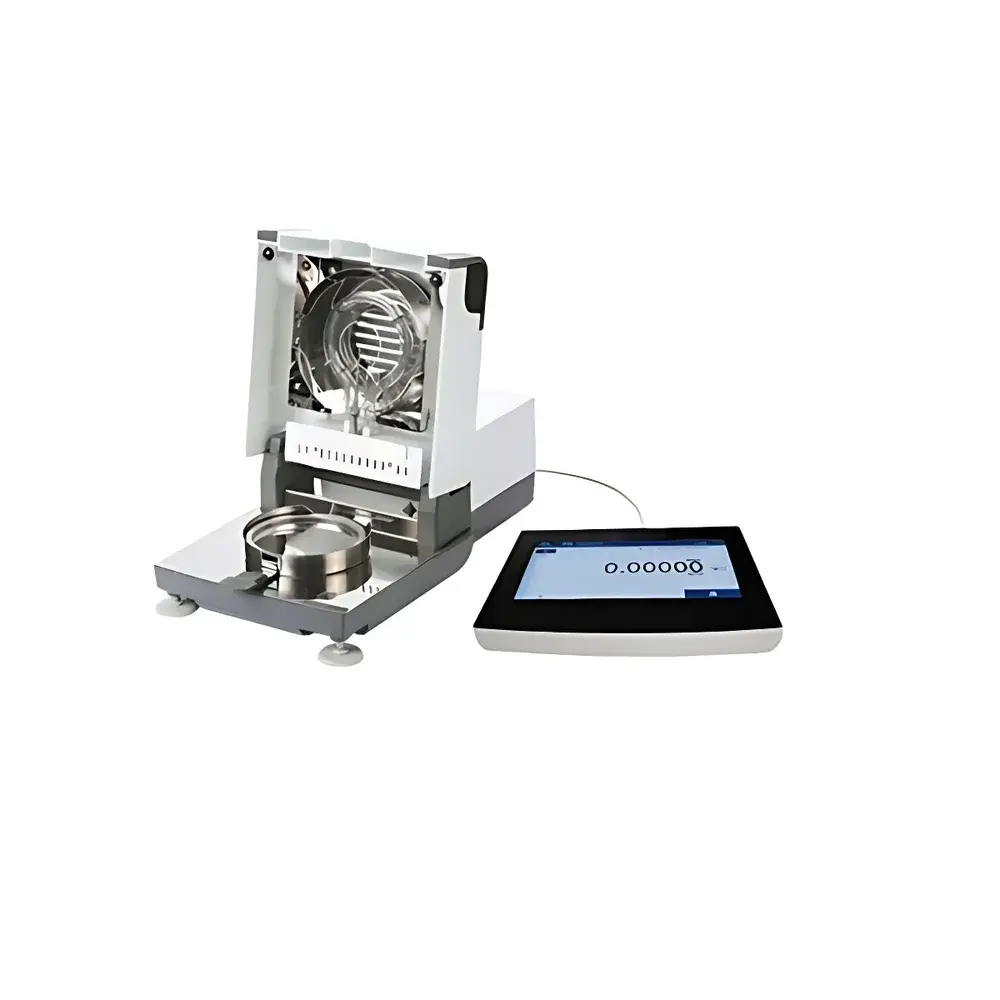
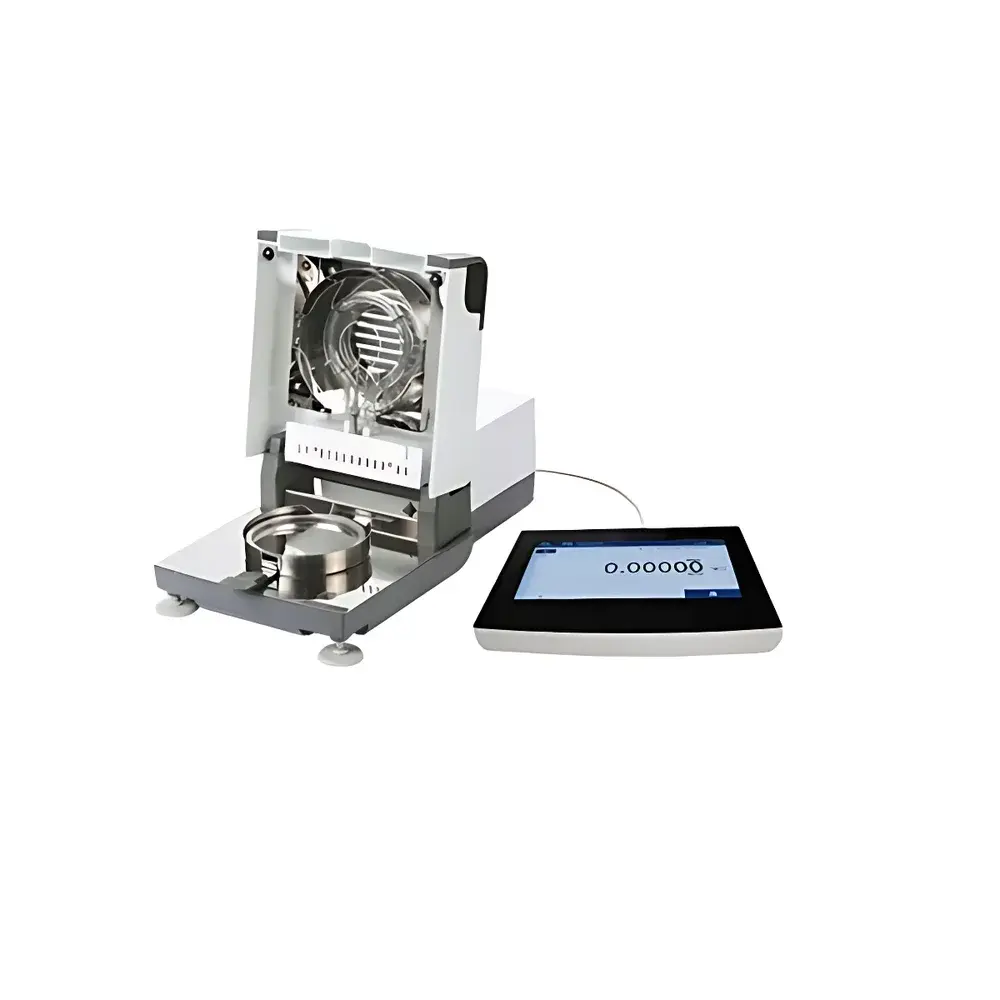
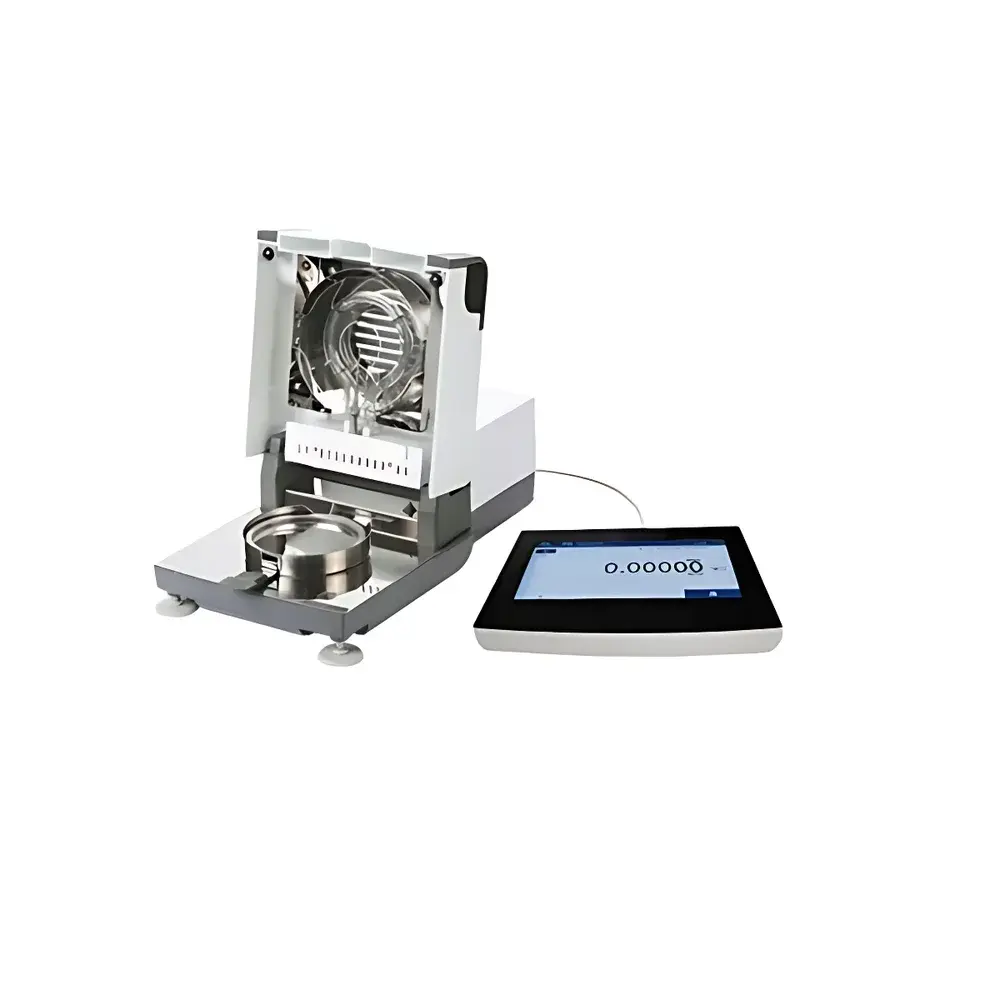
D&T EX-FH104A Infrared Moisture Analyzer
| Brand | D&T |
|---|---|
| Origin | Tianjin, China |
| Model | EX-FH104A |
| Heating Source | Halogen Lamp |
| Weighing Range | 120 g |
| Readability | 0.1 mg |
| Repeatability (2 g sample) | 0.05% SD, ±0.1% |
| Repeatability (10 g sample) | 0.01% SD, ±0.05% |
| Moisture Readability | 0.001% MC |
| Calibration | Fully Automatic Internal Calibration |
| Drying Temperature Range | Single-Glass Mode: 40–160 °C |
| Dual-Glass Mode | 40–200 °C |
| Increment | 1 °C |
| Pan Diameter | Φ90 mm |
| Dimensions (W × D × H) | 200 × 385 × 120 mm |
| Moisture Range | 0.01–100% MC |
| Method Storage | 300 methods |
| Result Storage | 3000 records |
| Heating Programs | Standard, Stepwise, Rapid |
| Drying Termination Modes | Timed, Auto (5 preset weight-loss thresholds + user-defined threshold) |
| Warm-up Time | 20–30 min |
| Display Modes | %MC, %DC, g |
| Output Interfaces | RS232/RS485, LAN, USB1 (data export/firmware update), USB2 (dedicated printer) |
| Touchscreen | 7-inch capacitive |
| Sensor Type | Integrated electromagnetic force compensation sensor |
| Design | Separated weighing and display units |
Overview
The D&T EX-FH104A Infrared Moisture Analyzer is a precision laboratory instrument engineered for rapid, gravimetric determination of moisture content in solid and semi-solid samples using halogen lamp-based thermal drying coupled with high-resolution electromagnetic force compensation weighing technology. Unlike traditional oven-drying methods requiring hours, the EX-FH104A delivers validated moisture results in minutes by applying controlled radiant heat to drive off free and surface-bound water while continuously monitoring mass loss in real time. Its measurement principle conforms to the fundamental ASTM E1447–22 and ISO 18810:2017 guidelines for thermogravimetric moisture analysis, ensuring methodological traceability to internationally accepted reference procedures. Designed specifically for routine QC/QA workflows in regulated environments, the analyzer integrates hardware-level stability enhancements—including a monolithic electromagnetic sensor architecture and vibration-isolated dual-unit configuration—to minimize mechanical drift and operator-induced perturbation during dynamic drying cycles.
Key Features
- Monolithic electromagnetic force compensation sensor: Reduces component count by 70%, improves response time by 30%, and enhances long-term repeatability under continuous operation.
- Separate weighing and display modules: Eliminates tactile interference during method selection or parameter adjustment—critical for sub-milligram stability in low-mass samples (e.g., spices, pharmaceutical excipients).
- 7-inch capacitive touchscreen interface: Supports multi-parameter visualization including real-time drying curves, elapsed time, chamber temperature, %MC, %DC, and absolute mass—enabling immediate assessment of drying kinetics and endpoint detection.
- Programmable halogen heating system: Offers three operational modes (Standard, Stepwise, Rapid), dual-glass temperature range (40–200 °C), and 1 °C resolution for precise thermal profiling across diverse matrices—from heat-sensitive biomaterials to refractory construction aggregates.
- Three-tier user access control: Administrator, operator, and guest roles with password protection and auto-lockout after configurable idle periods—supporting compliance with GLP and internal SOP governance requirements.
- Comprehensive connectivity suite: RS232/RS485 for legacy printer integration and bidirectional PC communication; LAN port for remote firmware updates and centralized method deployment; dual USB ports—one for encrypted data export (CSV/Excel-compatible), another dedicated to certified thermal label printers.
Sample Compatibility & Compliance
The EX-FH104A accommodates heterogeneous samples within the 0.01–100% moisture range, including but not limited to cereal grains, animal feed pellets, tobacco lamina, dried fungi, seafood jerky, paper pulp, clay-based building materials, and meat emulsions. Its Φ90 mm stainless-steel sample pan ensures uniform heat distribution and facilitates rapid cleanup between analyses. All drying protocols are fully customizable and auditable, with timestamped method parameters stored alongside each result—meeting documentation expectations under FDA 21 CFR Part 11 for electronic records and signatures when paired with compliant LIMS or ELN software. The instrument’s internal calibration routine satisfies ISO 9001:2015 clause 7.1.5.2 for monitoring and measuring resource verification.
Software & Data Management
Data integrity is maintained through deterministic storage architecture: up to 300 user-defined drying methods and 3000 result entries—including raw mass vs. time logs, final %MC/%DC values, and drying curve metadata—are retained onboard without volatile memory dependency. Export functions support CSV formatting compatible with statistical process control (SPC) platforms such as Minitab and JMP. Optional PC software (sold separately) enables batch report generation, trend analysis across multiple lots, and automated deviation alerts based on user-specified tolerance bands. Audit trails record all critical events—including method edits, calibration executions, and user logins—with immutable timestamps, fulfilling ALCOA+ data governance criteria for pharmaceutical and food safety laboratories.
Applications
- Food & Beverage: Quantification of moisture in flour blends, snack coatings, dairy powders, and ready-to-eat meals to ensure shelf-life stability and regulatory labeling accuracy per FDA 21 CFR §101.9(c)(1).
- Agriculture & Feed: Rapid verification of grain moisture prior to storage or milling, aligned with USDA FGIS moisture testing protocols for corn, soybean, and wheat.
- Pharmaceuticals: Residual solvent screening in lyophilized APIs and excipient blends, supporting ICH Q5C stability guidance where gravimetric loss on drying (LOD) remains a primary release test.
- Materials Science: Moisture assessment in gypsum board, ceramic green bodies, and polymer composites to correlate water content with dimensional stability and sintering behavior.
- Tobacco Processing: Batch consistency control of cut filler and reconstituted leaf (RL) moisture to optimize combustion characteristics and tar yield profiles.
FAQ
What standards does the EX-FH104A comply with for moisture determination?
It adheres to the core principles of ASTM E1447–22 (Standard Test Method for Moisture in Solids by Thermogravimetry) and ISO 18810:2017 (Soil quality — Determination of moisture content — Gravimetric method), and supports method validation per USP <921> Loss on Drying.
Can the instrument be integrated into a networked lab environment?
Yes—the embedded LAN interface enables remote configuration, real-time monitoring via web browser, and scheduled firmware updates without physical access to the device.
Is automatic calibration traceable to national standards?
Internal calibration utilizes factory-certified weights traceable to NIM (China National Institute of Metrology); external verification may be performed using Class E2 or better砝码 per OIML R76.
How is data security enforced during transfer or export?
USB exports generate password-protected, timestamped files with SHA-256 checksums; network transfers use TLS 1.2 encryption when communicating with authenticated enterprise servers.
Does the analyzer support Good Manufacturing Practice (GMP) workflows?
With enabled audit trail logging, role-based access, and electronic signature capability (via optional software), it meets foundational GMP requirements for equipment used in quality-critical manufacturing steps.
Related Products






