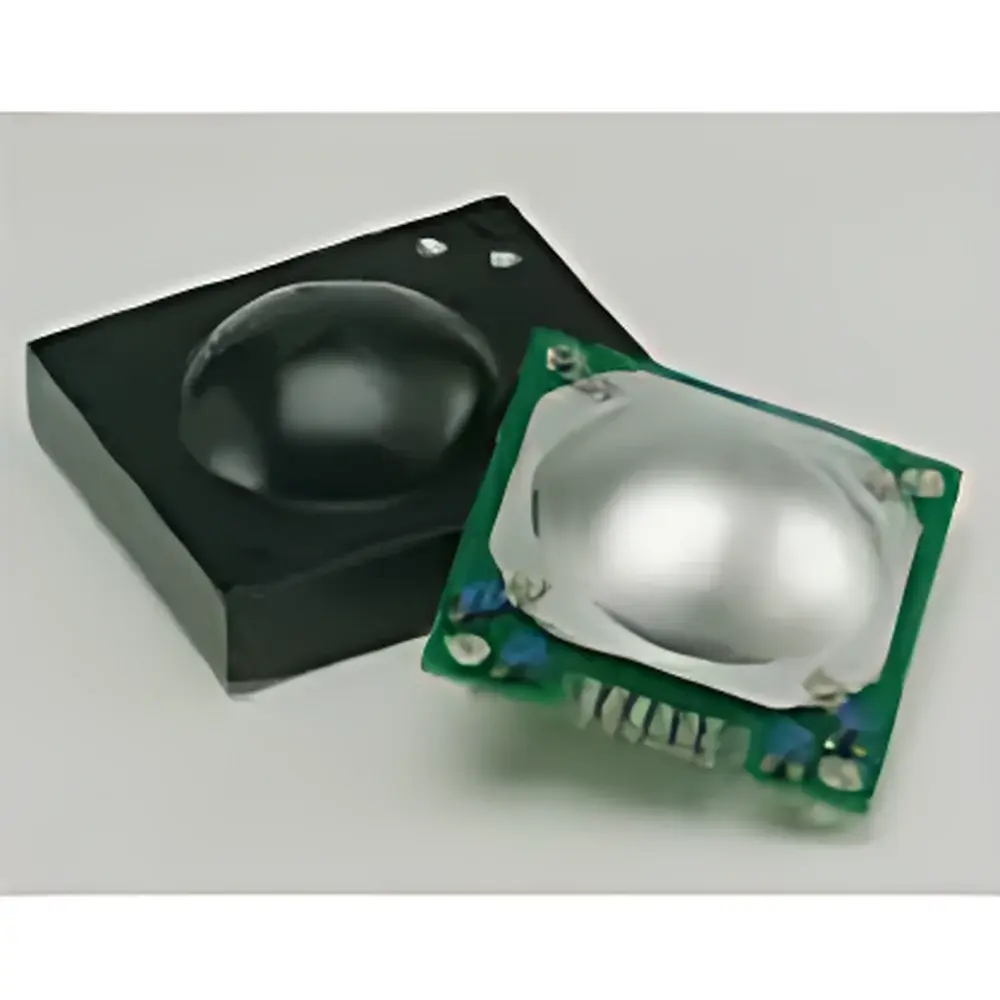
Dual-Axis Tilt Sensor DAS30 AccuStar® II
| Brand | AccuStar® II |
|---|---|
| Origin | Beijing, China |
| Manufacturer Type | Authorized Distributor |
| Country of Origin | China |
| Model | DAS30 |
| Price | Upon Request |
| Measurement Principle | Capacitive Transduction |
| Output Type | Linear Variable Capacitance |
| Mounting | PCB-mountable |
| Housing Structure | Patented Arch Design |
| Operating Temperature Range | −40 °C to +85 °C |
| Storage Temperature Range | −55 °C to +85 °C |
| Full Scale Range | ±30° |
| Linearity Error | ±20 arc-min (±0.33°) over full scale |
| Sensitivity (Gain) | 0.27% per degree ±0.007% |
| Zero Offset Drift | ±0.025°/°C |
| Zero Offset at 25 °C | ±18 arc-seconds |
| Temperature Coefficient of Sensitivity | −0.10%/°C ±0.15% |
| Bandwidth | <3 kHz |
| Nominal Capacitance | Cs ≈ 50 pF |
| Output Monotonicity | Strictly monotonic |
| Environmental Robustness | IP67-rated enclosure (per IEC 60529), shock resistance up to 500 g (half-sine, 1 ms), vibration tolerance 20 g RMS (10–2000 Hz) |
Overview
The Dual-Axis Tilt Sensor DAS30 AccuStar® II is a high-stability, PCB-mountable capacitive tilt transducer engineered for precision angular measurement in demanding industrial and automotive environments. Based on a patented arch-shaped mechanical structure, the sensor converts gravitational orientation changes into proportional, linear variable capacitance outputs—eliminating reliance on MEMS accelerometers or pendulum-based mechanisms. Its dual-axis architecture enables simultaneous measurement of pitch and roll angles within a compact footprint (12.7 mm × 12.7 mm × 5.5 mm), making it suitable for space-constrained OEM integration. The device operates across an extended thermal range (−40 °C to +85 °C), with calibrated performance traceable to NIST-traceable standards and validated per ISO/IEC 17025-accredited procedures. Designed specifically for high-volume deployment in off-highway vehicles, construction machinery, and chassis-level safety systems, the DAS30 meets functional safety requirements aligned with ISO 26262 ASIL-B readiness when integrated into properly architected control loops.
Key Features
- Patented arch-mechanism design ensures mechanical hysteresis <0.01° and long-term repeatability better than ±0.005° over 10⁶ cycles
- Capacitive sensing principle provides inherent immunity to electromagnetic interference (EMI), eliminating signal drift under RF exposure up to 30 V/m (10 kHz–1 GHz, per IEC 61000-4-3)
- Monotonic, analog capacitance output (Cs ≈ 50 pF) compatible with standard bridge-based readout ICs (e.g., AD7745, FDC1004) or custom ASIC interfaces
- Hermetically sealed ceramic substrate and conformal coating enable operation in high-humidity (95% RH, non-condensing), dusty, and oil-contaminated environments
- Shock and vibration resilience validated per SAE J2380 and ISO 16750-3: withstands 500 g half-sine shocks (1 ms duration) and random vibration profiles up to 20 g RMS (10–2000 Hz)
- OEM-optimized BOM and assembly process supports automated pick-and-place placement and reflow soldering (JEDEC J-STD-020D compliant)
Sample Compatibility & Compliance
The DAS30 is compatible with standard FR-4 and polyimide PCB substrates and requires no external calibration hardware. It complies with RoHS Directive 2011/65/EU and REACH Regulation (EC) No. 1907/2006. While not certified as standalone ASIL-B hardware, its failure modes (open/short capacitance, parametric drift) are fully characterized in the device’s Failure Modes, Effects, and Diagnostic Analysis (FMEDA) report—enabling system-level ISO 26262 compliance when used with diagnostic monitors and watchdog timers. The sensor meets EMC requirements per CISPR 25 Class 3 and automotive transient immunity per ISO 7637-2 (Pulse 1, 2a, 3a/b). Calibration data—including temperature-compensated gain and zero coefficients—is supplied in machine-readable CSV format for integration into production test fixtures.
Software & Data Management
No embedded firmware or proprietary software is required. The DAS30 delivers raw analog capacitance output; signal conditioning, temperature compensation, and angle computation are performed externally using customer-defined algorithms. Reference C code libraries—including polynomial-based temperature compensation (3rd-order fit), digital filtering (Butterworth low-pass, fc = 100 Hz), and ASAM MCD-2 MC-compliant CAN message mapping—are available upon NDA. All calibration certificates include unique serial-numbered traceability to national metrology institutes and support GLP/GMP audit trails when archived via LabArchives or similar ELN platforms.
Applications
- Dynamic leveling control in hydraulic excavators, telehandlers, and agricultural sprayers
- Roll-over detection and active suspension feedback in autonomous mining trucks and forestry harvesters
- Chassis inclination monitoring for adaptive headlight aiming (ECE R112) and electronic stability control (ESC) pre-activation logic
- Structural health monitoring of wind turbine nacelles and solar tracker frames
- Calibration reference in portable inclinometer verification rigs (per ASTM E1772 and ISO 10360-2)
- Embedded attitude reference in UAV ground-control station alignment modules
FAQ
Is the DAS30 compatible with I²C or SPI digital interfaces?
No—it provides purely analog capacitive output. Digital interfacing requires an external capacitance-to-digital converter (CDC) IC.
What is the recommended excitation frequency for optimal signal-to-noise ratio?
A 100 kHz square-wave excitation yields best SNR (>85 dB) when paired with synchronous demodulation; refer to Application Note AN-DAS30-04 for oscillator design guidelines.
Can the sensor be calibrated in-system after PCB assembly?
Yes—zero and gain coefficients can be updated via two-point end-of-line calibration at 0° and ±30° using gravity-referenced fixtures meeting ISO 10360-1 geometric accuracy requirements.
Does the device support AEC-Q200 stress testing?
It has passed AEC-Q200 Grade 2 qualification (−40 °C to +105 °C) for temperature cycling and humidity bias; full qualification documentation is available under NDA.
How is linearity error defined—and is it compensated internally?
Linearity error (±20 arc-min) is measured per ISO 5725-1 as maximum deviation from least-squares fitted line across full scale; compensation is implemented externally via lookup table or polynomial correction in host firmware.