
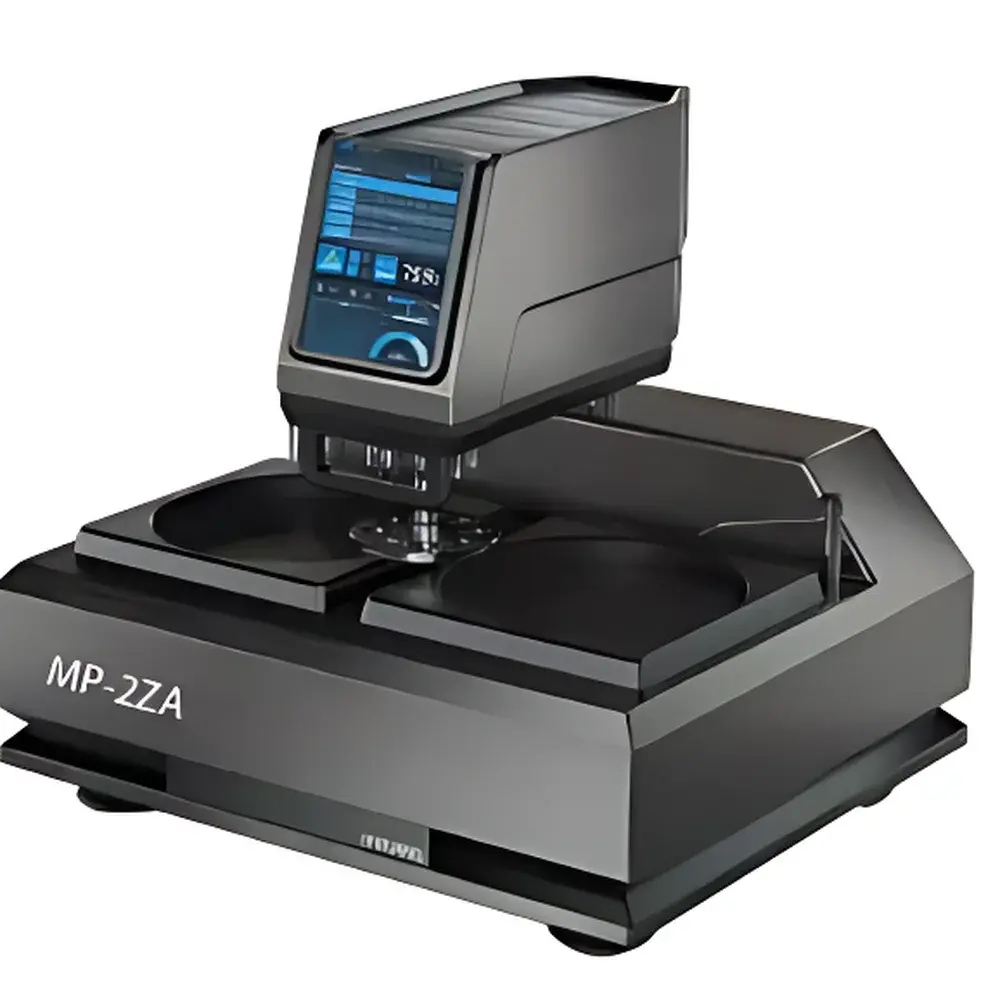
Dual-Disk Intelligent Automatic Grinding and Polishing Machine WEIYEE MP-2ZS
| Brand | WEIYEE |
|---|---|
| Origin | Guangdong, China |
| Manufacturer Type | Authorized Distributor |
| Country of Origin | China |
| Model | MP-2ZS |
| Rotational Speed (Platen) | 50–1500 rpm (infinitely variable) + 6 preset speeds (250/500/750/1000/1250/1500 rpm) |
| Platen Diameter | 250 mm (10") |
| Number of Platens | 2 |
| Polishing Head Speed | 20–120 rpm (infinitely variable) |
| Control Interface | 9" high-definition industrial touchscreen |
| Control System | Siemens S7-1200 PLC |
| Drive Motor | Panasonic servo motor with programmable vertical lift |
| Sample Capacity | up to 8 specimens simultaneously |
| Pressure Application | Pneumatic single-point loading with adjustable pressure |
| Operation Modes | Fully automatic, semi-automatic, and manual |
| Liquid Dispensing | Dual-channel intermittent dispensing system |
| Power Supply | 220 V AC, 50/60 Hz |
Overview
The WEIYEE MP-2ZS Dual-Disk Intelligent Automatic Grinding and Polishing Machine is an engineered solution for high-precision, reproducible specimen preparation in metallurgical, ceramic, geological, and advanced materials laboratories. Designed around the principle of controlled mechanical abrasion under programmable load and rotational dynamics, the MP-2ZS employs dual independently driven 250 mm platens to enable parallel grinding and polishing—either as complementary sequential steps or simultaneous co-processing of identical or dissimilar sample sets. Its core architecture integrates a rigid cast-iron base, precision-machined platen spindles with thermal stability compensation, and a vertically actuated polishing head driven by a Panasonic servo motor. This configuration ensures consistent material removal rates, minimized edge rounding, and superior planarity across diverse specimen geometries—from bulk metallographic mounts to brittle semiconductor wafers and composite laminates.
Key Features
- Dual independent 250 mm (10″) platens with fully separate speed control (50–1500 rpm, infinitely variable + six fixed setpoints), enabling synchronized or asynchronous operation for process optimization.
- Intelligent vertical actuation system featuring servo-driven head lift with programmable descent profiles, including curve-start ramping to prevent specimen slippage or abrasive shock during initial contact.
- Pneumatic single-point loading mechanism delivering uniform, digitally adjustable pressure across the entire specimen surface—critical for maintaining consistent removal rates in graded polishing sequences (e.g., SiC → diamond → colloidal silica).
- Siemens S7-1200 industrial PLC backbone paired with a 9-inch high-brightness resistive touchscreen interface, supporting multilingual UI, audit-trail-capable operation logging, and real-time parameter monitoring.
- Dual-channel intermittent liquid dispensing system with independent flow timing and volume control per channel—compatible with water-based coolants, oil-based lubricants, and aggressive chemical slurries (e.g., alumina, ceria, or chelating etchants).
- Three operational modes—fully automatic (predefined method execution), semi-automatic (operator-triggered stage transitions), and manual (direct speed/load/dispense override)—facilitating method development, troubleshooting, and training workflows.
Sample Compatibility & Compliance
The MP-2ZS accommodates standard 30 mm, 40 mm, and 50 mm diameter mounted specimens (including hot-pressed phenolic, epoxy, and conductive resins), as well as unmounted flat samples up to 25 × 25 mm. Its robust torque delivery (≥12 N·m per platen) and low-speed stability support soft polymers, brittle ceramics, and layered thin-film stacks without delamination or thermal artifact formation. The machine complies with IEC 61000-6-2 (EMC immunity) and IEC 61000-6-4 (EMC emission) standards. Its control architecture supports GLP/GMP-aligned documentation practices, including user-access-level permissions, electronic signature capability, and exportable CSV-formatted run logs—facilitating alignment with ISO/IEC 17025 accreditation requirements for testing laboratories.
Software & Data Management
The embedded HMI firmware enables creation, storage, and recall of up to 99 multi-stage polishing methods, each defining platen speed, head speed, dwell time, pressure profile, and dispensing schedule per stage. All method executions are timestamped and associated with operator ID, sample ID (manually entered or barcode-scanned via optional peripheral), and environmental metadata (e.g., ambient temperature/humidity if integrated sensors are installed). Audit trails record all parameter changes, mode switches, and emergency stops—retained for ≥180 days unless externally archived. Data export is supported via USB 2.0 port in CSV format, compatible with LIMS integration and statistical process control (SPC) platforms.
Applications
- Preparation of metallographic cross-sections for ASTM E3, ISO 643, and EN 10365 microstructure analysis.
- Planarization of sintered carbides, silicon nitride, and zirconia for hardness testing per ISO 6507 and ASTM E384.
- Surface conditioning of photovoltaic silicon wafers prior to SEM-EBSD characterization.
- Routine polishing of geological thin sections (30 µm thickness) meeting ASTM D3280 specifications.
- Grinding of composite brake pads and polymer matrix composites for interfacial adhesion assessment.
FAQ
What safety certifications does the MP-2ZS hold?
The unit conforms to IEC 61000-6-2 and IEC 61000-6-4 for electromagnetic compatibility and includes dual-channel emergency stop circuitry compliant with ISO 13850.
Can the MP-2ZS be integrated into a laboratory automation network?
Yes—it features Modbus TCP/IP communication protocol support for integration with central lab management systems or robotic sample handlers (custom integration kit available upon request).
Is remote diagnostics supported?
Field service engineers can initiate secure remote access via encrypted VPN tunnel using the built-in Ethernet port, subject to customer IT policy approval.
What maintenance intervals are recommended?
Platen bearing inspection every 1,500 operating hours; pneumatic regulator calibration annually; touchscreen calibration quarterly or after physical impact.
Does the system support USP or FDA 21 CFR Part 11 compliance?
While the base firmware provides audit trail functionality and role-based access, full 21 CFR Part 11 compliance requires installation of validated third-party electronic record software—available through WEIYEE’s certified partner ecosystem.



