
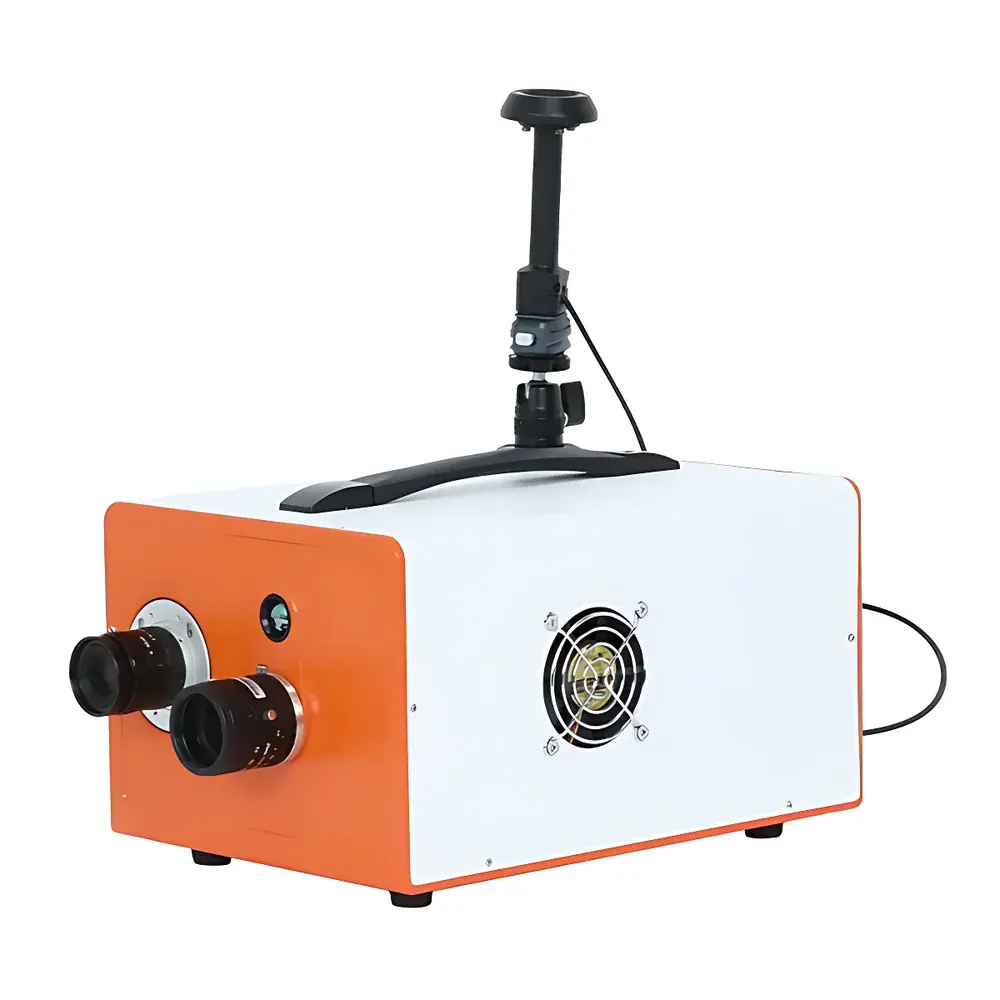
Dualix GaiaField-ImgFluo Portable Airborne Solar-Induced Chlorophyll Fluorescence (SIF) Hyperspectral Imager
| Brand | Dualix Spectral Imaging |
|---|---|
| Origin | Beijing, China |
| Manufacturer Type | Authorized Distributor |
| Product Origin | Domestic (China) |
| Model | GaiaField-ImgFluo |
| Spectral Range | 670–780 nm (extendable to 650–800 nm) |
| Spectral Resolution | 0.3–0.4 nm |
| Spectral Sampling Interval | 0.1 nm |
| Number of Spectral Bands | 100–1000 |
| Peak SNR | >1000:1 |
| Slit Width | 30 µm |
| Lens | 25 mm Fixed-Focal-Length |
| Spatial Resolution | ≥1200 × 1000 pixels |
| Frame Rate | 1–100 fps |
| Interface | USB 3.0 |
| Weight | <2.27 kg |
| Imaging Mode | Push-broom |
| Deployment Platform | Ground-based (tripod-mounted or vehicle-integrated), compatible with UAV integration via optional gimbal and power interface |
| Cooling | Thermoelectrically cooled or uncooled sCMOS sensor |
Overview
The Dualix GaiaField-ImgFluo is a field-deployable, push-broom hyperspectral imager engineered for high-fidelity solar-induced chlorophyll fluorescence (SIF) retrieval under natural illumination. It operates on the physical principle of Fraunhofer line depth modulation: incident solar radiation contains intrinsic absorption features—Fraunhofer lines—at characteristic wavelengths (e.g., O₂-A band at 760 nm, O₂-B band at 687 nm, and Ca II H/K lines near 397/393 nm). SIF emission from photosynthetic tissue—peaking at ~687 nm (F₆₈₇) and ~760 nm (F₇₆₀)—partially fills these dark lines in upwelling radiance spectra. By quantifying the differential depth between the incident solar reference spectrum and the target scene spectrum across high-resolution spectral windows centered on key Fraunhofer features, the system enables robust, absolute SIF radiance retrieval (unit: mW·m⁻²·sr⁻¹·nm⁻¹) without requiring active excitation sources. This passive, sun-driven measurement modality directly links to canopy-level photochemical efficiency (ΦPSII) and gross primary productivity (GPP), distinguishing it from conventional reflectance-based vegetation indices such as NDVI, which only infer structural greenness—not functional photosynthetic status.
Key Features
- High spectral fidelity: 0.3–0.4 nm resolution within the critical 650–800 nm window ensures sufficient sampling of Fraunhofer line structure—essential for accurate SIF inversion using differential optical absorption spectroscopy (DOAS) or singular value decomposition (SVD) algorithms.
- Real-time, frame-synchronized reference acquisition: Integrated cosine-corrected fiber-optic channel collects incident solar irradiance concurrently with each push-broom scan, enabling per-frame radiometric normalization and eliminating temporal drift artifacts induced by cloud transients or diurnal irradiance variation.
- Onboard calibration architecture: Supports reflectance calibration using certified white reference panels (e.g., Spectralon®) and dark-current subtraction; includes relative and absolute radiometric calibration modes traceable to NIST-traceable standards.
- Flexible spectral configuration: Software-defined spectral range (650–800 nm), start/end wavelength, and sampling interval (0.1 nm step) allow optimization for specific Fraunhofer bands (e.g., F₆₈₇: 680–695 nm; F₇₆₀: 750–775 nm) while minimizing data volume through region-of-interest (ROI) band binning.
- Integrated auxiliary sensors: Co-aligned infrared thermal imager (optional) and visible-light monitoring camera support multi-modal physiological interpretation—e.g., coupling SIF yield with canopy temperature stress indicators.
- Portable, low-SWaP design: Total mass <2.27 kg with integrated battery, USB 3.0 interface, and ruggedized enclosure rated for outdoor deployment under ISO 14644-1 Class 8 cleanroom-equivalent field conditions.
Sample Compatibility & Compliance
The GaiaField-ImgFluo is optimized for in situ and proximal remote sensing of terrestrial vegetation canopies—including agricultural crops, forest stands, grasslands, and controlled-environment growth chambers. Its ground-based push-broom geometry supports tripod, vehicle-mount, and lightweight UAV integration (with mechanical stabilization and GNSS-IMU synchronization). The system complies with spectral data quality requirements defined in ESA’s FLEX mission validation protocols and adheres to ASTM E2799-21 (Standard Guide for Hyperspectral Imaging Data Acquisition and Processing). All radiometric calibration procedures follow ISO/IEC 17025:2017 principles for measurement uncertainty estimation. Raw data output conforms to HDF5 and ENVI BIL formats, ensuring interoperability with NASA’s LP DAAC, ESA’s Copernicus Open Access Hub, and FAO’s WaPOR platform workflows.
Software & Data Management
The proprietary GaiaField Control Suite provides end-to-end acquisition, preprocessing, and quantitative SIF inversion. Key modules include: real-time DN-to-reflectance conversion using stored white/dark frames; per-pixel Fraunhofer line fitting (Gaussian or Voigt profile); SIF retrieval via the 3FLD (Three-Point Fraunhofer Line Depth) or iFLD (Improved FLD) algorithms; automated vegetation index computation (NDVI, SR, MCARI, OSAVI, PRI); and export of georeferenced hyperspectral cubes (BIL format) with embedded metadata (WKT projection, UTC timestamps, GPS coordinates, IMU attitude). The software supports FDA 21 CFR Part 11-compliant audit trails, electronic signatures, and role-based access control—enabling use in GLP/GMP-regulated environmental monitoring and crop phenotyping studies.
Applications
- Plant phenotyping: High-throughput screening of photosynthetic performance across breeding populations under field conditions.
- Ecosystem carbon flux modeling: Validation and downscaling of satellite-derived SIF products (e.g., TROPOMI, OCO-2/3) at plot scale.
- Drought and heat stress detection: Early identification of photoinhibitory responses prior to visible symptom onset.
- Precision agriculture: Variable-rate irrigation and nitrogen management informed by spatially explicit ΦPSII maps.
- Ecophysiological research: Coupling SIF with gas exchange (LI-6400XT), chlorophyll content (SPAD), and leaf water potential measurements.
- Urban vegetation health assessment: Monitoring street trees and green roofs under heterogeneous light environments.
FAQ
What spectral bands are most critical for SIF retrieval, and why?
The O₂-A band (757–775 nm) and O₂-B band (686–690 nm) are prioritized due to their deep, narrow Fraunhofer features and minimal atmospheric interference—enabling highest sensitivity to SIF signal with lowest inversion uncertainty.
Can the system operate under partial cloud cover?
Yes—the synchronized reference channel compensates for rapid irradiance fluctuations; however, sustained overcast conditions reduce SIF signal-to-noise ratio and are discouraged for quantitative GPP estimation.
Is UAV integration supported out-of-the-box?
UAV mounting requires optional gimbal stabilization, power regulation module, and GNSS/IMU time-synchronization hardware—available as an add-on kit with full firmware integration support.
Does the system provide absolute SIF radiance or relative yield metrics?
Both: calibrated radiance units (mW·m⁻²·sr⁻¹·nm⁻¹) are output by default; ΦPSII and other yield parameters are derived via post-processing using established biophysical models (e.g., Yang et al., 2021, Remote Sensing of Environment).
What level of technical support and software updates are provided?
Dualix offers 3-year hardware warranty, lifetime access to software updates, and remote application engineering support—including custom algorithm development for academic and industrial partners under NDA.
Related Products





