
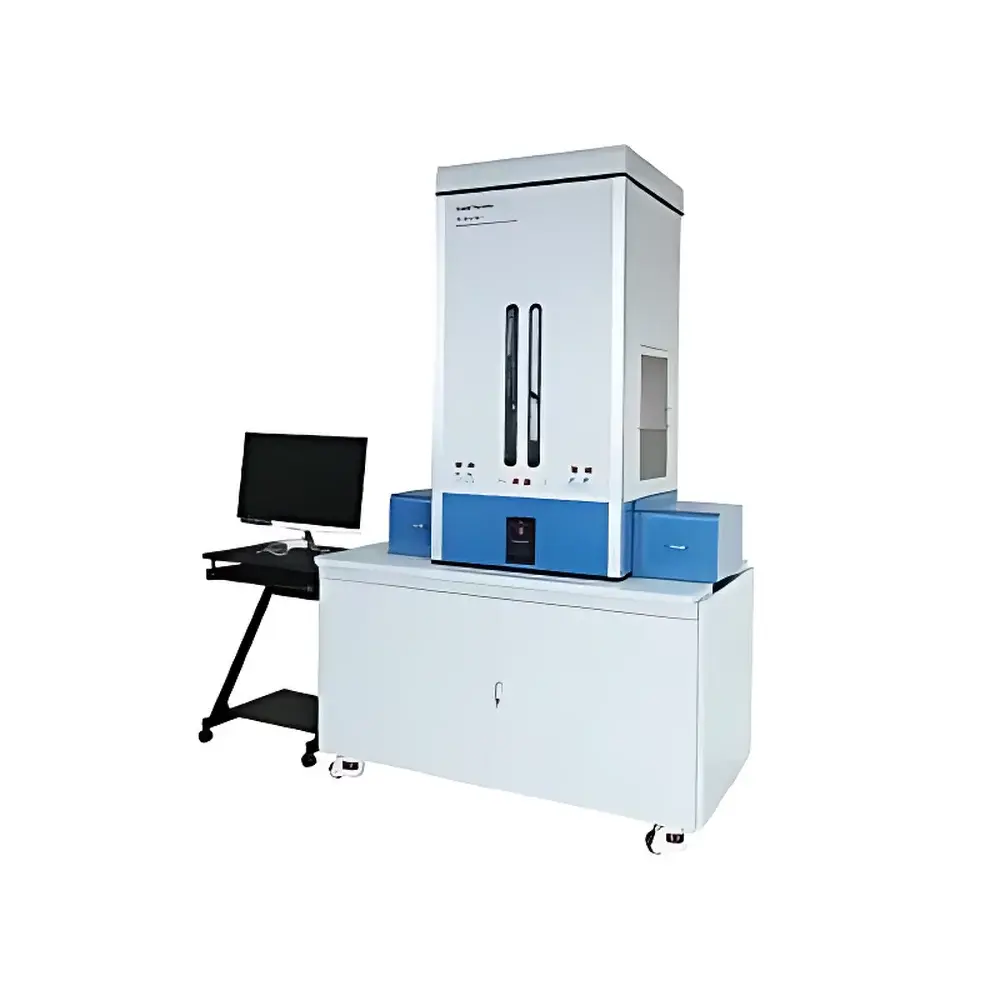
Dualix Spectral Imaging GaiaSorter-Dual Dual-Camera Full-Spectrum Hyperspectral Sorting System
| Brand | Dualix Spectral Imaging |
|---|---|
| Origin | Sichuan, China |
| Manufacturer Type | Authorized Distributor |
| Country of Origin | China |
| Model | GaiaSorter-Dual |
| Spectral Range | 350–2500 nm |
| Spectral Resolution | 2.8 nm |
| Spatial Resolution (IFOV) | 30 µm and 50 µm |
| Field of View (TFOV) | 20° |
| Imaging Resolution | 1392 × 1040 pixels |
| Frame Rate | 25–120 fps |
| Imaging Modality | 3D Scanning |
| Operational Mode | Airborne-Compatible Benchtop Configuration |
| Power Input | AC 220 V ±10% / DC 12 V |
| Total System Power Consumption | ~500 W |
| Sample Chamber Max Dimensions | 300 × 300 × 100 mm |
| Working Distance Adjustment Range | 100–600 mm |
| Scan Travel | 800 mm |
| Output Interfaces | USB, Ethernet, RS-232 |
Overview
The Dualix Spectral Imaging GaiaSorter-Dual is a dual-sensor, full-spectrum hyperspectral sorting system engineered for laboratory-grade material characterization and industrial-scale spectral classification. Unlike conventional single-band or narrow-spectrum imaging systems, the GaiaSorter-Dual integrates two synchronized hyperspectral cameras—covering complementary sub-ranges within the 350–2500 nm electromagnetic spectrum—to deliver contiguous, high-fidelity spectral data across ultraviolet-visible-near-infrared (UV-VIS-NIR) and short-wave infrared (SWIR) domains. Its optical architecture is based on push-broom scanning combined with precision motorized translation, enabling spatially resolved reflectance and transmittance measurements under controlled illumination conditions. The system operates as a benchtop platform with airborne-compatible mechanical and thermal design, supporting both static sample analysis and continuous-line sorting when integrated with conveyor-based automation. Core optical components—including a PTFE-coated hemispherical dome light source (HSIA-DS) and a collimated linear transmittance source (HSIA-LS-TS-30)—are calibrated to ensure >95% spatial irradiance uniformity and minimal specular artifact, critical for quantitative spectroscopic analysis of heterogeneous, curved, or irregular surfaces.
Key Features
- Dual-camera architecture with automatic spectral band switching: supports concurrent or sequential acquisition in 400–1000 nm (VIS-NIR) and 1000–2500 nm (SWIR) ranges, configurable via software-triggered hardware arbitration
- Integrated real-time bad-pixel correction and dark-current compensation for SWIR sensor, ensuring stable radiometric integrity over extended acquisition sequences
- Automated spectral reflectance calibration using certified 300 × 25 × 10 mm PTFE reference tile, traceable to NIST-traceable standards
- Modular mechanical design: interchangeable sample stage options include K9 optical glass transmission stage, motorized 800-mm linear translation platform, or industrial conveyor interface
- Uniform illumination subsystems: HSIA-DS dome source (DC 12 V, 400 W) eliminates angular dependence and specular glare; HSIA-LS-TS-30 linear transmittance source (AC 220 V, 150 W) features quartz homogenizer rod and adjustable focus for thin-sample transmission profiling
- Native support for Image-λ “G” series and GaiaField portable hyperspectral cameras, enabling cross-platform data harmonization and method transfer
Sample Compatibility & Compliance
The GaiaSorter-Dual accommodates samples up to 300 × 300 × 100 mm in volume, including planar substrates (e.g., paper, banknotes, thin films), spherical objects (e.g., fruits, pills), and topographically complex specimens (e.g., granular minerals, composite panels). Its illumination geometry—validated per ASTM E308-22 and ISO 13655:2017—ensures compliance with standardized reflectance measurement protocols for colorimetry, pigment identification, and moisture content estimation. The system’s hardware-level shutter synchronization, temperature-stabilized detector housing, and factory-calibrated wavelength registration support GLP-compliant operation. Data provenance is maintained through embedded metadata tags (including exposure time, integration gain, lamp voltage, and stage position), satisfying audit requirements under FDA 21 CFR Part 11 when deployed with validated software configurations.
Software & Data Management
Control and analysis are executed via Dualix’s proprietary Hyperspectral Studio Suite, a Windows-based application built on Qt and Python 3.9 with HDF5-native I/O. The software provides real-time preview, batch-acquisition scripting, ROI-based spectral extraction, and multivariate statistical tools (PCA, PLS-DA, SVM classification). All raw data files (.hsi) are stored with embedded EXIF-like headers containing instrument configuration, calibration timestamps, and environmental logs. Export formats include ENVI .hdr/.bin, MATLAB .mat, and CSV-compatible spectral matrices. For enterprise integration, the suite supports OPC UA server mode and RESTful API endpoints for remote orchestration within LIMS or MES environments. Audit trails record all user actions—including parameter edits, calibration events, and file exports—with immutable timestamps and operator ID tagging.
Applications
- Pharmaceutical QC: Identification of counterfeit tablets via spectral fingerprinting of excipients and active pharmaceutical ingredients (APIs) across UV-VIS-NIR-SWIR bands
- Agricultural sorting: Detection of bruising, mold, or sugar content in fruits and grains using water absorption features near 1450 nm and 1940 nm
- Recycling automation: Discrimination of polymer types (PET, HDPE, PVC) and contamination detection in mixed plastic streams
- Forensic document analysis: Differentiation of ink formulations, erased alterations, and security feature verification under non-destructive illumination
- Mineralogical mapping: Quantitative assessment of clay mineralogy, iron oxide phases, and hydroxyl-bearing species in geological core samples
- Thin-film metrology: Thickness and refractive index profiling of anti-reflective coatings and semiconductor layers via interference fringe analysis
FAQ
What spectral calibration standards are supported?
The system includes a NIST-traceable 300 × 25 × 10 mm PTFE white reference tile (reflectance >99% from 350–2500 nm) and supports user-defined custom standards via spectral library import.
Can the GaiaSorter-Dual operate in ambient lighting conditions?
No—it requires controlled illumination. The HSIA-DS dome and HSIA-LS-TS-30 sources provide spectrally stable, spatially uniform output; ambient light must be excluded during acquisition to maintain radiometric fidelity.
Is conveyor integration supported out-of-the-box?
Yes—the mechanical interface allows direct mounting of industrial belt conveyors; synchronization signals (encoder input, trigger output) are accessible via DB9 and opto-isolated GPIO ports.
What is the minimum detectable spectral contrast for material discrimination?
Under optimal SNR conditions (100 ms integration, 60 fps), the system resolves reflectance differences ≥0.5% across adjacent 2.8 nm spectral channels, validated using certified ceramic step wedges per ISO 15739:2013.
Does the software support automated pass/fail decision logic for inline sorting?
Yes—Hyperspectral Studio Suite includes rule-based classifier modules with configurable confidence thresholds, binary output mapping, and PLC handshake protocol support (Modbus TCP/RTU).




