
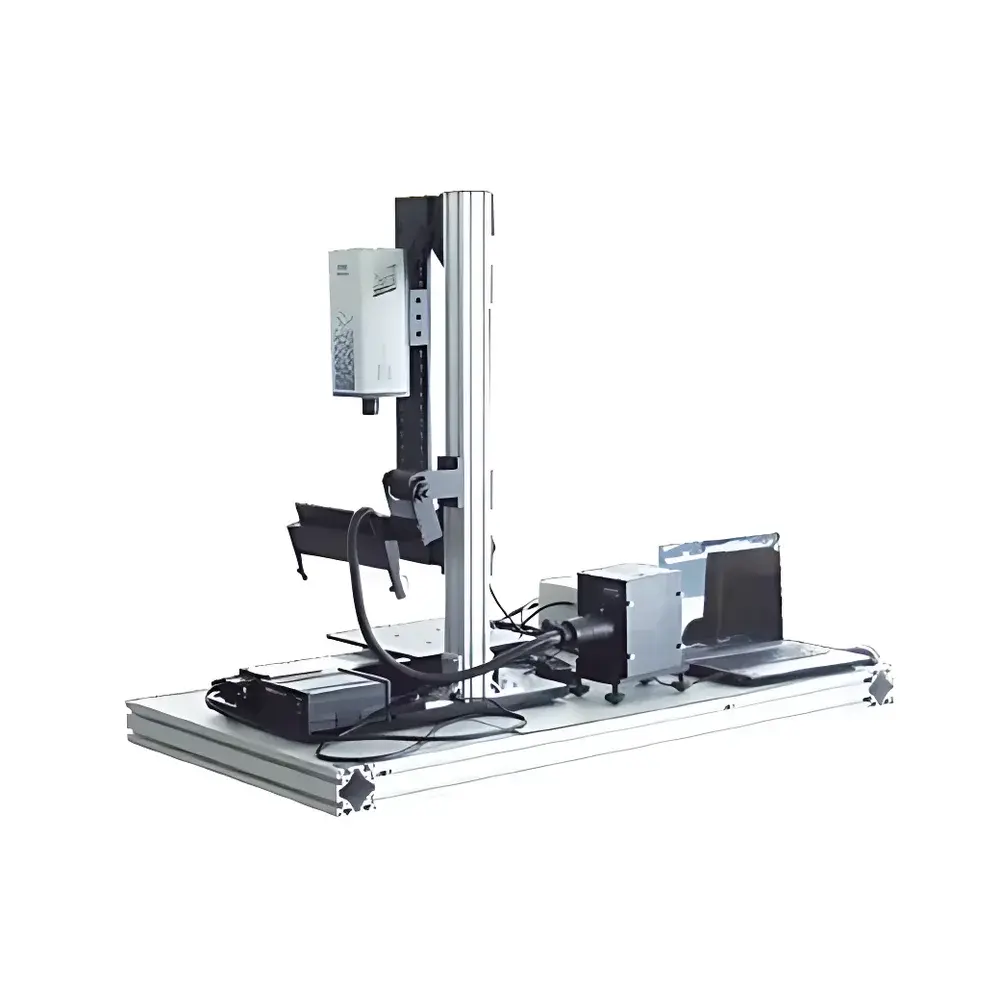
Dualix Spectral Imaging GaiaTracer Forensic Evidence Analysis System
| Brand | Dualix Spectral Imaging |
|---|---|
| Origin | Sichuan, China |
| Model | GaiaTracer |
| Imaging Modality | Hyperspectral (Push-broom & Tunable Filter variants) |
| Deployment | Benchtop Laboratory |
| Spectral Range | 250–2500 nm (configurable by variant) |
| Spectral Resolution | 8–20 nm (FWHM, wavelength-dependent) |
| Spatial Resolution | ≤100 µm at 300 mm working distance |
| Field of View (TFOV) | ±7° |
| Instantaneous Field of View (IFOV) | <0.1 mrad |
| Frame Rate | 22–25 fps (GigE data interface) |
| Optical Interface | USB 2.0 (control), GigE (image data) |
| Illumination | Dual 300 W adjustable broadband source (VIS–SWIR), UV optional |
| Sample Stage | Motorized Z-axis (0–800 mm), X/Y translation (300 mm travel), tilt/height-adjustable line source |
| Compliance | Designed for ISO/IEC 17025-aligned forensic laboratories |
| Software | Proprietary acquisition & spectral unmixing suite with spectral library matching and PCA-based anomaly detection |
Overview
The Dualix Spectral Imaging GaiaTracer Forensic Evidence Analysis System is a benchtop hyperspectral imaging platform engineered for non-destructive, spatially resolved chemical identification in forensic science applications. It integrates two complementary optical architectures—liquid crystal tunable filter (LCTF)-based snapshot imaging (GaiaTracer-F series) and grating-based push-broom scanning (GaiaTracer-G series)—to deliver high-fidelity spectral cubes (x, y, λ) across the ultraviolet–visible–shortwave infrared (UV–VIS–SWIR) and near-infrared (NIR) domains (250–2500 nm). Unlike conventional RGB or multispectral imaging, GaiaTracer captures contiguous, narrowband spectral bands at each pixel, enabling quantitative spectral signature extraction and material classification based on molecular absorption features. Its design adheres to core forensic imaging principles: trace preservation, repeatability under controlled illumination, and metrological traceability through calibrated reference standards (e.g., PTFE white reflectance target, NIST-traceable spectral response characterization).
Key Features
- Modular spectral architecture: Select between LCTF-based F-series (high-speed, snapshot acquisition) or grating-based G-series (high spectral resolution, broadest coverage up to 2500 nm)
- Configurable spectral bands: Four standard variants—Vis-8/-20 (400–720 nm), SNIR-8/-20 (550–1000 nm), Dual-band (manual switching), and NIR (900–1700 nm)—each with programmable step size ≥1 nm
- Precision illumination system: Dual 300 W broadband halogen sources with adjustable height (0–90° tilt) and axial position; optional UV-enhanced lamp for 250–350 nm analysis
- Motorized sample handling: Z-axis stage (0–800 mm travel), 300 mm × 300 mm XY translation platform, and integrated linear light guide for uniform push-broom illumination
- Calibration-ready optics: Pre-aligned collimated beam path, <50 mm effective aperture, and factory-characterized IFOV (<0.1 mrad) supporting sub-100 µm spatial sampling at standard working distances
- Dual-interface control: USB 2.0 for real-time parameter adjustment; Gigabit Ethernet for lossless image streaming (up to 25 fps at 3296 × 2472 pixels)
Sample Compatibility & Compliance
GaiaTracer supports flat, rigid, and semi-flexible evidentiary samples—including latent fingerprints on porous/non-porous substrates, inked documents, gunshot residue particles, fiber swatches, bloodstains, and drug powders—without physical contact or chemical treatment. The system accommodates objects up to 290 mm × 210 mm (G-series) or 300 mm × 300 mm (F-series) within its stage envelope. All optical components are housed in a light-tight enclosure to eliminate ambient interference. Designed for use in accredited forensic laboratories, GaiaTracer’s hardware and software architecture support audit-ready workflows aligned with ISO/IEC 17025:2017 requirements for method validation, instrument calibration records, and environmental monitoring logs. While not FDA-cleared, its data structure and metadata tagging comply with digital evidence chain-of-custody best practices per ENFSI guidelines and ASTM E2919-21 (Standard Guide for Digital Image Authentication in Forensic Science).
Software & Data Management
The proprietary GaiaCapture and GaiaAnalyze software suite provides full control over acquisition parameters, real-time preview, and post-processing analytics. Acquisition modules support single-wavelength capture, spectral sweep (with user-defined start/stop/step), and auto-exposure optimization per band. Processed data are stored in HDF5 format with embedded EXIF-like metadata (wavelength grid, illumination settings, stage coordinates, calibration timestamps). Analytical tools include spectral angle mapper (SAM), constrained least-squares unmixing, principal component analysis (PCA), and library matching against built-in forensic spectral libraries (e.g., ink databases, pigment references, textile dyes). Software supports export to common formats (ENVI .hdr/.img, MATLAB .mat, CSV) and includes role-based user accounts with configurable permissions. Audit trails record all processing steps, parameter changes, and file exports—meeting GLP/GMP documentation expectations for casework reproducibility.
Applications
- Latent fingerprint enhancement and substrate differentiation without powdering or cyanoacrylate fuming
- Ink discrimination in questioned document examination, including age estimation via oxidative degradation signatures
- Gunshot residue (GSR) particle mapping and elemental correlation using spectral absorption edges (e.g., Pb, Ba, Sb compounds)
- Fiber and paint chip identification through polymer-specific C–H, N–H, and O–H vibrational overtones in SWIR
- Blood detection and species differentiation on dark or patterned backgrounds using hemoglobin deoxy/oxy absorption ratios
- Counterfeit currency and security feature verification via spectral response of optically variable inks and holographic layers
FAQ
What spectral ranges are supported across GaiaTracer variants?
The F-series covers 400–720 nm (Vis), 550–1000 nm (SNIR), or dual-band operation; the G-series extends continuously from 250 nm (UV) to 2500 nm (MWIR) using interchangeable grating and detector modules.
Is the system compatible with existing forensic laboratory information management systems (LIMS)?
Yes—raw and processed data can be exported in standardized formats (HDF5, ENVI, CSV) and integrated via API or scheduled file transfer; metadata fields align with NIEM 4.0 and NIST SP 800-111 forensic data exchange profiles.
How is spectral calibration maintained over time?
Each system ships with a certified PTFE reference tile (250–2500 nm reflectance profile); users perform daily dark-current and white-reference acquisitions; factory recalibration services are available annually or after optical re-alignment.
Can GaiaTracer be used for in situ crime scene documentation?
No—it is a benchtop laboratory instrument requiring stable power, vibration isolation, and controlled ambient lighting; portable derivatives (e.g., GaiaField series) are available for field deployment but are distinct product lines.
Does the software support automated match-to-library reporting for court-admissible outputs?
Yes—reports include spectral correlation coefficients, confidence intervals derived from replicate measurements, and full traceability to reference spectra; output templates meet Daubert standard documentation requirements for expert testimony.




