
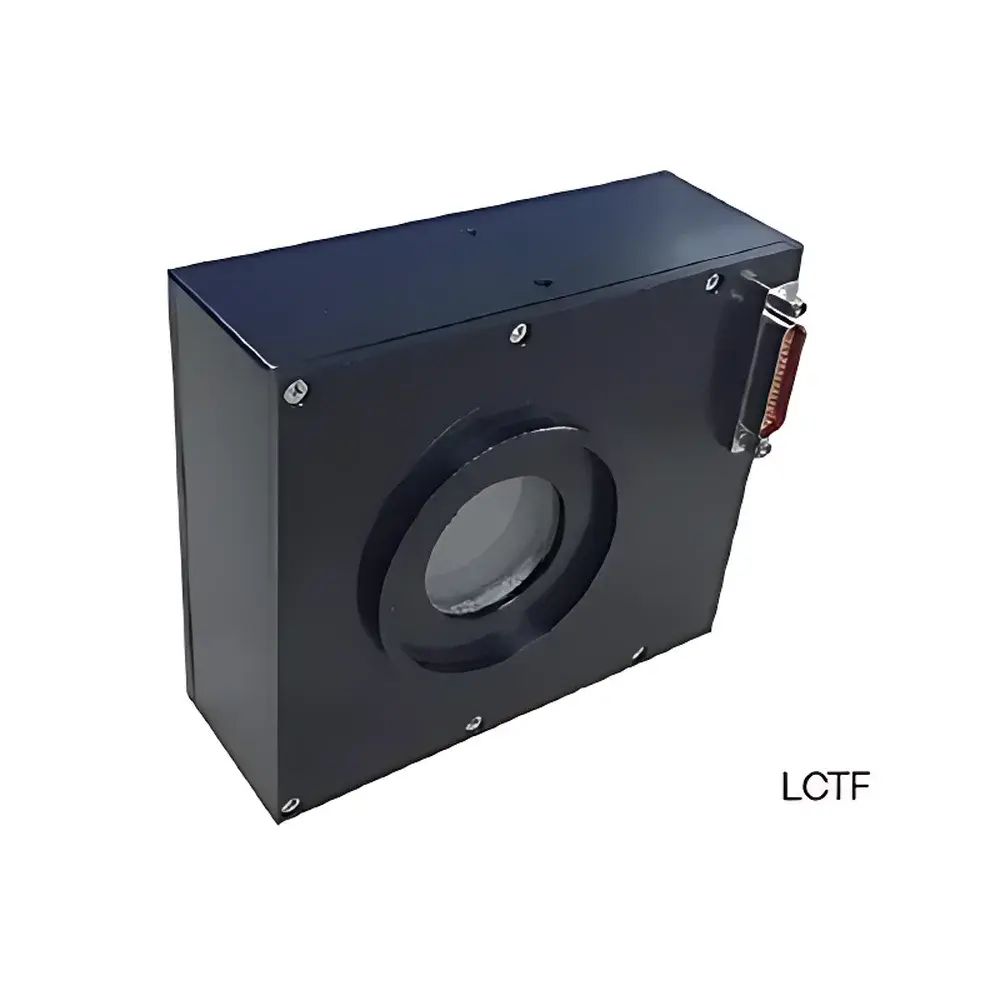
Dualix Spectral Imaging Iris Series Liquid Crystal Tunable Filter (LCTF) Module
| Brand | Dualix Spectral Imaging |
|---|---|
| Model | Iris-V / Iris-SN / Iris-N |
| Type | Filter-Based Hyperspectral Imaging Module |
| Spectral Range | 400–720 nm (Iris-V), 550–1000 nm (Iris-SN), 900–1700 nm (Iris-N) |
| FWHM Bandwidth | 8–20 nm (customizable), e.g., 8 nm @ 550 nm (Iris-V/Iris-SN), 20 nm @ 900 nm (Iris-N) |
| Tuning Resolution | ≥1 nm |
| Aperture | 28 mm (standard), customizable up to 48 mm |
| Acceptance Angle | ±8° (Iris-V/Iris-SN), ±10° (Iris-N) |
| Switching Time | 50–150 ms |
| Wavelength Accuracy | FWHM/8 ± 0.5 nm |
| Operating Temperature | −10 to +40 °C |
| Storage Temperature | −20 to +80 °C |
| Power Supply | DC 5 V @ 8 A |
| Polarization Sensitivity | Transmission doubles under linearly polarized illumination vs. unpolarized (reference condition) |
Overview
The Dualix Spectral Imaging Iris Series Liquid Crystal Tunable Filter (LCTF) Module is a solid-state, voltage-controlled spectral filtering device engineered for high-fidelity, non-scanning hyperspectral imaging applications. Unlike mechanically tuned filters or dispersive spectrometers, the Iris LCTF operates on the principle of electrically induced birefringence in nematic liquid crystal layers—configured as a Lyot or Evans-type multi-stage retarder stack—to selectively transmit narrowband spectral channels within user-defined ranges. By applying precise DC voltage gradients across integrated LC cells, the effective optical path difference is modulated, enabling continuous, stepwise, or random-access spectral tuning without moving parts. This electro-optic architecture delivers intrinsic advantages in reliability, shock resistance, and integration flexibility—particularly critical for ground-based remote sensing, airborne payload systems, laboratory microspectroscopy, and real-time industrial inspection platforms.
Key Features
- Solid-state spectral tuning: No mechanical actuators, motors, or rotating filter wheels—eliminates wear, vibration, and alignment drift.
- Multi-band configuration support: Three standard variants (Iris-V, Iris-SN, Iris-N) cover visible (400–720 nm), NIR (550–1000 nm), and SWIR (900–1700 nm) domains with optimized retarder design per range.
- Narrow passband control: Full width at half maximum (FWHM) tunable from 8 nm to 20 nm; typical values are 8 nm @ 550 nm (Iris-V/SN) and 20 nm @ 900 nm (Iris-N), with custom bandwidths available.
- High spatial fidelity: 28 mm clear aperture (expandable to 48 mm) ensures compatibility with standard C-mount and F-mount lenses while maintaining uniform transmission across field-of-view.
- Fast spectral agility: Switching time between wavelengths ranges from 50 to 150 ms—enabling video-rate spectral acquisition when synchronized with high-speed CMOS or scientific CCD sensors.
- Low-power operation: Operates on regulated DC 5 V @ 8 A, suitable for embedded UAV payloads and portable field spectrometers.
- Polarization-aware design: Delivers doubled peak transmittance under linearly polarized illumination—facilitating polarization-resolved hyperspectral analysis when paired with external polarizers.
Sample Compatibility & Compliance
The Iris LCTF is designed for seamless integration into reflective, transmissive, and fluorescence-based optical paths. Its wide acceptance angle (±8°–±10°) accommodates standard telecentric and non-telecentric imaging lenses without vignetting or wavelength shift artifacts. The module complies with RoHS 2011/65/EU directives and meets IEC 61340-5-1 ESD protection standards. While not certified for medical or aerospace-grade qualification out-of-the-box, its thermal stability (−10 to +40 °C operating range) and mechanical robustness support deployment in GLP-compliant laboratories and ISO 17025-accredited analytical environments. For regulatory traceability, wavelength accuracy is specified as FWHM/8 ± 0.5 nm—validated via NIST-traceable calibrated light sources during factory calibration.
Software & Data Management
Dualix provides the Iris Control SDK (Windows/Linux/macOS) supporting USB 3.0 and TTL-triggered synchronization. The API enables full spectral parameter scripting—including wavelength list definition, dwell time per channel, and dynamic bandwidth adjustment—via Python, MATLAB, or LabVIEW bindings. Acquired hyperspectral data cubes (x, y, λ) conform to ENVI .hdr/.dat and HDF5 formats, ensuring interoperability with commercial processing suites such as Specim INSIGHT, Malvern Panalytical’s HyperVision, and open-source tools like scikit-image and hsi. Audit trails for spectral acquisition parameters—including timestamped voltage settings, ambient temperature logs, and firmware revision—are recorded automatically to meet FDA 21 CFR Part 11 requirements for electronic records in regulated QC/QA workflows.
Applications
- Agricultural phenotyping: Quantitative assessment of chlorophyll content, water stress, and nitrogen status using targeted vegetation indices (e.g., NDVI, PRI, MCARI).
- Pharmaceutical tablet coating uniformity analysis: In-line spectral mapping of active pharmaceutical ingredient (API) distribution across compressed dosage forms.
- Cultural heritage documentation: Non-invasive pigment identification and degradation mapping in manuscripts, paintings, and archaeological artifacts.
- Food quality inspection: Detection of bruising, mold contamination, and adulteration in fruits, grains, and dairy products based on spectral fingerprinting.
- Defense & surveillance: Camouflage detection, material classification, and concealed object identification under natural daylight or active illumination.
- Microscopy: Hyperspectral fluorescence lifetime imaging (FLIM) and label-free tissue diagnostics in pathology workflows.
FAQ
Is the Iris LCTF compatible with scientific CMOS cameras?
Yes—the module features standard C-mount threading and supports direct coupling with monochrome sCMOS sensors (e.g., Hamamatsu ORCA-Fusion, Photometrics Prime BSI). Optimal performance requires collimated illumination and lens f-number ≤ f/4.
Can multiple Iris units be synchronized for dual-band or polarization-diverse acquisition?
Yes—TTL trigger input/output ports enable master-slave daisy-chaining of up to four modules with sub-millisecond timing precision, facilitating simultaneous VNIR+SWIR capture or Stokes parameter measurement.
What calibration documentation is provided with each unit?
Each Iris module ships with a factory calibration report including wavelength accuracy verification, FWHM characterization across the tuning range, and spatial uniformity maps measured at three representative wavelengths.
Does the LCTF require temperature stabilization during operation?
No active cooling is required; however, operation above 35 °C may induce minor wavelength drift (~0.02 nm/°C). For metrology-grade applications, optional thermistor feedback and PID-controlled heater plates are available as OEM add-ons.






