
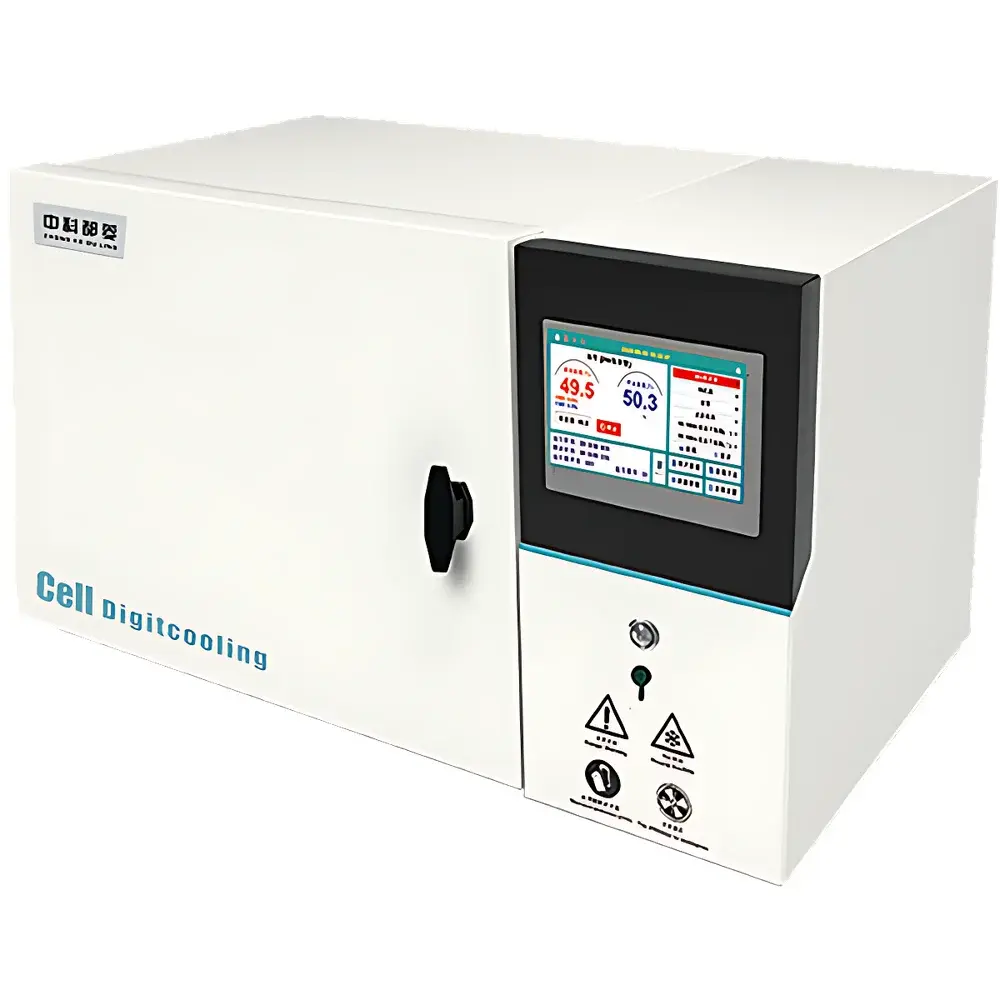
Duling CDG-17 Programmable Controlled-Rate Freezer
| Brand | Duling |
|---|---|
| Model | CDG-17 |
| Internal Volume | 17 L |
| Cryovial Capacity (2 mL) | 385 units |
| Temperature Range | +50 °C to −190 °C |
| Temperature Accuracy | < ±2 °C |
| Temperature Uniformity | < 2 °C (max deviation between two points in chamber during cooling) |
| Power Supply | 230 V, 50/60 Hz |
| Dimensions (W×D×H) | 810 × 540 × 790 mm |
| Insulation | In-situ foamed polyurethane |
| Chamber Material | SUS304 stainless steel |
| Control Interface | 10-inch LCD touch screen with microprocessor-based controller |
| Software Connectivity | PC-compatible control & monitoring software (multi-unit support) |
| Safety Features | Dual solenoid valves, automatic LN₂ cutoff upon door opening, over-temperature protection, fan shutdown on door opening |
| User Management | 5-level access control with PDF-exportable audit log |
| Temperature Monitoring | Dual independent probes (sample + chamber), real-time curve display including latent heat absorption phase indicators |
Overview
The Duling CDG-17 Programmable Controlled-Rate Freezer is an engineered solution for reproducible, traceable, and biologically validated cryopreservation of sensitive biological materials—including primary cells, stem cell lines, hybridomas, and tissue samples. It operates on the principle of precisely regulated liquid nitrogen (LN₂) vapor-phase cooling, where thermal energy is extracted via controlled injection of gaseous nitrogen into an insulated chamber, enabling programmable cooling rates from +50 °C down to −190 °C. Unlike passive freezing methods or mechanical ultra-low temperature freezers, the CDG-17 delivers deterministic thermal profiles essential for minimizing intracellular ice formation, preserving membrane integrity, and maintaining post-thaw viability and functionality. Its microprocessor-driven architecture ensures closed-loop feedback control using dual platinum resistance thermometers (PRTs), one embedded in the sample carrier and another monitoring ambient chamber conditions—enabling simultaneous tracking of both thermal domains throughout the entire freeze cycle.
Key Features
- 10-inch high-resolution LCD touchscreen interface with intuitive graphical programming environment for defining multi-step cooling/heating protocols
- Dual independent temperature sensing system: separate PRT probes for sample and chamber, displayed concurrently with real-time cooling curves
- In-situ foamed polyurethane insulation (≥150 mm thickness) minimizes thermal bridging and condensation, eliminating manual dew wiping and improving long-term stability
- SUS304 stainless-steel inner chamber and powder-coated steel exterior ensure corrosion resistance, cleanability, and compliance with ISO 13485-grade laboratory environments
- Dual-solenoid valve architecture for LN₂ delivery provides redundant safety control; automatic cutoff triggered by door interlock and thermal fault detection
- Integrated horizontal laminar airflow system with guarded centrifugal fan ensures uniform nitrogen dispersion and <2 °C spatial uniformity across the 17 L working volume
- Preloaded library of ≥6 standardized cryopreservation protocols (e.g., PBMC, ESC, iPSC, oocytes) plus ≥20 user-definable programs with up to 10 segments per profile
- Comprehensive electronic audit trail: time-stamped operation logs, user authentication history, and parameter change records exportable as password-protected PDF files
Sample Compatibility & Compliance
The CDG-17 accommodates standard cryogenic storage formats, including 2 mL external-thread cryovials (385 units per run), 1.8 mL internally threaded vials, and custom racks compatible with ANSI/SLAS footprint standards. Its design supports GMP-aligned workflows: all temperature data—including sample probe readings, chamber setpoints, cooling rate deviations, and latent heat transition markers—are time-synchronized and stored locally with optional network backup. The system meets core requirements for GLP-compliant biobanking per ISO 20387:2018 and supports FDA 21 CFR Part 11 readiness through role-based access control (five-tier permissions), electronic signature validation, and immutable log exports. Validation documentation—including IQ/OQ templates and temperature mapping reports—is available upon request for site-specific qualification.
Software & Data Management
The included Windows-based Duling CryoControl Suite enables remote supervision of multiple CDG-17 units via Ethernet or USB. It provides real-time visualization of dual-temperature trajectories, deviation alerts, and automated report generation compliant with ALCOA+ principles (Attributable, Legible, Contemporaneous, Original, Accurate, Complete, Consistent, Enduring, Available). All raw thermal datasets are saved in .csv format with metadata headers (operator ID, protocol name, timestamp, probe IDs), facilitating integration with LIMS platforms such as LabVantage or STARLIMS. Optional API access allows scripting-based protocol deployment and event-triggered notifications via SMTP or SNMP.
Applications
- Cryopreservation of human peripheral blood mononuclear cells (PBMCs) with optimized ramp rates (−1 °C/min to −3 °C/min) to retain antigen-presenting function
- Controlled-rate freezing of induced pluripotent stem cells (iPSCs) to minimize epigenetic drift and clonal selection bias
- Biobank-scale processing of tumor tissue fragments under SOP-defined thermal profiles for downstream NGS and organoid derivation
- Validation of cryoprotectant efficacy studies requiring precise sub-zero phase transition monitoring (e.g., DMSO vs. trehalose formulations)
- Regulatory submission support: generation of auditable freeze-thaw records for IND/IMPD dossiers and ISO 13485 certification audits
FAQ
What is the minimum achievable cooling rate, and how is it maintained at ultra-low temperatures?
The CDG-17 achieves programmable cooling rates from 0.1 °C/min to 10 °C/min across its full range. Below −80 °C, rate stability is maintained via pulsed LN₂ injection modulated by dual-solenoid feedback, compensating for reduced thermal conductivity in vapor-phase operation.
Does the system support 21 CFR Part 11 compliance out of the box?
While the hardware and firmware include core technical controls (audit logging, electronic signatures, role-based access), formal Part 11 compliance requires site-specific configuration, validation, and procedural documentation—services available through Duling’s certified validation partners.
Can the CDG-17 operate without continuous LN₂ supply?
No. It is a vapor-phase LN₂-dependent system and requires uninterrupted liquid nitrogen feed via standard 3/8″ OD stainless-steel or nylon-insulated transfer hose (included). Backup LN₂ dewars with level monitoring are recommended for unattended overnight runs.
How is temperature uniformity verified during qualification?
Duling provides a 9-point temperature mapping protocol per ICH Q5C Annex 1 guidance, using calibrated Class A PT100 probes placed at defined geometric locations within the loaded chamber, with acceptance criteria of ≤2 °C max deviation during dynamic cooling.
Is service and calibration support available outside China?
Yes. Duling maintains authorized service centers in Germany, Singapore, and the United States, offering annual calibration, preventive maintenance, and IQ/OQ execution with NIST-traceable equipment and ISO/IEC 17025-accredited reporting.





