
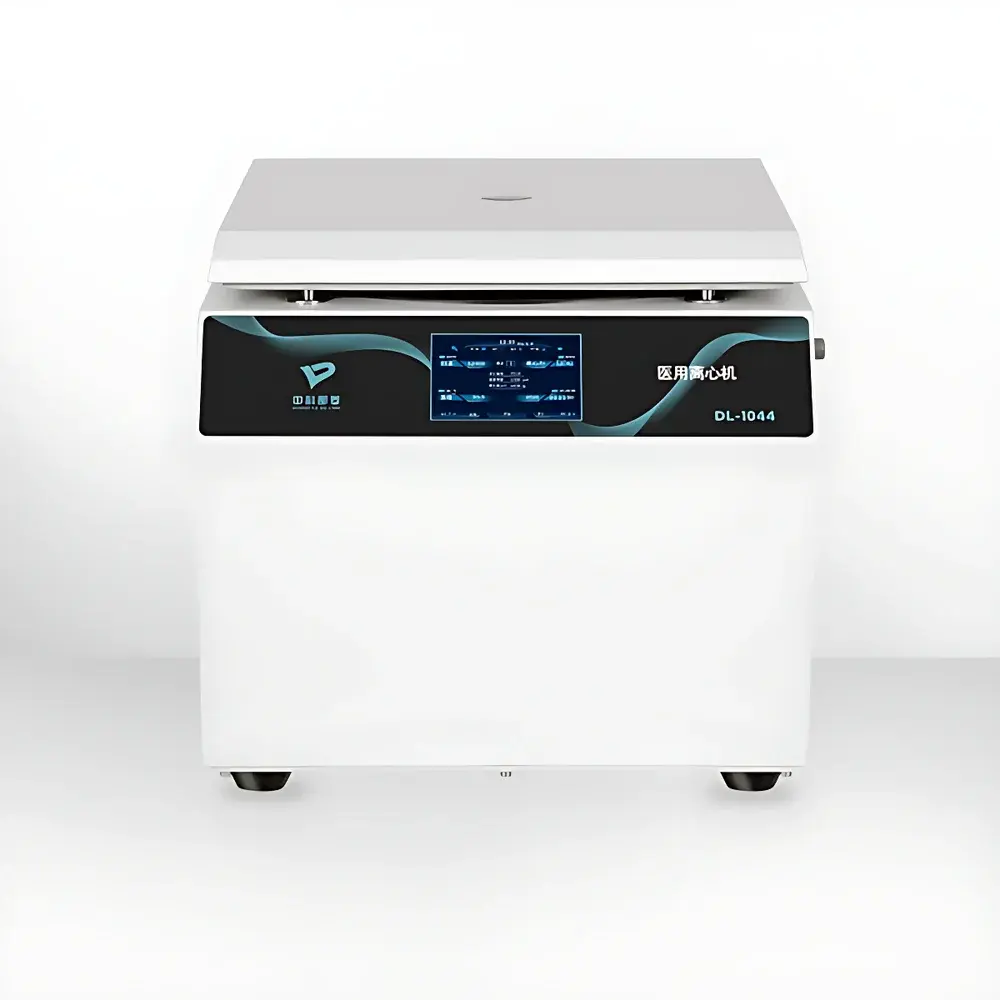
Duling DL-1044 Benchtop Low-Speed Centrifuge for PRP and Clinical Sample Processing
| Brand | Duling |
|---|---|
| Origin | Anhui, China |
| Manufacturer Type | Authorized Distributor |
| Product Category | Domestic |
| Model | DL-1044 |
| Instrument Type | Benchtop Centrifuge |
| Speed Range | 0–6,000 rpm |
| Max RCF | 5,037 × g |
| Max Capacity | 5 × 96 mL (horizontal rotor) |
| Dimensions (L×W×H) | 580 × 485 × 420 mm |
| Construction | Dual-layer steel housing with stainless-steel centrifuge chamber |
| Drive System | Maintenance-free AC brushless frequency-controlled motor |
| Control Interface | Microprocessor-based touch keypad with LED display |
| Safety Features | Dual interlocked door latch, automatic imbalance detection, overspeed protection, audible alarm |
| Programmability | User-defined protocols with independent setpoints for RCF, speed, and time |
| Operational Mode | Real-time parameter adjustment during non-programmed runs |
Overview
The Duling DL-1044 is a microprocessor-controlled benchtop low-speed centrifuge engineered for routine clinical and biomedical separation tasks—including platelet-rich plasma (PRP) preparation, whole blood fractionation, cell pellet recovery, and serum/plasma isolation. It operates on the principle of sedimentation under controlled centrifugal force, leveraging Newtonian fluid dynamics to separate components based on density differentials. Designed specifically for laboratories requiring high reproducibility in low-g applications (up to 5,037 × g), the DL-1044 avoids high-shear stress conditions that could compromise cellular integrity or protein conformation—making it suitable for sensitive biological matrices such as anticoagulated blood, bone marrow aspirates, and tissue homogenates. Its brushless AC frequency-controlled motor ensures stable rotational output across the full speed range (0–6,000 rpm), minimizing thermal drift and mechanical wear while delivering consistent torque delivery and precise RCF accuracy.
Key Features
- Microprocessor-based control system with real-time LED display showing simultaneous RCF, rotational speed (rpm), and remaining time
- Touch-sensitive keypad interface with dedicated RCF setting button—enabling direct input of relative centrifugal force without manual conversion from rpm
- Brushless AC frequency-controlled motor: eliminates carbon brush degradation, reduces electromagnetic interference, and extends service life beyond 20,000 operating hours
- Dual interlocked door latch mechanism: automatically engages at startup and prevents accidental opening during operation; meets IEC 61010-2-020 safety requirements for laboratory centrifuges
- Stainless-steel centrifuge chamber housed within a dual-layer steel frame—providing structural rigidity, vibration damping, and corrosion resistance
- Intelligent imbalance detection: continuously monitors load distribution during acceleration and deceleration; triggers audible alert and immediate rotor stop if asymmetry exceeds ±5 g tolerance
- Overspeed protection circuitry: independently verifies rotational velocity against user-set maximums and halts operation if threshold is exceeded by >2%
- Programmable memory for up to 10 user-defined protocols, each storing RCF, time, acceleration/deceleration profiles, and rotor identification
Sample Compatibility & Compliance
The DL-1044 accommodates standard horizontal rotors supporting 5 × 96 mL conical tubes (e.g., 50 mL Falcon-style or equivalent), compatible with common clinical tube formats including EDTA, citrate, and heparin vacutainers. It supports ISO 22870-compliant point-of-care (POC) workflows and aligns with CLSI GP44-A4 guidelines for centrifugation parameters in diagnostic specimen processing. While not certified under FDA 21 CFR Part 11, its parameter logging capability (via optional RS-232/USB data export) enables traceable recordkeeping suitable for GLP-aligned environments. The unit complies with electromagnetic compatibility (EMC) standards EN 61326-1 and electrical safety standard EN 61010-1, and carries CE marking for use within the European Economic Area.
Software & Data Management
The DL-1044 operates autonomously without external software dependencies. All operational parameters—including start/stop timestamps, final RCF achieved, total run duration, and fault logs—are retained in non-volatile memory for up to 100 cycles. Optional firmware upgrade paths support ASCII-formatted data export via serial or USB interface for integration into LIMS or ELN platforms. Audit trail functionality records operator ID (if enabled via external authentication), protocol selection, and any mid-run parameter modifications—facilitating internal quality reviews and adherence to ISO/IEC 17025 documentation requirements.
Applications
- Preparation of platelet-rich plasma (PRP) for orthobiologics and regenerative medicine protocols
- Serum and plasma separation from whole blood specimens prior to immunoassay or clinical chemistry analysis
- Cellular pellet recovery from suspension cultures (e.g., PBMCs, adipose-derived stem cells)
- Clarification of tissue lysates and crude extracts prior to downstream chromatography or electrophoresis
- Routine sedimentation of urine, cerebrospinal fluid (CSF), and synovial fluid samples
- Low-force pelleting of extracellular vesicles (EVs) in early-stage isolation workflows
FAQ
What is the maximum recommended rotor capacity for the DL-1044?
The instrument supports a maximum load of five 96 mL tubes in a horizontal configuration—equivalent to 480 mL total volume when using standard polypropylene conical tubes.
Does the DL-1044 meet international safety standards for clinical laboratory use?
Yes—it conforms to IEC 61010-1 (safety) and IEC 61010-2-020 (centrifuge-specific requirements), and carries CE marking for compliance with EU directives.
Can centrifugation parameters be modified during an active run?
Yes—when operating outside of stored protocols, users may adjust time, speed, or RCF in real time without interrupting rotation.
Is calibration documentation available for regulatory audits?
Factory calibration certificates are provided with each unit; periodic verification can be performed using NIST-traceable tachometers and RCF calculators per ISO 8573-1 Annex B guidance.
What maintenance is required for the brushless motor?
None—the motor contains no consumable parts and requires only periodic cleaning of the chamber and inspection of rotor threads and bucket alignment.



