
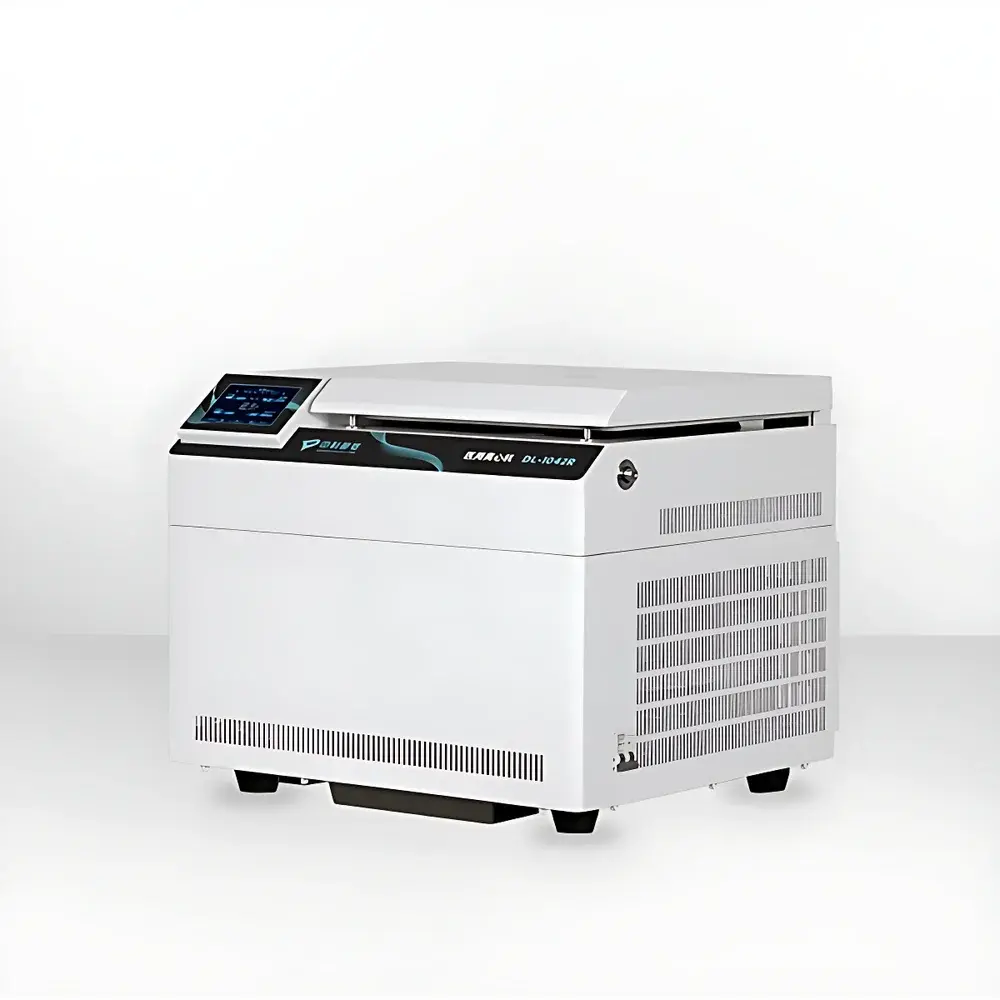
Duling DL-1044R Benchtop Low-Speed Refrigerated Centrifuge
| Brand | Duling |
|---|---|
| Origin | Anhui, China |
| Manufacturer Type | Authorized Distributor |
| Country of Origin | China |
| Model | DL-1044R |
| Instrument Type | Benchtop Centrifuge |
| Speed Range | 0–5500 rpm |
| Max RCF | 5400 × g |
| Max Capacity | 4 × 750 mL (horizontal rotor) |
| Temperature Range | –20 °C to +40 °C |
| Dimensions (L×W×H) | 702 × 590 × 890 mm |
| Drive System | Brushless AC Frequency-Controlled Motor |
| Rotor Compatibility | Horizontal, microplate, and fixed-angle rotors |
| Safety Features | Dual interlocked door lock, automatic imbalance detection, overspeed protection, acoustic alarm |
| Control Interface | LED-displayed parameters (speed, RCF, time, temperature), touch keypad, 20 programmable protocols |
| Acceleration/Deceleration | 15-step selectable ramp rates |
| Special Functions | “At Set RCF” timing mode, short-spin (pulse) mode, real-time parameter adjustment during non-programmed runs |
| Compliance | Designed per IEC 61010-2-020 (Safety Requirements for Centrifuges), supports GLP-compliant operation with audit-ready parameter logging |
Overview
The Duling DL-1044R is a benchtop low-speed refrigerated centrifuge engineered for routine separation tasks in academic, clinical, and industrial laboratories. It operates on the principle of sedimentation under controlled gravitational force (RCF), enabling efficient pelleting of cells, bacteria, organelles, and macromolecular complexes without compromising structural integrity. Unlike high-speed or ultracentrifuges, the DL-1044R prioritizes thermal stability, operational safety, and reproducible low-shear separation—making it ideal for applications where sample viability, temperature sensitivity, or large-volume processing is critical. Its refrigeration system maintains chamber temperatures between –20 °C and +40 °C, ensuring consistent thermal management during extended runs. The unit complies with IEC 61010-2-020 safety standards for laboratory centrifuges and supports traceable operation through timestamped parameter logging—a foundational requirement for GLP and internal quality assurance frameworks.
Key Features
- Brushless AC frequency-controlled motor ensures maintenance-free operation, stable torque delivery across speed ranges, and extended service life.
- Dual mechanical and electronic door interlock system automatically engages at startup, preventing accidental opening during rotation and meeting Class II biosafety expectations.
- 20 user-programmable protocols allow storage and recall of frequently used combinations of speed, time, temperature, and acceleration/deceleration profiles—eliminating repetitive manual input and reducing operator error.
- 15-step acceleration and deceleration ramp control enables precise adaptation to fragile samples (e.g., peripheral blood mononuclear cells or yeast spheroplasts), minimizing shear-induced damage during spin-up and braking phases.
- Real-time dual-parameter display shows both rotational speed (rpm) and relative centrifugal force (×g) simultaneously, with dedicated RCF-setting key for direct force-based method development.
- Automatic imbalance detection continuously monitors rotor load distribution; if deviation exceeds tolerance, the system halts rotation and triggers an audible alert—preventing mechanical stress and potential rotor failure.
Sample Compatibility & Compliance
The DL-1044R accommodates a broad range of sample containers via interchangeable rotor configurations: standard horizontal carriers (max 4 × 750 mL bottles), microplate adapters (96-well formats), and optional fixed-angle rotors for higher RCF applications up to 5400 × g. It supports common labware including polypropylene conical tubes, glass centrifuge bottles, and PCR strip holders. All rotors are dynamically balanced and certified for continuous operation at rated speeds. The instrument’s design aligns with ISO/IEC 17025 documentation practices and facilitates compliance with FDA 21 CFR Part 11 when integrated with validated LIMS or ELN systems—particularly when audit trails capture parameter changes, start/stop timestamps, and error events.
Software & Data Management
While the DL-1044R operates as a standalone instrument with embedded firmware, its parameter structure is fully compatible with external data capture workflows. Each run logs date/time, setpoints (temperature, speed, duration, RCF), actual achieved values, and any fault codes—exportable via USB interface in CSV format. This supports retrospective analysis, SOP adherence verification, and root-cause investigation during QA/QC reviews. Optional PC-based configuration utilities enable batch protocol deployment and firmware updates, maintaining version control across multi-unit installations.
Applications
- Cell culture harvest: Pelleting mammalian, insect, or bacterial cells at 1,500–4,000 × g with temperature control to preserve membrane integrity.
- Clinical specimen processing: Separation of serum, plasma, or urine sediments in diagnostic labs adhering to CLSI GP44-A4 guidelines.
- Environmental microbiology: Concentration of waterborne pathogens (e.g., E. coli, Legionella) from large-volume filtration eluates.
- Vaccine and bioprocess intermediate handling: Clarification of lysates, virus harvests, or antibody-containing supernatants prior to chromatography.
- Food and beverage QC: Fat separation in milk homogenates or starch granule isolation from plant extracts.
FAQ
What is the minimum operating temperature, and how quickly does the chamber reach –20 °C?
The refrigeration system achieves –20 °C within ≤25 minutes from ambient (25 °C), verified under no-load conditions per manufacturer test protocol.
Can the DL-1044R be used with sealed aerosol-tight buckets for BSL-2 work?
Yes—when equipped with certified sealed horizontal rotors and biocontainment buckets, it meets CDC/NIH recommendations for low-risk biological agents requiring primary containment.
Is rotor calibration required annually?
No routine recalibration is mandated; however, periodic verification of speed accuracy (±10 rpm) and temperature uniformity (±1 °C across chamber) is recommended per ISO/IEC 17025 clause 6.4.3.
Does the unit support remote monitoring or network connectivity?
It does not feature built-in Ethernet or Wi-Fi; however, USB-triggered data export and third-party serial-to-USB integration enable connection to centralized lab monitoring platforms.
How is “At Set RCF” timing implemented?
The system dynamically adjusts rotational speed in real time to maintain constant RCF despite load variations or temperature-induced rotor expansion—ensuring consistent sedimentation kinetics across runs.



