
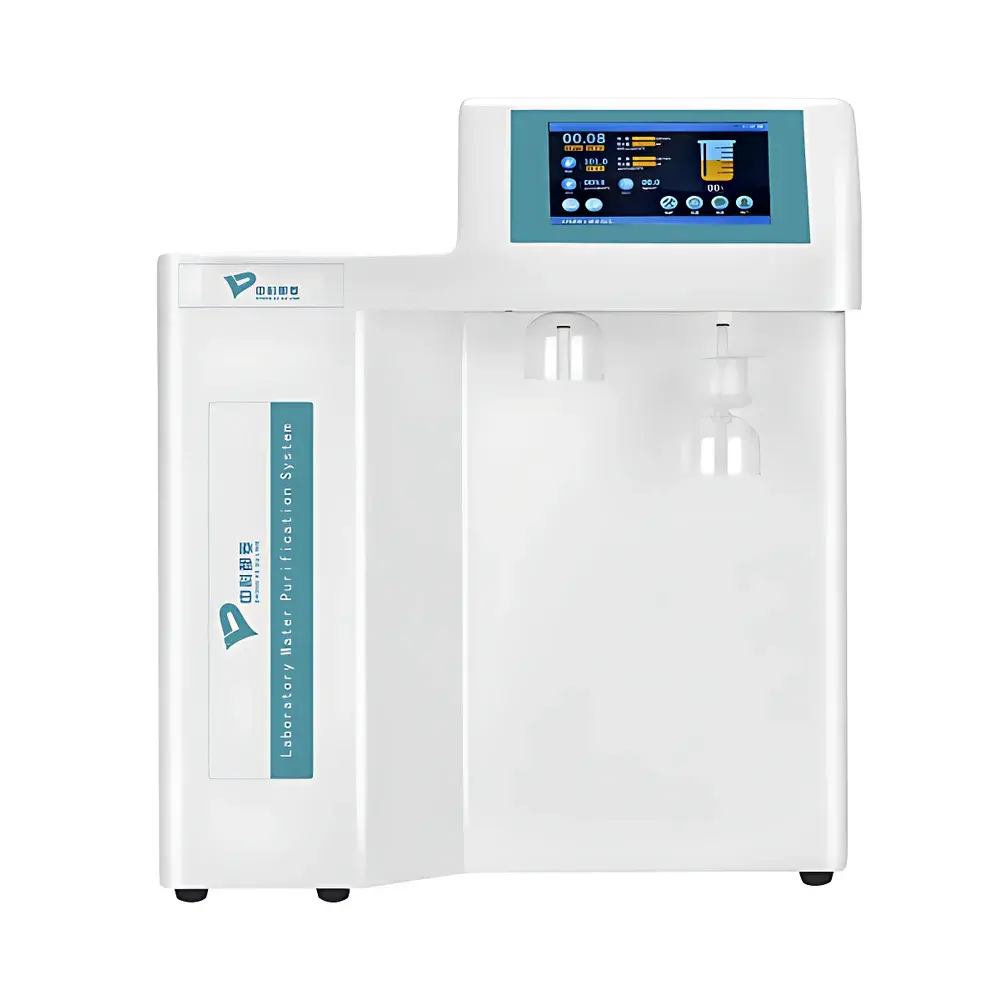
Duling DL-P3 Life Science-Grade Ultra Pure Water System
| Brand | Duling |
|---|---|
| Origin | Anhui, China |
| Manufacturer Type | Authorized Distributor |
| Product Category | Domestic |
| Model | DL-P3 |
| Price Range | USD 4,200–7,000 (FOB) |
| Purified Water Grade | ASTM Type I / ISO 3696 Grade 1 |
| Resistivity | 18.2 MΩ·cm @ 25 °C |
| Heavy Metals & Soluble Silica | < 0.1 ppb |
| Total Organic Carbon (TOC) | < 3 ppb |
| Microbial Count | < 0.001 EU/mL |
| Particulates (> 0.1 µm) | < 1 particle/mL |
| Flow Rate | 10 mL/min |
| Feed Water Requirements | RO or deionized water inlet |
| Operating Temperature | 5–35 °C |
| Ambient Pressure | 0.1–0.4 MPa (1–4 bar) |
Overview
The Duling DL-P3 Life Science-Grade Ultra Pure Water System is an integrated, point-of-use purification platform engineered for laboratories requiring consistent, high-fidelity ultrapure water in life science applications—including cell culture, molecular biology, HPLC mobile phase preparation, ELISA assay development, and trace elemental analysis. It employs a multi-stage purification architecture combining dual-wavelength UV oxidation (185/254 nm), electrodeionization (EDI), and terminal ultrafiltration with a 5,000 Dalton molecular weight cutoff (MWCO) membrane to achieve end-point water quality compliant with ASTM D1193 Type I, ISO 3696 Grade 1, and CLSI EP21-A standards. The system operates on pre-purified feed water—typically from a reverse osmosis (RO) or centralized deionized water loop—and delivers stable 18.2 MΩ·cm resistivity at 25 °C, with real-time conductivity and TOC monitoring calibrated against NIST-traceable reference standards.
Key Features
- Real-time dual-parameter monitoring: Integrated digital sensors continuously track resistivity (±0.01 MΩ·cm resolution) and total organic carbon (TOC < 3 ppb detection limit) with automatic data logging and timestamped event alerts.
- Terminal ultrafiltration module: 0.1 µm prefilter + 5 kDa ultrafilter removes endotoxins, nucleases, and viable microorganisms to < 0.001 EU/mL and < 1 CFU/100 mL, validated per USP and .
- UV photo-oxidation chamber: Dual-lamp 185/254 nm UV source ensures complete mineralization of low-molecular-weight organics and microbial DNA/RNA fragments prior to final polishing.
- Intelligent maintenance management: System tracks cartridge service life, UV lamp hours, and EDI stack performance; generates predictive replacement alerts aligned with ISO/IEC 17025 calibration intervals.
- Touchscreen HMI with audit trail: 7-inch capacitive display supports user-level access control (admin/operator), GLP-compliant electronic signatures, and 21 CFR Part 11–ready audit logs exportable via USB or Ethernet.
Sample Compatibility & Compliance
The DL-P3 is designed for compatibility with sensitive analytical workflows where ionic interference, organic leachables, or pyrogenic contamination compromise data integrity. Its output meets the strictest specifications for critical applications: ≤ 0.1 ppb heavy metals (Pb, Cd, Hg, As) and soluble silica, verified by ICP-MS cross-validation; ≤ 3 ppb TOC, measured via high-temperature catalytic oxidation (HTCO); and particulate count 0.1 µm (ISO 21501-4 compliant). All consumables—including ion exchange resins, UV quartz sleeves, and ultrafiltration membranes—are certified non-pyrogenic and extractables-tested per USP . The system supports full GMP/GLP documentation packages, including IQ/OQ protocols, calibration certificates traceable to NIST, and material compliance declarations (RoHS, REACH, SVHC).
Software & Data Management
The embedded firmware supports local data storage for ≥ 12 months of continuous sensor readings (resistivity, TOC, flow rate, UV intensity, temperature), with configurable sampling intervals (1 sec to 60 min). Data export formats include CSV and PDF reports with embedded digital signatures. Optional Ethernet/Wi-Fi connectivity enables integration into laboratory information management systems (LIMS) via Modbus TCP or HTTP RESTful API. Remote diagnostics and firmware updates are performed over secure TLS 1.2 channels. Audit trails record all user actions—including parameter changes, maintenance events, and alarm acknowledgments—with immutable timestamps and operator ID binding.
Applications
- Cell and tissue culture media preparation requiring endotoxin-free water (e.g., DMEM, RPMI-1640).
- HPLC and UHPLC mobile phase formulation where sub-ppb ionic residues affect column longevity and peak symmetry.
- Next-generation sequencing (NGS) library prep and qPCR master mix dilution, where nuclease activity must be eliminated.
- Atomic absorption spectroscopy (AAS), ICP-OES, and ICP-MS blank matrix preparation to minimize spectral interferences.
- Pharmaceutical stability testing and QC release assays under ICH Q5C and USP water quality guidance.
FAQ
What feed water quality is required for optimal DL-P3 performance?
The DL-P3 requires pretreated feed water with conductivity ≤ 10 µS/cm (ideally from a certified RO system). Direct tap or distilled water input is not supported.
Can the system be integrated into a central water distribution loop?
Yes—DL-P3 supports loop recirculation mode with optional 0.22 µm sanitary loop filter and flow-controlled return line; compatible with stainless-steel 316L piping networks.
Is the TOC sensor factory-calibrated and field-verifiable?
Yes—each TOC module ships with NIST-traceable sucrose calibration verification report; field recalibration uses certified 500 ppb potassium hydrogen phthalate standard.
Does the system comply with 21 CFR Part 11 requirements for electronic records?
Yes—audit trail, electronic signatures, and role-based access control meet FDA 21 CFR Part 11 Subpart B criteria for closed systems; validation documentation available upon request.
What is the recommended service interval for the ultrafiltration cartridge?
Under typical lab use (≤ 20 L/day), replace the UF cartridge every 6 months or after 1,500 L throughput—whichever occurs first—as tracked automatically by the onboard meter.



