
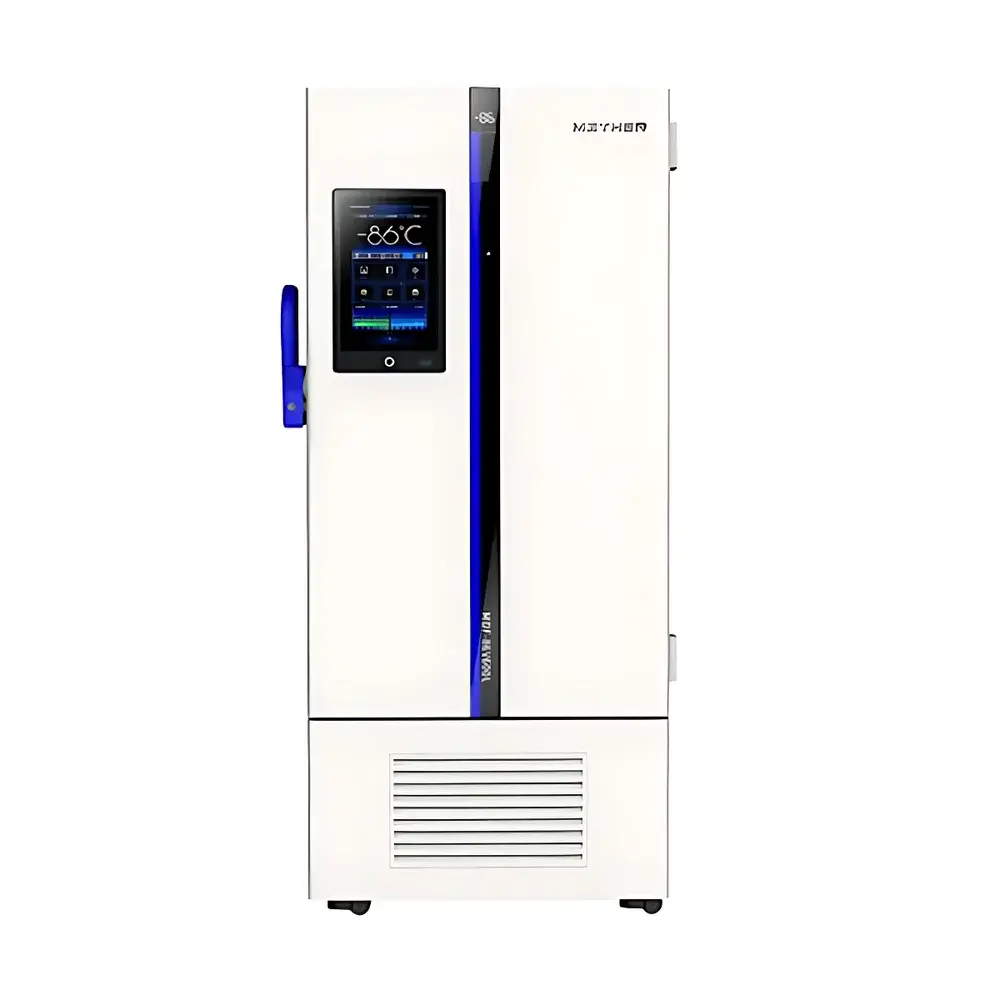
Duling MDF-86V600L Ultra-Low Temperature Freezer
| Brand | Duling |
|---|---|
| Origin | Anhui, China |
| Model | MDF-86V600L |
| Configuration | Upright |
| Effective Volume | 600 L |
| Internal Dimensions (W×D×H) | 606 × 740 × 1310 mm |
| External Dimensions (W×D×H) | 891 × 1155 × 1994.5 mm |
| Power Supply | 220 V / 50 Hz |
| Rated Power Consumption | 1500 W |
| Noise Level | 53 dB(A) |
| Exterior Material | Powder-Coated Steel |
| Interior Material | AISI 304 Stainless Steel |
| Insulation | CFC-Free High-Density Polyurethane Foam (100 mm) + Second-Generation VIP Panels (≥25 mm) |
| Door Configuration | 1 Outer Door (powder-coated steel), 2 Inner Doors (304 stainless steel) |
| Shelf System | 3 Adjustable 304 Stainless Steel Shelves with Calibrated Suspension Rails |
| Handle System | Integrated Single-Hand Outer Door Handle with Built-in Locking Mechanism and Optional Padlock Compatibility |
Overview
The Duling MDF-86V600L Ultra-Low Temperature Freezer is an upright, laboratory-grade cryogenic storage system engineered for long-term preservation of biological specimens—including primary cells, stem cell lines, tissue samples, serum, mRNA, and cryopreserved reagents—at sustained temperatures of –86 °C. Designed in accordance with ISO 13485-aligned manufacturing practices and validated for compliance with ICH guidelines for stability storage, the unit employs a dual-stage cascade refrigeration architecture with environmentally compliant refrigerants (R290/R170), eliminating ozone-depleting substances and reducing global warming potential (GWP). Its thermally optimized cabinet structure integrates 100 mm thick CFC-free polyurethane foam insulation combined with ≥25 mm second-generation Vacuum Insulation Panels (VIPs), achieving a net improvement of ~30% in thermal resistance compared to conventional ULT freezers of similar footprint—enabling higher energy efficiency and reduced external dimensions without compromising internal volume or temperature uniformity.
Key Features
- Stable –86 °C operating temperature with ±2 °C uniformity across all zones (per IEC 61000-4-2 validation protocol) and ≤0.5 °C short-term fluctuation under standard load conditions.
- Acoustically optimized mechanical design: noise level maintained at ≤53 dB(A) through strategic placement of vibration-damping elastomeric mounts on compressors, fans, and condenser assemblies, plus high-density fire-retardant acoustic insulation surrounding the entire refrigeration module.
- Corrosion-resistant interior constructed entirely from electropolished AISI 304 stainless steel—including inner doors, shelves, rails, and drip pans—ensuring compatibility with ethanol, isopropanol, and other common decontamination agents used in GLP/GMP environments.
- Intuitive human-centered access system: single-hand operable outer door handle with integrated key lock and padlock-ready shackle; two independently adjustable inner door handles with calibrated compression force control to maintain seal integrity across varying ambient humidity levels.
- Three-tier shelf system with precision-calibrated suspension rails (marked in 10-mm increments), supporting up to 25 kg per shelf while maintaining full vertical adjustability without tools.
Sample Compatibility & Compliance
The MDF-86V600L supports storage of vials (1.2–5.0 mL), cryoboxes (10×10 format), racks (e.g., Nunc™, Thermo Scientific™), and custom specimen containers compatible with ANSI/SLAS standards. Its temperature mapping profile meets ASTM F2697-22 requirements for ultra-low temperature freezer qualification. The unit’s data logging capability (via optional RS485/Modbus interface) supports 21 CFR Part 11-compliant audit trails when integrated with validated third-party monitoring platforms. All materials in direct contact with stored samples comply with USP <661.1> and ISO 10993-5 biocompatibility testing criteria. Electrical safety conforms to IEC 61010-1:2010 and EMC performance satisfies EN 61326-1:2013.
Software & Data Management
While the base configuration includes an embedded microprocessor controller with LED display (showing setpoint, actual temperature, alarm status, and compressor runtime), optional connectivity modules enable integration into centralized laboratory infrastructure. The RS485 port supports Modbus RTU protocol for real-time telemetry to building management systems (BMS) or enterprise-level cold chain monitoring software (e.g., TempTale®, Sensitech®, or custom LIMS). Optional Ethernet-enabled controllers provide TLS 1.2–secured web interface with configurable email/SMS alerts, historical trend export (CSV), and user-access-level permissions—facilitating adherence to ISO/IEC 17025 and CAP accreditation requirements.
Applications
This freezer serves critical roles in biobanking, clinical trial sample repositories, academic research laboratories, and pharmaceutical QC/QA workflows. It is routinely deployed for archiving PBMCs, induced pluripotent stem cells (iPSCs), viral vectors (AAV, lentivirus), genomic DNA libraries, and temperature-sensitive enzyme formulations. Its stable thermal environment ensures minimal ice recrystallization during prolonged storage—a key factor influencing post-thaw viability metrics reported in publications indexed in journals such as Nature Biotechnology and Cell Stem Cell. The compact external footprint (under 1.03 m² floor space) makes it suitable for modular lab layouts where spatial constraints limit adoption of larger cabinet formats.
FAQ
What is the minimum ambient temperature required for stable operation?
The unit is rated for continuous operation in ambient environments between 10 °C and 32 °C, with relative humidity ≤70% non-condensing.
Does the freezer support remote monitoring via cloud-based platforms?
Yes—when equipped with the optional Ethernet controller module, it supports secure HTTPS API access and integration with cloud-hosted environmental monitoring services.
Is the inner door gasket replaceable, and what is its service life under routine use?
The magnetic silicone gasket is field-replaceable and certified for ≥100,000 open/close cycles per ISO 14644-1 Class 5 cleanroom handling protocols.
Can this model be validated for GxP-regulated environments?
Yes—the freezer’s construction, documentation package (including IQ/OQ templates), and optional electronic log functionality support full qualification under FDA 21 CFR Part 11, EU Annex 11, and WHO TRS 961 guidelines.
What maintenance intervals are recommended for optimal performance?
Compressor oil inspection every 24 months; condenser coil cleaning every 6 months in standard lab environments; full thermal mapping and alarm verification annually per ISO/IEC 17025 Clause 5.9.




