
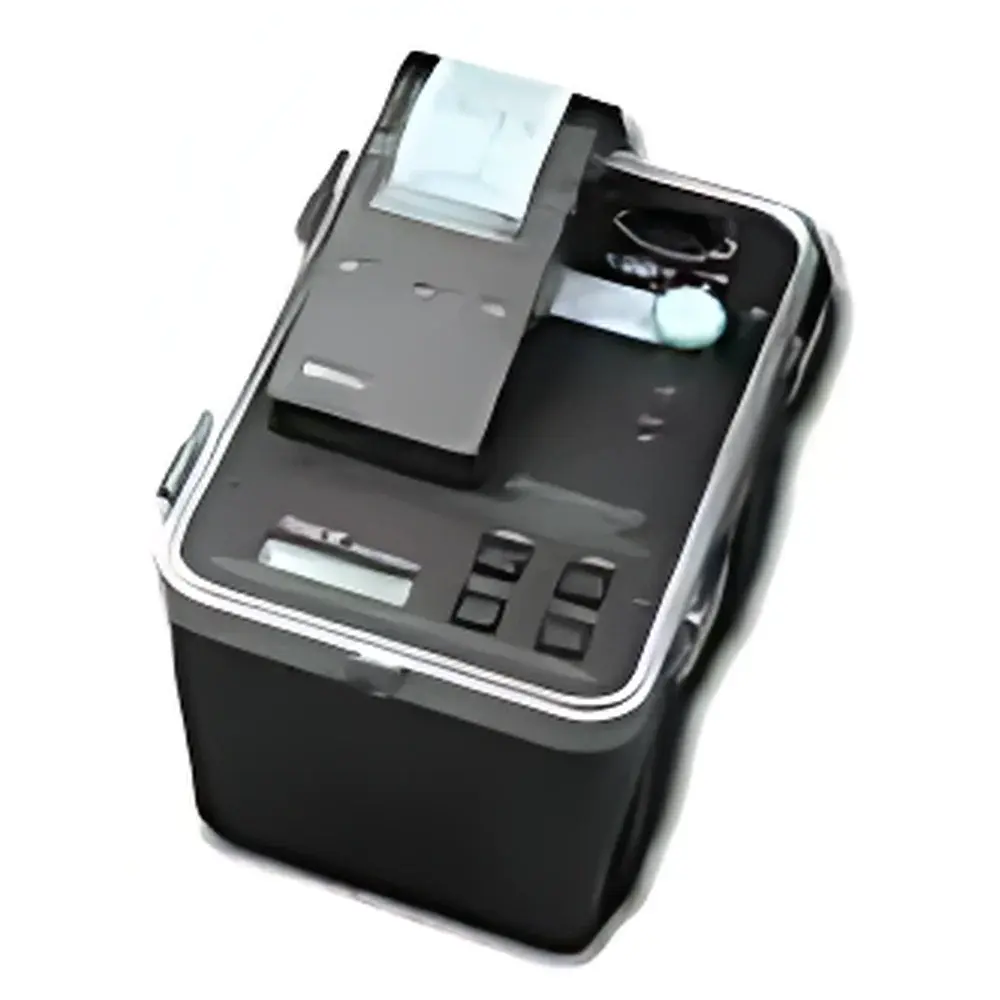
Durridge RAD7 Portable Radon Detector
| Origin | USA |
|---|---|
| Manufacturer Type | Authorized Distributor |
| Origin Category | Imported |
| Model | RAD7 |
| Sampling Method | Active Sampling |
| Detection Range | 3.7–74,000 Bq/m³ (0.1–20,000 pCi/L) |
| Minimum Detectable Concentration | 3.7 Bq/m³ (0.1 pCi/L) |
| Sensitivity | 12.8 counts/min per Bq/m³ (air monitoring mode) |
Overview
The Durridge RAD7 Portable Radon Detector is a field-deployable, solid-state alpha spectrometer engineered for high-precision, real-time radon-222 and thoron-220 measurement in air, soil gas, and water (with optional accessories). Unlike passive diffusion-based detectors, the RAD7 employs electrostatic collection of radon progeny followed by alpha-particle energy spectroscopy—enabling unambiguous discrimination between 218Po (6.00 MeV), 214Po (7.69 MeV), and 212Po (8.78 MeV) emissions. This spectral resolution eliminates interference from thoron decay chains and background radiation, delivering quantitative specificity required for EPA-compliant residential screening, occupational health assessments, geological surveys, and regulatory compliance audits. Its compact, ruggedized chassis—certified for continuous operation across temperature ranges of 5–40 °C and humidity up to 99.99% RH (non-condensing)—supports mission-critical deployment in mines, brownfield sites, basements, and outdoor soil-gas investigations.
Key Features
- Active sampling via integrated 1 L/min diaphragm pump with particulate inlet filter for consistent flow control and particle-free alpha detection
- Zero-background chamber design achieving a minimum detectable concentration of 0.1 pCi/L (3.7 Bq/m³) with statistical confidence
- Three operational modes: Continuous Radon Monitoring (CRM), Integrated Long-Term/Short-Term Measurement, and Sniffer Mode with detachable probe for source localization
- Rapid recovery kinetics: t1/2 = 3.05 min after high-exposure saturation; reaches ≤1% of peak signal within 30 minutes
- Onboard alpha spectrum display (histogram) for real-time validation of instrument performance and progeny identification
- Integrated rechargeable 6 V / 5 Ah battery supporting 24 hours in sniffer mode or 72 hours in standard monitoring mode
- Two-line alphanumeric LCD with audible count-rate feedback for radon and thoron—enabling hands-free hazard awareness during field sweeps
Sample Compatibility & Compliance
The RAD7 accommodates direct air sampling, soil-gas extraction via probe (using optional soil-gas kit), and aqueous radon analysis (with RAD H2O accessory and degassing module). All measurements adhere to ASTM D6915–22 (Standard Practice for Radon Testing in Soil Gas) and ISO 11665-2:2021 (Measurement of Radioactivity — Radon-222 — Part 2: Integrated Measurement Methods). The device’s spectral verification capability satisfies QA/QC requirements under U.S. EPA Protocol for Radon and Radon Decay Product Measurements (40 CFR Part 146), and its audit-trail-capable data logging supports GLP/GMP-aligned documentation workflows. No radioactive check sources are required—calibration is traceable to NIST-standard radon chambers.
Software & Data Management
Data export occurs via RS-232 serial interface or infrared link to HP 82240A printers (included). The RAD7 stores up to 1,000 time-stamped readings with associated statistics (min/max/mean/standard deviation) and full alpha spectra. Optional RAD7 Utility Software enables PC-based configuration, firmware updates, spectral analysis, and CSV export compliant with FDA 21 CFR Part 11 requirements—including electronic signature support and immutable audit logs. All measurement parameters—including flow rate, chamber temperature, humidity, and spectral fit residuals—are embedded in each data record for forensic traceability.
Applications
- Residential and commercial building radon screening per EPA Action Level (4 pCi/L), with statistically valid results achievable in ≤60 minutes
- Soil-gas radon mapping for uranium exploration, geotechnical risk assessment, and landfill cover integrity evaluation
- Occupational exposure monitoring in underground mining, nuclear facility maintenance, and radon spa environments
- Research-grade longitudinal studies requiring high temporal resolution and low-noise baseline stability
- Regulatory enforcement and third-party verification for real estate transactions and public health surveillance programs
FAQ
What is the principle of radon detection used in the RAD7?
The RAD7 uses electrostatic collection of positively charged radon progeny (218Po, 214Po) onto a silicon alpha detector, followed by pulse-height analysis to resolve individual alpha energies—distinguishing radon-222 from thoron-220 and background interferences.
Can the RAD7 measure radon in water?
Yes—when paired with the RAD H2O accessory kit, it performs aqueous radon analysis via liquid scintillation-equivalent degassing and subsequent air-phase detection.
Does the RAD7 require calibration with radioactive standards?
No. It is factory-calibrated using NIST-traceable radon reference chambers; routine verification is performed via built-in spectral diagnostics and known-source response checks.
How does the “Auto Mode” improve measurement reliability?
Auto Mode initiates sniffer-mode acquisition for rapid source localization, then automatically transitions to integrated CRM mode after 3 hours—eliminating manual timing errors while preserving statistical rigor.
Is the RAD7 suitable for outdoor or high-humidity environments?
Yes. Its sealed, conformally coated electronics and condensation-resistant thermal management enable stable operation at 0–99.99% RH and ambient temperatures from 5 °C to 40 °C.







