
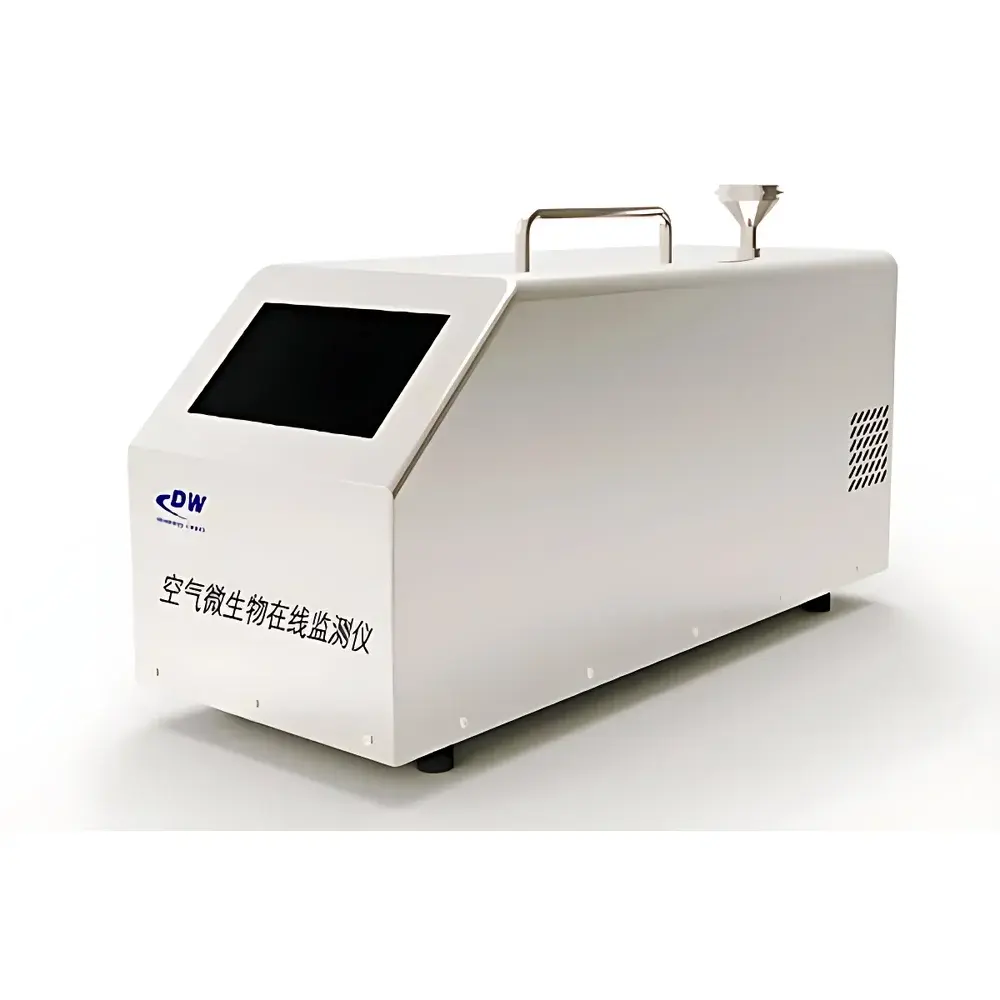
DW-Biolaser902 Airborne Microbial Online Monitor
| Brand | DW |
|---|---|
| Origin | Zhejiang, China |
| Manufacturer Type | Original Equipment Manufacturer (OEM) |
| Country of Origin | China |
| Model | DW-Biolaser902 |
| Pricing | Upon Request |
| Principle | Laser-Induced Autofluorescence + Mie Scattering |
| Particle Size Range | 0.5–10 µm |
| Detection Resolution | Single Bio-Particle |
| Sampling Flow Rate | ≥2 L/min |
| Excitation Wavelength | 405 nm Semiconductor Laser |
| Max Detection Rate | 5,000 bio-particles/sec |
| Measurement Cycle | 1 min (configurable) |
| Power Consumption | 12 W |
| Operating Temperature | 5–40 °C |
| Relative Humidity | <90% RH |
| Dimensions | 550 × 225 × 248 mm |
Overview
The DW-Biolaser902 Airborne Microbial Online Monitor is an optically based, real-time environmental monitoring system engineered for continuous, non-cultivation detection of viable airborne microorganisms—including bacteria, yeasts, molds, and spores—in critical controlled environments. Unlike conventional culture-based methods requiring 24–72 hours for colony formation, the DW-Biolaser902 employs dual-channel laser-induced autofluorescence (LIAF) combined with Mie scattering to discriminate biologically active particles from inert aerosols on a per-particle basis. This principle leverages endogenous fluorophores (e.g., NAD(P)H, riboflavin, and tryptophan) naturally present in metabolically active cells, which emit characteristic fluorescence upon 405 nm excitation. Simultaneously, the forward-scattered light signal provides aerodynamic diameter estimation within the 0.5–10 µm range—covering the respirable fraction relevant to pharmaceutical cleanrooms, aseptic processing suites, and high-containment biosafety facilities. Designed initially for defense-grade biological threat surveillance, the instrument has been adapted to meet stringent regulatory expectations in GMP-compliant pharmaceutical manufacturing, where rapid detection of microbial excursions supports timely intervention and data integrity requirements under FDA 21 CFR Part 11 and EU Annex 1.
Key Features
- Real-time, continuous monitoring without consumables: No filters, agar plates, or reagents required—eliminating batch-to-batch variability and operator-dependent handling errors.
- Single-particle resolution: Capable of detecting and classifying individual viable bioaerosol particles at concentrations as low as 1 CFU/m³ equivalent, enabling early warning of contamination events.
- Dual-signal discrimination architecture: Integrates one fluorescence channel (405 nm excitation, 450–700 nm emission) and one side-scatter channel to reject abiotic interferences (e.g., dust, skin flakes, fiber fragments) with high specificity.
- Configurable sampling parameters: Adjustable cycle time (default 60 s), flow rate (≥2 L/min standard; customizable up to 5 L/min), and particle size gating allow optimization for ISO Class 5–8 environments.
- Low-power design (12 W): Supports extended operation via external DC power or integrated lithium battery pack—ideal for mobile validation studies or temporary monitoring deployments.
- Rugged industrial enclosure: IP54-rated housing with thermal management ensures stable performance across ambient conditions of 5–40 °C and ≤90% RH.
Sample Compatibility & Compliance
The DW-Biolaser902 is validated for use in ISO 14644-1 classified cleanrooms, particularly those adhering to EU GMP Annex 1 (2022 revision) requirements for continuous environmental monitoring of Grade A/B zones. It detects native autofluorescence signatures from Gram-positive and Gram-negative bacteria, fungal conidia, and bacterial endospores—without reliance on exogenous dyes or substrate addition. The system complies with ASTM E2993-21 (“Standard Practice for Determination of Viable Airborne Microorganisms Using Laser-Induced Fluorescence”), and its measurement traceability aligns with ISO/IEC 17025 principles when operated within documented calibration and verification protocols. Data output meets ALCOA+ criteria (Attributable, Legible, Contemporaneous, Original, Accurate, Complete, Consistent, Enduring, Available) when paired with compliant software configurations.
Software & Data Management
The included BiolaserView™ desktop application provides real-time visualization of particle count trends, size distribution histograms, and fluorescence intensity scatter plots. All raw event data (timestamp, scatter amplitude, fluorescence integral, classification flag) are stored in vendor-neutral CSV and HDF5 formats. Audit trail functionality records user logins, parameter changes, and report generation events—supporting GLP/GMP compliance. Optional integration with MES/SCADA systems is available via Modbus TCP or OPC UA protocols. Software validation packages—including IQ/OQ documentation templates and electronic signature support per 21 CFR Part 11—are provided upon request.
Applications
- Continuous monitoring of Grade A laminar airflow hoods and isolators during aseptic filling operations.
- Rapid assessment of HVAC filtration efficiency and room requalification after maintenance.
- Environmental baseline establishment and trending for risk-based monitoring strategies.
- Investigation of microbial excursions linked to personnel activity, equipment operation, or material transfer events.
- Supporting process simulation studies (media fills) by quantifying real-time bioburden exposure levels.
- Biodefense and BSL-3/4 facility air screening for unauthorized biological agent release.
FAQ
Does the DW-Biolaser902 require daily calibration?
No routine daily calibration is required. The system performs automated optical self-checks at startup and every 24 hours. Annual factory recalibration against NIST-traceable reference aerosols is recommended.
Can it distinguish between live and dead microorganisms?
It detects metabolic activity via native fluorophore emission intensity and decay kinetics—correlating strongly with viability—but does not replace colony-forming unit (CFU) enumeration for regulatory release testing.
Is the instrument suitable for outdoor or uncontrolled environments?
It is optimized for indoor, temperature- and humidity-stabilized settings. Outdoor use is not advised due to uncontrolled particulate load and condensation risks.
How is data integrity ensured during network transmission?
All communications employ TLS 1.2 encryption; local storage includes SHA-256 checksums for each data file to prevent tampering or corruption.
What maintenance is required?
Annual cleaning of the inlet nozzle and optical windows using isopropyl alcohol and lint-free wipes; no internal user-serviceable components exist.





