
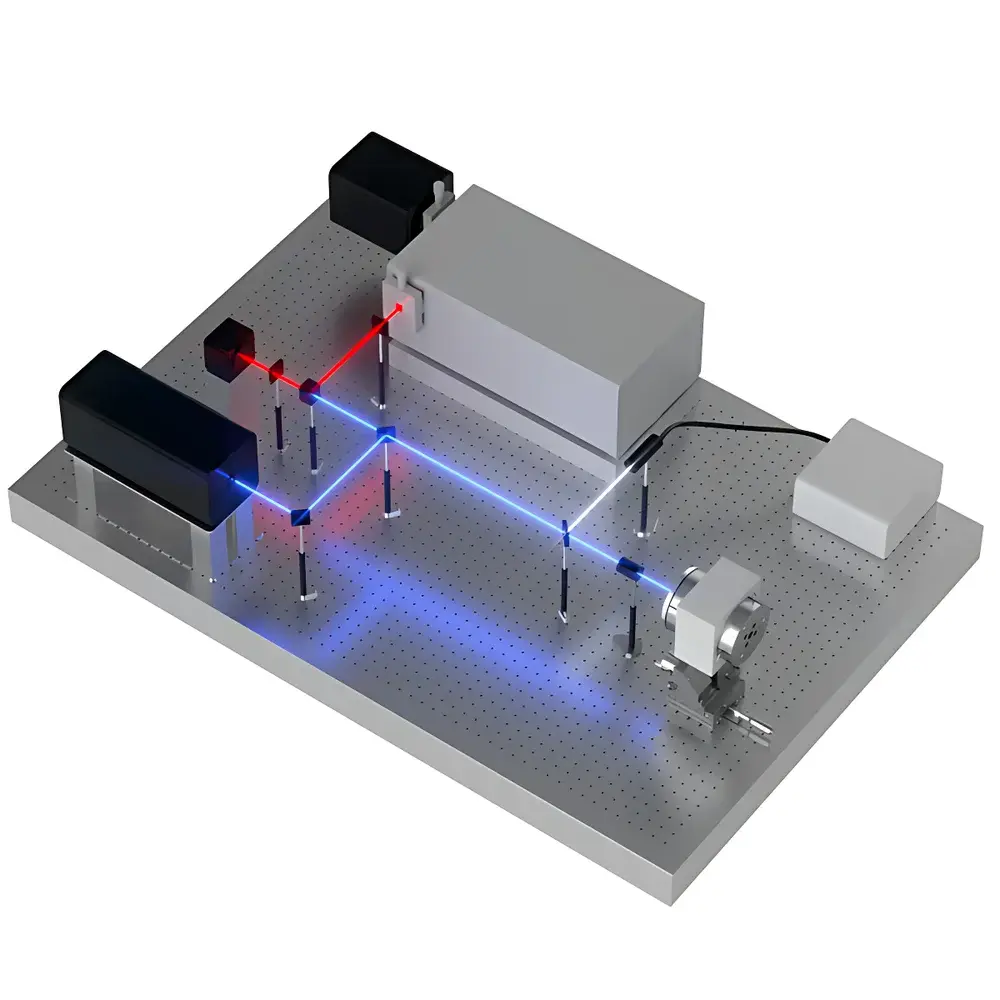
Dynamic Loading Resistance Measurement System
| Brand | GKInst |
|---|---|
| Origin | Anhui, China |
| Manufacturer Type | Authorized Distributor |
| Product Origin | Domestic (China) |
| Model | Custom-Engineered System |
| Pricing | Available Upon Request |
Overview
The Dynamic Loading Resistance Measurement System is a purpose-built experimental platform engineered to characterize the time-resolved electrical response of materials under controlled mechanical perturbation. Unlike conventional static or quasi-static resistivity measurement setups, this system integrates synchronized high-speed mechanical actuation with microsecond-level electrical metrology to probe non-equilibrium electronic behavior during transient deformation events. Its core operational principle relies on concurrent acquisition of contact-force–time profiles and four-terminal resistance waveforms, enabling direct correlation between stress evolution and charge transport dynamics. Designed specifically for integration with proprietary dynamic loading modules—including pneumatic-film actuators (for low-strain-rate, high-displacement applications) and piezoelectric stack drivers (for high-strain-rate, sub-millisecond loading)—the system supports fundamental studies in solid-state physics, metastable phase transformation kinetics, and shock-induced conductivity transitions.
Key Features
- Simultaneous dual-channel acquisition: Force/pressure transduction and four-wire resistance measurement with temporal synchronization accuracy < ±100 ns
- Ultra-high temporal resolution: Resistance sampling interval down to 2 µs (500 kHz effective bandwidth), supporting detection of transient conduction states during rapid lattice reorganization
- High-speed pressure waveform capture: Up to 4,000 frames per second via integrated piezoresistive or capacitive load cell digitization
- Modular actuator interface: Standardized mechanical and electrical coupling for pneumatic membrane drivers (strain rates: 10−3–101 s−1) and piezoelectric actuators (strain rates: 102–104 s−1)
- Optical integration port: C-mount and SM1-threaded interfaces for synchronization with high-speed imaging systems (e.g., Phantom v2512 or IDT Y4), enabling correlative analysis of microstructural evolution and resistivity dynamics
- Customizable signal conditioning: User-selectable excitation current ranges (10 µA–100 mA), programmable filtering (Bessel or elliptic), and galvanically isolated analog outputs compliant with IEEE 1149.4 boundary-scan standards
Sample Compatibility & Compliance
The system accommodates solid-state specimens in disk, foil, or thin-film geometries (diameter/thickness: 1 mm–25 mm / 10 nm–2 mm), including metallic alloys, intermetallic compounds, chalcogenides, and ceramic composites. Electrical contacts are implemented via spring-loaded tungsten carbide probes or lithographically defined Ti/Au pads to minimize contact resistance drift during dynamic loading. All hardware modules comply with IEC 61000-4 electromagnetic compatibility requirements and meet CE marking directives for laboratory instrumentation. Data acquisition firmware supports audit-trail logging and user-access control per GLP-compliant workflows; optional configuration available for 21 CFR Part 11 electronic signature readiness upon customer specification.
Software & Data Management
Control and analysis are performed using GKInst DynamicLab Suite—a modular, Python-based application framework built on Qt5 and NumPy/SciPy backends. The software provides real-time oscilloscope-style visualization of force–resistance cross-correlation, automated event-triggering based on thresholded strain rate or resistance jump magnitude, and batch processing for multi-run statistical analysis (e.g., Weibull distribution fitting of phase transition onset times). Raw data are stored in HDF5 format with embedded metadata (sample ID, actuator type, environmental conditions, calibration coefficients), ensuring FAIR (Findable, Accessible, Interoperable, Reusable) principles. Export options include MATLAB .mat, CSV with ISO 8601 timestamps, and MDF4 for integration with dSPACE or ETAS toolchains.
Applications
- Investigation of pressure-induced insulator-to-metal transitions in correlated electron systems (e.g., VO2, FeSe)
- Quantification of resistivity hysteresis during martensitic transformation in NiTi shape-memory alloys under cyclic loading
- Correlation of shear-band nucleation kinetics (via high-speed imaging) with localized resistivity anomalies in bulk metallic glasses
- In situ monitoring of electrochemical interface stability in solid-state battery anodes subjected to mechanical fatigue
- Calibration of constitutive models linking electrical conductivity tensors to deviatoric stress in polycrystalline ceramics
FAQ
Is the system compatible with third-party dynamic loading platforms?
Yes—mechanical mounting templates and electrical interface specifications (including TTL trigger lines, analog voltage output scaling, and CAN bus protocol documentation) are provided upon request for integration with non-GKInst actuators.
What is the minimum detectable resistance change under dynamic conditions?
Detection limit depends on sample geometry and excitation current; typical noise floor is 20 nΩ at 10 mA excitation with 2 µs sampling, corresponding to ~10−5 relative change for 1 mΩ baseline resistance.
Can the system operate under inert or controlled-atmosphere environments?
The base unit is designed for ambient lab use; vacuum-compatible or glovebox-integrated variants—including feedthrough-rated cabling and sealed probe stages—are available as custom configurations.
Does the software support automated compliance testing per ASTM E2658 or ISO 178?
While not pre-configured for standardized mechanical test protocols, the DynamicLab Suite includes scripting APIs to implement custom test sequences aligned with ASTM, ISO, or national standards upon user-defined parameter mapping.
What calibration services are offered?
NIST-traceable calibration of force sensors and resistance reference standards is available through GKInst’s certified metrology lab, with certificates issued per ISO/IEC 17025 requirements.
Related Products






