
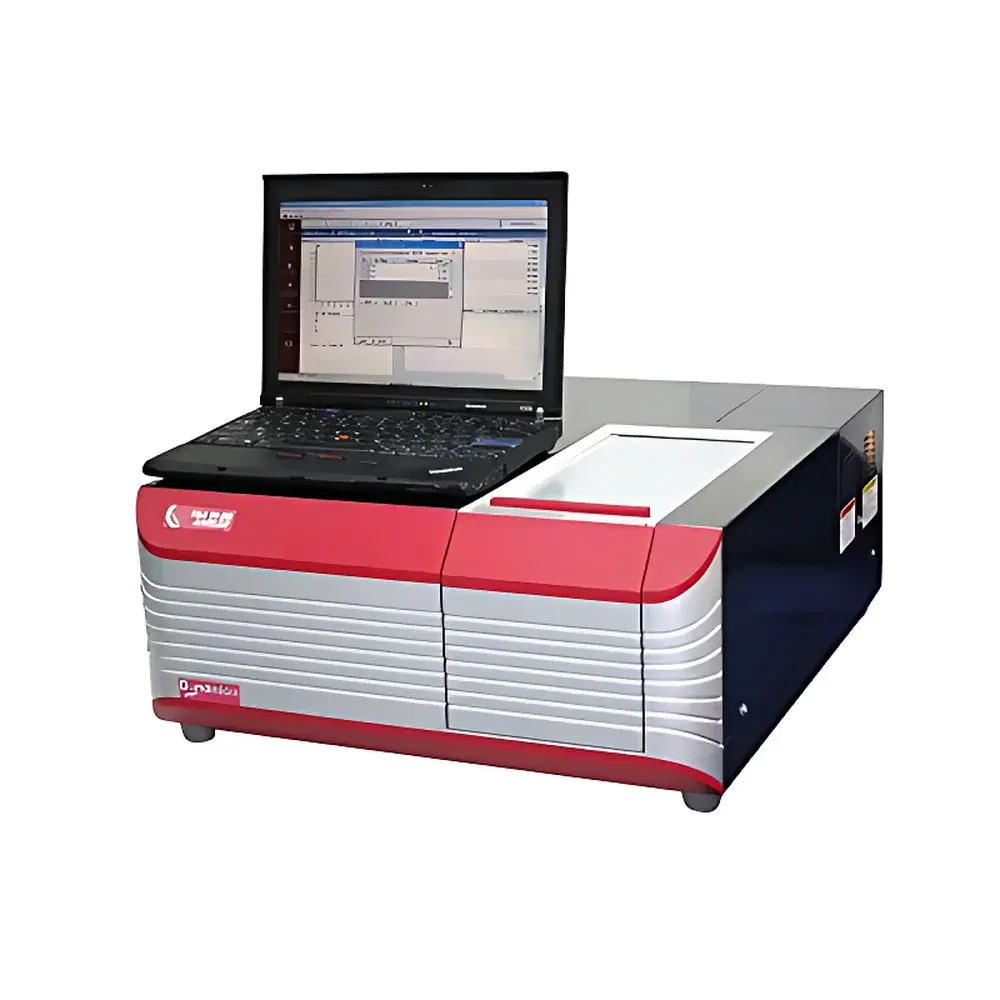
Dynamica DB20R Dual-Beam UV-Vis-NIR Spectrophotometer
| Brand | Dynamica |
|---|---|
| Origin | Australia |
| Model | DB20R |
| Optical Design | Dual-beam |
| Detector Type | Photodiode Array |
| Wavelength Range | 190–1100 nm |
| Spectral Bandwidth | 1.0 nm |
| Stray Light | ≤0.05% (at 220 nm with NaI, 340 nm with NaNO₂) |
| Wavelength Accuracy | ±0.3 nm |
| Absorbance Range | –3.0 to +3.0 A |
| Transmittance Range | 0–300% T |
| Concentration Range | 0.000–9.999 units |
| Scan Speeds | 10–3600 nm/min (8 selectable rates) |
| Baseline Stability | 0.0003 A/hr (500 nm, 2 h) |
| Noise Level | 0.0003 A (500 nm, RMS) |
| Light Sources | Deuterium Lamp + Tungsten-Halogen Lamp |
| Automatic Lamp Switching | 325–370 nm |
| Interface | PC-controlled (no built-in display) |
| Dimensions (W×D×H) | 505 × 705 × 225 mm |
| Net Weight | 29 kg |
| Power Supply | 110–220 V AC, 50/60 Hz |
Overview
The Dynamica DB20R is a high-performance dual-beam UV-Vis-NIR spectrophotometer engineered for precision quantitative and qualitative analysis across pharmaceutical, academic, and industrial laboratories. Its optical architecture employs a concave holographic diffraction grating coupled with a true real-time dual-beam design—where sample and reference beams are measured simultaneously using two independent photodiode array detectors. This configuration eliminates time-dependent drift and ensures exceptional photometric stability during kinetic studies, spectral scanning, or multi-sample batch analysis. The instrument covers the full ultraviolet through visible spectrum (190–1100 nm), enabling reliable characterization of organic chromophores, transition metal complexes, nucleic acids, proteins, and nanomaterials. With a fixed spectral bandwidth of 1.0 nm and wavelength accuracy of ±0.3 nm, the DB20R meets the instrumental performance criteria defined in key pharmacopoeial standards—including the European Pharmacopoeia (Ph. Eur.) General Chapter 2.2.25—and supports method validation under GLP and GMP frameworks.
Key Features
- True real-time dual-beam optics with synchronized sample/reference detection for minimized baseline drift and enhanced reproducibility
- Concave holographic grating monochromator delivering high optical throughput and low aberration across 190–1100 nm
- Automated deuterium/tungsten-halogen lamp switching at 325–370 nm, ensuring optimal signal-to-noise ratio across UV and Vis ranges
- Photodiode array detector with rapid acquisition capability and <0.0003 A RMS noise at 500 nm
- Eight programmable scan speeds (10–3600 nm/min) supporting both high-resolution spectral profiling and rapid screening applications
- Integrated UV Detective software suite with pre-validated methods for nucleic acid quantification (A260/A280, A260/A230), protein assays (Bradford, BCA, Lowry), enzyme kinetics, and custom calibration curves
- Compliance-ready architecture: supports audit trails, user access control, electronic signatures, and data integrity features aligned with FDA 21 CFR Part 11 requirements when deployed with validated software configurations
Sample Compatibility & Compliance
The DB20R accommodates standard 10-mm pathlength cuvettes as well as optional accessories including micro-volume cell holders (down to 0.5 µL), temperature-controlled Peltier cells, and fiber-optic probes for remote or in-situ measurements. Its optical design satisfies the essential performance parameters outlined in Ph. Eur. 2.2.25 for UV-Vis spectrophotometers used in pharmaceutical quality control—including stray light limits (≤0.05% at specified wavelengths), wavelength accuracy, and photometric linearity. Instrument qualification documentation (IQ/OQ/PQ protocols) is available upon request, and the system supports routine verification using NIST-traceable holmium oxide and didymium filters. All firmware and software updates are version-controlled and documented per ISO/IEC 17025 and ASTM E2500 guidelines.
Software & Data Management
UV Detective software serves as the native control and analysis platform for the DB20R. It operates exclusively via Windows-based PCs and provides intuitive workflows for method development, data acquisition, post-processing, and report generation. The software includes embedded templates compliant with USP , EP 2.2.25, and ISO 6425 for absorbance ratio calculations, purity assessment, and concentration determination. Raw spectral data are stored in vendor-neutral ASCII formats (.csv, .txt) alongside metadata-rich .uvd files supporting long-term archival and third-party interoperability. Audit trail functionality logs all user actions—including parameter changes, measurement executions, and file exports—with timestamps and operator IDs. Data export modules integrate directly with LIMS platforms via ODBC or HL7-compatible interfaces.
Applications
The DB20R is routinely deployed in QC laboratories for raw material identification, assay validation, dissolution testing, and stability-indicating assays. In research settings, it supports ligand-binding studies, redox reaction monitoring, polymer degradation kinetics, and nanoparticle size estimation via surface plasmon resonance shifts. Its broad dynamic range (–3.0 to +3.0 A) enables accurate measurement of highly concentrated biological samples without dilution, while low-noise detection facilitates trace-level impurity analysis in small-molecule APIs. The instrument is also utilized in environmental labs for COD and nitrate/nitrite quantification, and in food science for pigment profiling and antioxidant capacity evaluation (e.g., FRAP, DPPH assays).
FAQ
Does the DB20R support regulatory compliance for pharmaceutical testing?
Yes—the optical performance, software audit trail, and method validation tools align with Ph. Eur. 2.2.25, USP , and FDA 21 CFR Part 11 when configured with appropriate SOPs and change control procedures.
Is the instrument capable of measuring beyond 1100 nm?
No—the DB20R is optimized for 190–1100 nm; extension into NIR (up to 2600 nm) is not supported by this model. For NIR applications, Dynamica offers complementary FT-NIR systems.
Can the DB20R operate without a connected PC?
No—it lacks an integrated display or standalone interface and requires continuous connection to a Windows PC running UV Detective software.
What verification standards are recommended for routine performance checks?
Holmium oxide (for wavelength accuracy), potassium dichromate (for photometric accuracy), and neutral density filters (for linearity verification) are recommended per Ph. Eur. 2.2.25 Annex.
How is lamp lifetime managed and monitored?
UV Detective software tracks cumulative lamp operating hours and displays warnings prior to end-of-life thresholds; automatic lamp switching logic minimizes unnecessary deuterium lamp usage during visible-range scans.






