
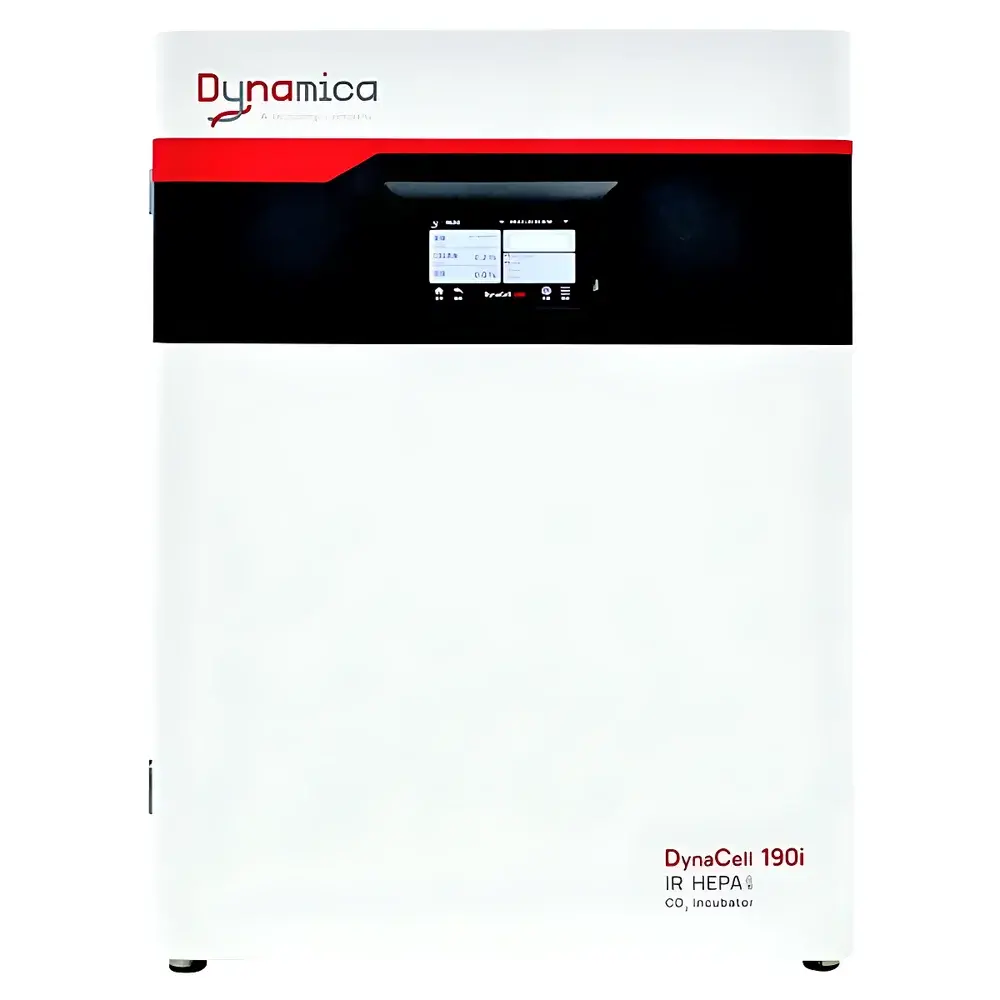
Dynamica DynaCell190i CO₂ Incubator
| Brand | Dynamica |
|---|---|
| Origin | Shanghai, China |
| Manufacturer Type | Authorized Distributor |
| Country of Origin | China |
| Model | DynaCell190i |
| Price Range | USD 7,800–10,000 (FOB) |
| Instrument Type | Air-jacketed CO₂ Incubator |
| CO₂ Detection | Infrared (IR) Sensor |
| Temperature Control Range & Accuracy | Ambient +5°C to 50°C, ±0.1°C (at setpoint) |
| Temperature Uniformity | ±0.3°C at 37°C |
| CO₂ Concentration Control Range & Accuracy | 0–20% vol., ±0.1% (full scale) |
| Humidity Control Range & Accuracy | 20–95% RH, ±3% RH (measured at 37°C, 5% CO₂) |
| Chamber Capacity | 190 L |
| External Dimensions (W×D×H) | 720 × 694.5 × 890 mm |
| Standard Configuration | Dual-stage HEPA filtration (0.3 µm, ≥99.97% efficiency), Dual sterilization protocol (180°C dry-heat bake-out, 90°C moist-heat cycle) |
Overview
The Dynamica DynaCell190i is an air-jacketed CO₂ incubator engineered for precision cell culture applications in academic research laboratories, biopharmaceutical QC facilities, and clinical diagnostic environments. It employs a robust thermal management architecture—featuring independent air-jacket heating zones and PID-controlled fan-assisted convection—to maintain stable, uniform thermal conditions across the entire 190 L working chamber. CO₂ concentration is continuously monitored and regulated via a non-dispersive infrared (NDIR) sensor with automatic zero-point compensation, ensuring long-term stability and minimal drift over extended operation cycles. Relative humidity is actively maintained using a stainless-steel water reservoir with integrated ultrasonic humidification and real-time feedback control, minimizing condensation while sustaining physiological moisture levels essential for monolayer and suspension cultures. The system operates within a validated environmental envelope: temperature range from ambient +5°C to 50°C, CO₂ from 0 to 20% (v/v), and RH from 20% to 95%, all traceable to NIST-traceable reference standards.
Key Features
- Air-jacketed thermal design with dual-zone independent heating elements for rapid recovery (<6 min to re-stabilize after 30-sec door opening at 37°C/5% CO₂)
- Infrared CO₂ sensor with auto-calibration and built-in pressure compensation, compliant with ISO 13485 and ASTM E1918-22 requirements for gas monitoring accuracy
- Dual sterilization capability: programmable 180°C dry-heat bake-out (for complete decontamination of sensors and internal surfaces) and 90°C moist-heat cycle (validated per EN 1422:2012 for microbial reduction ≥6-log)
- Class II A2-certified HEPA filtration system (0.3 µm, ≥99.97% efficiency) with pre-filter and recirculation path, meeting ISO 14644-1 Class 5 cleanroom performance criteria inside the chamber
- Touchscreen HMI with multi-level access control (operator, supervisor, administrator), audit trail logging, and configurable alarm thresholds (audible/visual/email/SNMP)
- Stainless-steel interior (304 grade) with seamless welded corners and rounded edges to prevent microbial retention and facilitate cleaning validation
Sample Compatibility & Compliance
The DynaCell190i supports standard T-flasks (up to T225), multi-well plates (6–384-well), Petri dishes, roller bottles, and bioreactor vessels up to 5 L volume. Its chamber geometry and airflow profile have been verified for uniform distribution of heat, CO₂, and humidity under load conditions (per ISO 13408-1 Annex C). The system complies with IEC 61010-1:2010 (safety), IEC 61326-1:2021 (EMC), and meets essential requirements for GLP/GMP-aligned operations—including 21 CFR Part 11-compliant electronic records when paired with optional software modules. All sterilization cycles are documented with time-stamped logs, including temperature ramp rates, dwell times, and cooling profiles, supporting FDA audit readiness.
Software & Data Management
The incubator integrates with Dynamica’s optional LabLink™ Connect platform—a secure, browser-based data acquisition and remote monitoring suite. LabLink™ provides real-time telemetry streaming (temperature, CO₂, RH, door status, alarm history), configurable email/SMS alerts, and encrypted local database storage (SQLite with AES-256 encryption). Data export supports CSV, PDF, and XML formats compliant with LIMS integration protocols (HL7, ASTM E1384). Audit trails record user actions, parameter changes, and event timestamps with immutable digital signatures—fully aligned with ALCOA+ principles (Attributable, Legible, Contemporaneous, Original, Accurate, Complete, Consistent, Enduring, Available).
Applications
- Mammalian cell line expansion for monoclonal antibody production (e.g., CHO, HEK293, Vero)
- Primary human tissue explant culture and organoid development under controlled hypoxic or normoxic CO₂ setpoints
- Stem cell maintenance (pluripotent and mesenchymal) requiring stringent humidity stability and low VOC emission
- In vitro fertilization (IVF) embryo culture workflows where transient pH shifts must be minimized via precise CO₂ buffering
- Microbiology applications involving fastidious CO₂-dependent organisms (e.g., Neisseria gonorrhoeae, Campylobacter jejuni)
- Regulatory stability studies per ICH Q5C guidelines, including forced degradation and shelf-life modeling
FAQ
What CO₂ sensor technology does the DynaCell190i use, and how often does it require calibration?
It uses a factory-calibrated NDIR infrared sensor with automatic baseline correction; no user calibration is required during routine operation. Annual verification against certified gas standards is recommended per ISO/IEC 17025.
Is the humidification system resistant to mineral buildup when using tap water?
The ultrasonic humidifier includes an integrated descaling mode and is designed for use with deionized or distilled water only; tap water is not supported to preserve sensor integrity and prevent chamber contamination.
Can the incubator be integrated into a centralized laboratory building management system (BMS)?
Yes—via Modbus TCP or BACnet/IP communication protocols (optional interface module), enabling real-time status reporting and alarm forwarding to facility-wide SCADA platforms.
Does the 180°C dry-heat cycle affect the IR CO₂ sensor lifespan?
No—the sensor is thermally isolated and automatically powered down during bake-out cycles; its operational lifetime remains unaffected by routine sterilization procedures.




