
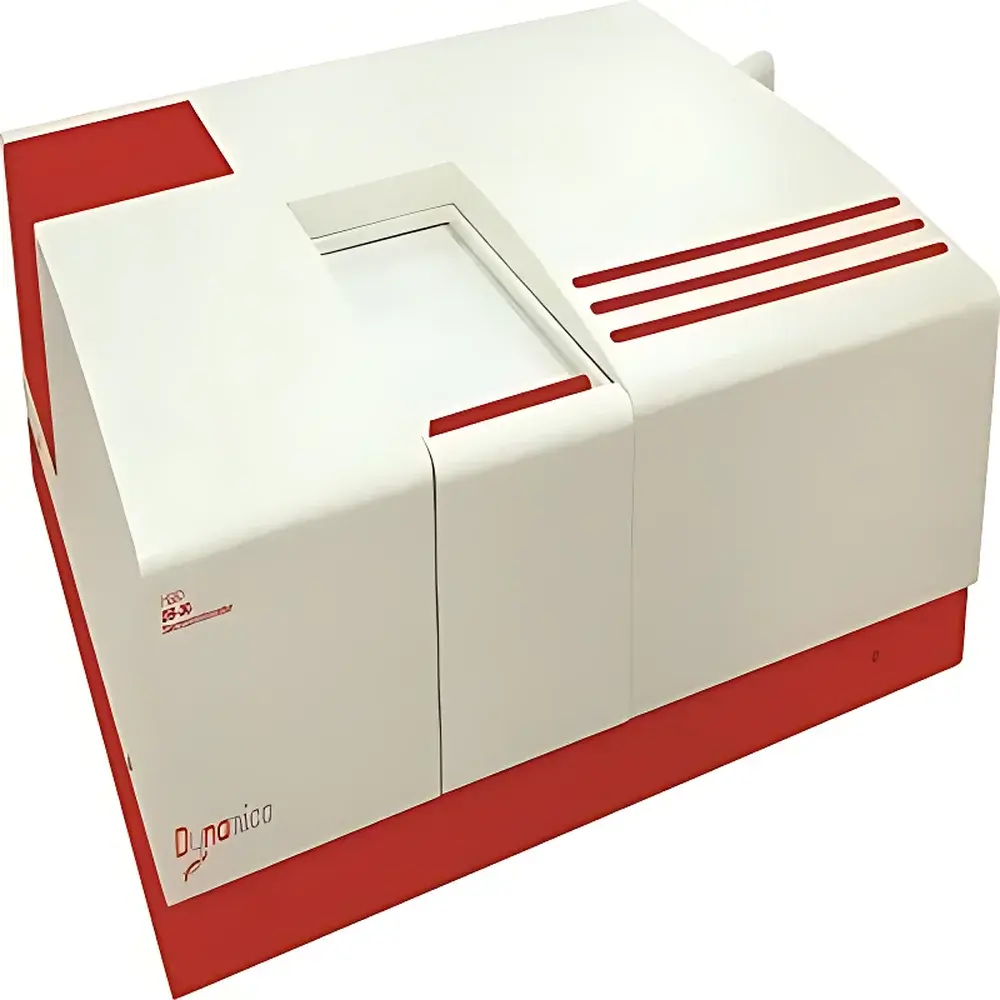
Dynamica HALO DB-30 Dual-Beam UV-Vis Spectrophotometer
| Brand | Dynamica |
|---|---|
| Origin | Australia |
| Model | DB-30 |
| Wavelength Range | 190–900 nm |
| Spectral Bandwidth | 0.1–5.0 nm (6 selectable slits) |
| Stray Light | ≤0.01%T (220 nm NaI, 340 nm NaNO₂) |
| Wavelength Accuracy | ±0.3 nm |
| Photometric Accuracy | ±0.002 Abs (0–0.5 Abs, NIST 900D) |
| Photometric Repeatability | ±0.001 Abs (0–0.5 Abs, NIST 930D) |
| Baseline Flatness | ±0.001 Abs (200–850 nm) |
| Baseline Stability | 0.0004 Abs/hr (500 nm, after 2 hr) |
| Noise Level | ±0.0003 Abs (500 nm) |
| Scan Speeds | 1–2,000 nm/min (8 selectable rates) |
| Light Sources | Tungsten-halogen & Deuterium lamps with automatic switching (325–370 nm) |
| Detector | Photomultiplier tube (PMT) |
| Control OS | Windows XP or Windows 7 Pro |
| Dimensions | 710 × 630 × 268 mm (W×D×H) |
| Net Weight | 50 kg |
| Power | 110–220 V AC, 50/60 Hz, 300 VA |
Overview
The Dynamica HALO DB-30 is a high-performance dual-beam ultraviolet-visible (UV-Vis) spectrophotometer engineered for precision quantitative and qualitative analysis in regulated and research-intensive laboratory environments. Its optical architecture employs a concave holographic diffraction grating and a true dual-beam, dual-detector configuration—enabling real-time reference beam compensation to eliminate source drift, thermal fluctuation, and electronic noise effects. This design ensures exceptional photometric stability and reproducibility across extended measurement sessions. The instrument operates over a broad spectral range of 190–900 nm, covering deep-UV absorbance of nucleic acids and aromatic compounds, through visible-region quantification of dyes and transition-metal complexes, to near-IR applications including polymer characterization and colloidal stability assessment. The inclusion of a long-focal-length grating and optimized optical path delivers high photon throughput and reduced stray light—quantified at ≤0.01%T (per ASTM E387 and ISO 9022-10), a critical specification for low-absorbance measurements and high-dynamic-range assays.
Key Features
- True dual-beam optics with independent PMT detectors for simultaneous sample and reference monitoring—minimizing baseline drift and enabling high-accuracy kinetic and time-resolved studies.
- Concave holographic diffraction grating with six programmable slit widths (0.1, 0.2, 0.5, 1.0, 2.0, and 5.0 nm), allowing resolution optimization from high-sensitivity screening to narrow-band spectral deconvolution.
- Automated lamp switching between deuterium (190–370 nm) and tungsten-halogen (325–900 nm) sources within the 325–370 nm overlap region—ensuring seamless spectral continuity and extended lamp lifetime.
- UV Detective™ software suite compliant with GLP/GMP workflows: supports audit trails, user access levels, electronic signatures (in alignment with FDA 21 CFR Part 11 requirements), method validation templates, and IQ/OQ documentation support.
- Thermally stabilized optical bench and precision wavelength drive mechanism deliver ±0.3 nm wavelength accuracy and 0.01 nm wavelength increment resolution—meeting ISO 8579-1 and USP specifications for spectrophotometric system suitability.
- Low-noise photomultiplier detection system achieving ±0.0003 Abs RMS noise at 500 nm and baseline stability of 0.0004 Abs/hr—enabling reliable measurement of sub-millimolar concentrations and trace impurity detection.
Sample Compatibility & Compliance
The HALO DB-30 accommodates standard 10 mm rectangular cuvettes (quartz, glass, or plastic), microvolume adapters (down to 1 µL pathlength), and optional fiber-optic probes for in situ or flow-cell applications. It supports both single-beam and dual-beam acquisition modes, facilitating compatibility with non-standard sample formats requiring external referencing. The instrument conforms to international standards including ISO/IEC 17025 for testing laboratories, ASTM E275 (spectrophotometer performance verification), and ICH Q2(R2) guidelines for analytical method validation. Built-in validation routines—covering wavelength accuracy (using holmium oxide and didymium filters), photometric linearity (NIST-traceable 900D and 930D filters), and stray light assessment—enable full compliance with pharmaceutical QC protocols and academic instrumentation calibration requirements.
Software & Data Management
UV Detective™ is a native Windows-based application supporting Windows XP and Windows 7 Pro platforms. It provides comprehensive control over scanning parameters, kinetic acquisition, multi-wavelength quantitation, and spectral derivative analysis. Data export is supported in CSV, ASCII, and JCAMP-DX formats for integration with LIMS, ELN, and statistical analysis platforms (e.g., JMP, OriginLab). All instrument actions—including method execution, parameter changes, and calibration events—are logged with timestamps, operator IDs, and digital signatures. Audit trail functionality meets ALCOA+ principles (Attributable, Legible, Contemporaneous, Original, Accurate, Complete, Consistent, Enduring, Available), ensuring readiness for regulatory inspections under FDA, EMA, or PMDA frameworks.
Applications
- Pharmaceutical QC: Assay of active pharmaceutical ingredients (APIs), dissolution testing, excipient compatibility studies, and cleaning validation via residual solvent analysis.
- Life sciences: DNA/RNA quantification (A260/A280 ratios), protein concentration determination (Bradford, BCA, Lowry), enzyme kinetics (NADH/NADPH monitoring at 340 nm), and cell culture density estimation.
- Environmental analysis: Nitrate/nitrite quantification (EPA 353.2), phosphate detection (ascorbic acid method), and heavy metal complexation studies (e.g., Fe²⁺/1,10-phenanthroline).
- Materials science: Bandgap estimation of semiconductors, thin-film thickness calculation via interference fringes, and nanoparticle size distribution modeling using Mie theory.
- Food & beverage: Colorimetric assessment of anthocyanins, carotenoids, and chlorophyll; preservative (sulfite, nitrite) quantification; and authenticity verification via spectral fingerprinting.
FAQ
What regulatory standards does the HALO DB-30 support for pharmaceutical use?
It supports FDA 21 CFR Part 11, USP , ICH Q2(R2), and EU Annex 11 requirements through its validated UV Detective™ software, audit trail, and integrated system suitability testing protocols.
Can the instrument perform kinetic measurements with variable time intervals?
Yes—UV Detective™ allows user-defined time points, fixed-interval acquisition, or trigger-based sampling synchronized with external devices (e.g., reaction injectors or temperature controllers).
Is the 0.1 nm spectral bandwidth verified and traceable?
Yes—the narrowest slit setting is calibrated using mercury and holmium oxide emission lines per ISO 14785 and verified annually with NIST-traceable line sources.
Does the DB-30 support automated method transfer between instruments?
Method files (.uvd) are portable across HALO-series instruments; spectral data retain full metadata, including instrument ID, calibration date, and operator credentials.
What maintenance is required to sustain photometric accuracy?
Annual performance qualification (PQ) is recommended, including wavelength calibration, stray light verification, photometric linearity check, and lamp energy profiling—documented via built-in validation reports.




