
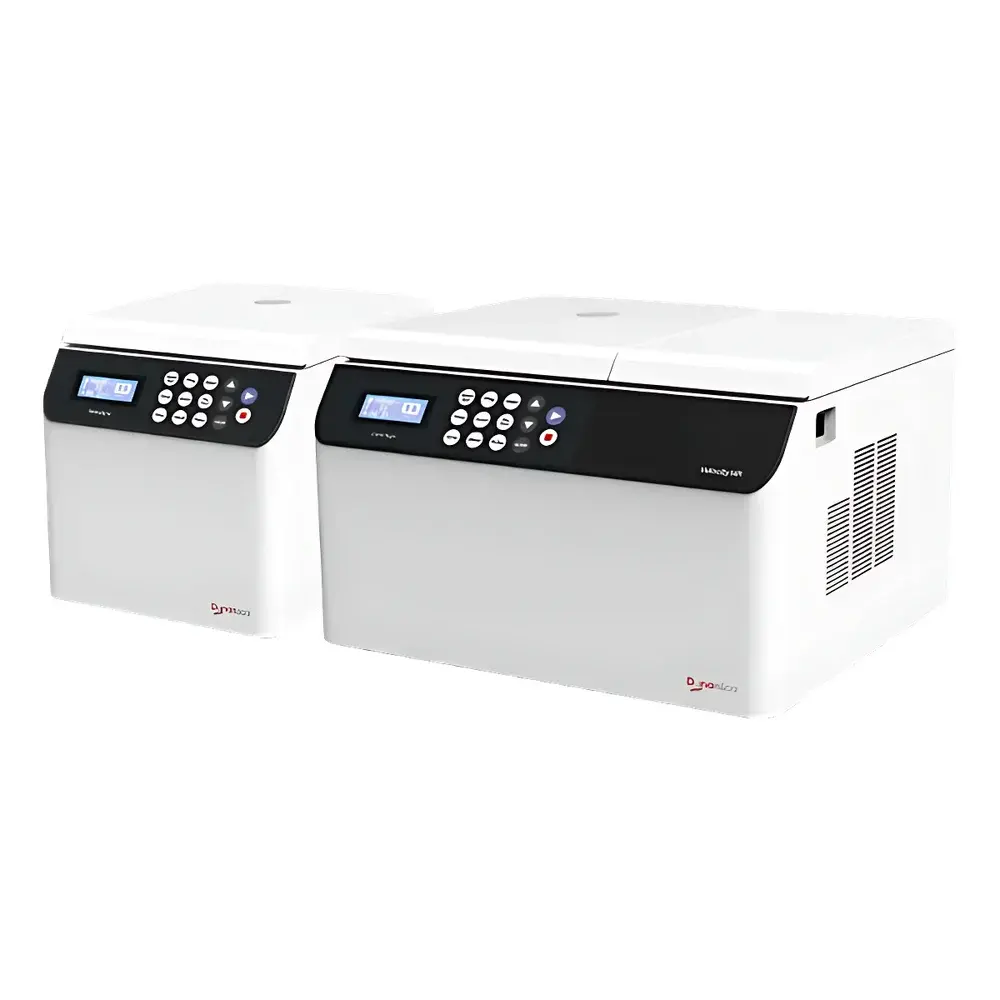
Dynamica VELOCITY 14/14R Pro Benchtop Centrifuge
| Brand | Dynamica |
|---|---|
| Model | VELOCITY 14/14R Pro |
| Type | Refrigerated Benchtop Centrifuge |
| Max Speed | 14,000 rpm |
| Max RCF | 21,780 × g |
| Max Capacity | 6 × 50 mL |
| Temperature Range | –20 °C to +40 °C |
| Acceleration/Deceleration | 9-step programmable |
| Unbalance Detection | Non-contact electronic |
| Rotor Recognition | Automatic |
| Drive | Brushless Induction Motor |
| Noise Level | <58 dB(A) (14R), <53 dB(A) (V14) |
| Dimensions (W×D×H) | 560 × 500 × 380 mm (14R), 340 × 490 × 380 mm (V14) |
| Net Weight | 60 kg (14R), 40 kg (V14) |
| Power Supply | AC 220 V, 50/60 Hz, 10 A (14R), 8 A (V14) |
Overview
The Dynamica VELOCITY 14/14R Pro is a high-performance refrigerated benchtop centrifuge engineered for precision, safety, and operational efficiency in demanding laboratory environments. Designed around the principles of rotor dynamics and thermal management, it employs a brushless induction motor to deliver stable rotational control across its full speed range (300–14,000 rpm), enabling reproducible separation of biological samples—including mammalian cells, bacterial pellets, subcellular organelles, and nucleic acid complexes—under precisely regulated temperature conditions. The 14R variant integrates active refrigeration with pre-cool functionality and real-time rotor temperature monitoring, ensuring sample integrity during prolonged or heat-sensitive protocols. Its compact footprint and dual-chamber-compatible architecture make it suitable for shared core facilities, QC laboratories, and academic research settings where space, reliability, and regulatory traceability are critical.
Key Features
- Brushless induction motor with zero maintenance requirements and extended service life—eliminates carbon dust contamination and ensures consistent torque delivery across all speeds.
- Automatic rotor recognition system prevents misconfiguration and enforces speed/RCF limits based on detected rotor geometry and maximum rated parameters.
- Non-contact unbalance detection continuously monitors mass distribution during acceleration, deceleration, and steady-state operation—triggering immediate shutdown if threshold deviation exceeds ISO 15837-compliant tolerance levels.
- Dual electronic lid lock mechanism with mechanical interlock provides redundant safety assurance; centrifuge cannot start unless lid is fully closed and sealed, and will not open until rotor has fully stopped and brake sequence completed.
- Programmable 9-step acceleration and deceleration profiles allow optimization of pelleting efficiency and sample integrity—especially critical for fragile vesicles, exosomes, or lysosomal fractions.
- Pre-cool function rapidly equilibrates chamber and rotor to setpoint prior to run initiation—reducing thermal lag and improving reproducibility in temperature-critical applications such as RNA isolation or enzyme activity assays.
- Backlit LCD display presents real-time values for speed, RCF, time remaining, elapsed time, temperature (14R only), and error codes—with intuitive navigation via membrane keypad and tactile feedback.
Sample Compatibility & Compliance
The VELOCITY 14/14R Pro supports standard angle rotors compatible with common tube formats including 0.2–50 mL conical, round-bottom, and PCR tubes. It is validated for use with polycarbonate and polypropylene centrifuge vessels meeting ISO 7218 and ASTM D4169 standards. The instrument complies with IEC 61010-1:2010 (Safety Requirements for Electrical Equipment for Measurement, Control, and Laboratory Use) and IEC 61326-1:2012 (EMC for Laboratory Equipment). Its firmware architecture supports audit trail generation and user-access logging, facilitating alignment with GLP and GMP documentation practices. While not FDA 21 CFR Part 11–certified out-of-the-box, the system’s password-protected parameter locking and non-erasable event logs provide foundational capabilities for validation under internal SOPs.
Software & Data Management
The centrifuge operates via embedded microprocessor control without external PC dependency. All method parameters—including speed, time, temperature (14R), acceleration/deceleration ramps, hold-on-complete, and rotor ID—are stored in non-volatile memory with timestamped execution history (last 100 runs). Export of run logs is supported via USB port (device class: CDC ACM) using plain-text CSV format for integration into LIMS or ELN systems. Firmware updates are performed via USB stick using signed binary packages to ensure integrity and prevent unauthorized modification. No cloud connectivity or remote access features are implemented—maintaining data sovereignty and network security in regulated environments.
Applications
- Cell culture harvest and bacterial pellet concentration (E. coli, yeast, mammalian suspension cells)
- Clarification of cell lysates prior to chromatography or electrophoresis
- Isolation of mitochondria, nuclei, and microsomal fractions via differential centrifugation
- Routine plasmid DNA and total RNA purification workflows requiring cold processing
- Preparative centrifugation of nanoparticles, liposomes, and extracellular vesicles
- Quality control testing in pharmaceutical manufacturing (e.g., particulate matter analysis per USP )
- Environmental microbiology—sedimentation of waterborne pathogens and biofilm fragments
FAQ
What is the difference between the V14 and 14R models?
The V14 is a non-refrigerated version optimized for ambient-temperature applications with lower power draw and reduced acoustic emission (<53 dB[A]). The 14R adds compressor-based cooling, pre-cool capability, real-time rotor temperature sensing, and expanded operating range (–20 °C to +40 °C), making it suitable for thermolabile samples.
Can the centrifuge be validated for GMP use?
Yes—the device supports IQ/OQ documentation through configurable test protocols, built-in calibration verification routines (speed and temperature), and immutable event logging. Full PQ requires site-specific risk assessment and integration with facility utilities (e.g., chilled water supply for 14R condenser heat rejection).
Is rotor autoclaving supported?
Aluminum and titanium rotors are compatible with standard steam autoclaving (121 °C, 15 psi, 20 min); however, repeated sterilization may affect anodized surface integrity. Polycarbonate buckets require chemical disinfection only (e.g., 70% ethanol or 0.5% sodium hypochlorite).
How does the unbalance detection system respond during operation?
Upon detecting >5 g mass asymmetry at ≥8,000 rpm, the system initiates controlled deceleration within 2 seconds and halts rotation completely before opening the lid lock. Error code “UB-01” is displayed and logged with timestamp and estimated imbalance magnitude.



