
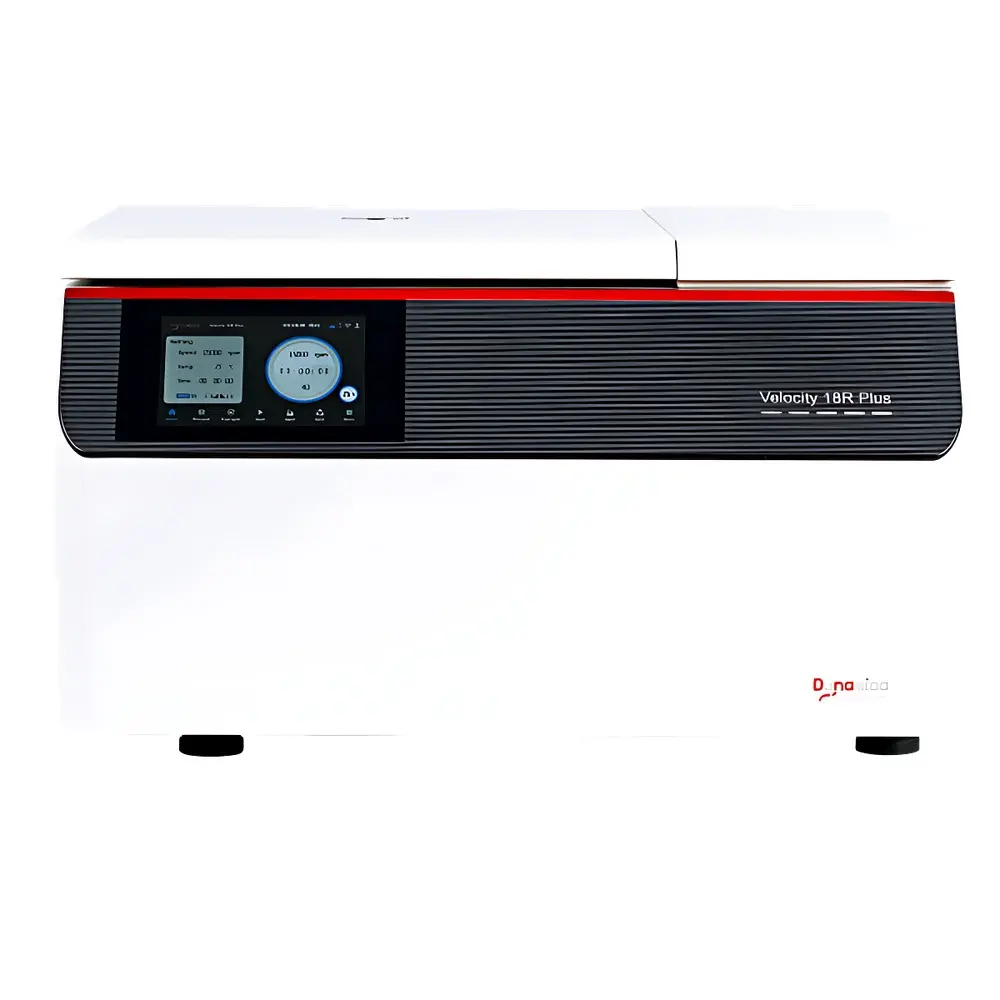
Dynamica VELOCITY 18R Benchtop High-Speed Refrigerated Centrifuge
| Brand | Dynamica |
|---|---|
| Origin | Shanghai, China |
| Model | VELOCITY 18R |
| Instrument Type | Benchtop Centrifuge |
| Function | Refrigerated Centrifugation |
| Configuration | Horizontal Rotor System |
| Max. Capacity | 4 × 300 mL |
| Max. Speed | 18,000 rpm |
| Max. RCF | 30,318 × g |
| Dimensions (L×W×H) | 730 × 610 × 380 mm |
| Net Weight | 100 kg |
| Power Supply | AC 220 V, 50/60 Hz, 10 A |
| Temperature Range | −20 °C to +40 °C |
| Temp. Accuracy | ±2 °C |
| Noise Level | <58 dB(A) |
| Acceleration | 9 levels |
| Deceleration | 10 levels |
| Rotor Recognition | Automatic, non-contact |
| Imbalance Detection | Non-contact electronic sensing |
| Speed Range | 300–18,000 rpm (100 rpm increments) |
| Speed Accuracy | ±20 rpm |
| Timer | 1 min – 99 h 59 min + Hold function |
| Memory | 9 programmable protocols |
| Drive | Brushless induction motor |
| Display | Backlit LCD panel |
| Pre-cool Function | Yes |
| Sample Temperature Monitoring | Real-time rotor-based temperature measurement |
Overview
The Dynamica VELOCITY 18R is a high-performance benchtop refrigerated centrifuge engineered for precision separation of biological, clinical, and industrial samples under controlled thermal conditions. Utilizing brushless induction motor technology and a rigid cast-aluminum frame, the system delivers stable rotational dynamics at speeds up to 18,000 rpm and relative centrifugal forces (RCF) up to 30,318 × g. Its horizontal rotor architecture supports high-volume processing—up to 1,200 mL per run (4 × 300 mL)—making it suitable for routine sample preparation in molecular biology labs, biopharmaceutical QC facilities, and academic core facilities. The integrated refrigeration system maintains chamber temperatures between −20 °C and +40 °C with ±2 °C accuracy, enabling reproducible pelleting of temperature-sensitive biomolecules such as plasmids, exosomes, and viral particles. Unlike air-cooled alternatives, the VELOCITY 18R employs direct rotor-based temperature sensing—not ambient chamber monitoring—ensuring that displayed values reflect actual sample thermal conditions during operation.
Key Features
- Automatic non-contact rotor recognition: Eliminates manual input errors by detecting rotor identity, maximum speed rating, and safety limits upon insertion.
- Pre-cool function: Chills the chamber and rotor to target temperature prior to sample loading, minimizing thermal shock and preserving sample integrity.
- Real-time sample temperature monitoring: Dedicated sensor embedded in the rotor hub provides continuous feedback of actual sample temperature—not just chamber air—enabling precise thermal validation.
- High imbalance tolerance (up to 12 g per side): Achieved through dynamic load compensation algorithms and reinforced suspension design, supporting robust operation even with minor tube weight discrepancies.
- Programmable acceleration/deceleration profiles: Nine acceleration and ten deceleration ramps allow optimization for shear-sensitive applications (e.g., organelle isolation) or rapid turnaround workflows.
- Quiet operation (<58 dB[A] at 18,000 rpm): Acoustic dampening housing and balanced drive assembly meet ISO 15702 noise standards for shared laboratory environments.
- Microprocessor-controlled interface: Backlit LCD display with intuitive navigation, real-time parameter visualization (speed, RCF, time remaining, temperature), and on-screen context help.
Sample Compatibility & Compliance
The VELOCITY 18R accommodates standard 15 mL and 50 mL conical tubes, blood collection tubes (including serum separator tubes), and custom adapters for microtubes and PCR strips. It supports all Dynamica-certified horizontal rotors—including the FA18C rotor used for maximum RCF performance—and complies with IEC 61010-1:2010 for electrical safety and IEC 61010-2-020:2016 for centrifuge-specific mechanical requirements. While not certified for GLP/GMP production environments out-of-the-box, its audit-ready features—including 9-user-programmable protocols, hold-function persistence, and timestamped operational logs—facilitate alignment with FDA 21 CFR Part 11 data integrity expectations when integrated into validated workflows. Temperature calibration records and rotor lifetime tracking are supported via optional service documentation packages.
Software & Data Management
The VELOCITY 18R operates autonomously without external software dependency. All user-defined parameters—including speed, time, temperature, acceleration/deceleration ramp selection, and hold mode—are stored locally in non-volatile memory. Each protocol retains full execution metadata: start time, end time, final RCF, average temperature deviation, and rotor ID. No proprietary drivers or cloud connectivity are required; however, optional RS-232 or USB-to-serial interfaces enable integration with LIMS or ELN systems for automated log export. Firmware updates are performed via secure USB stick, with version history and checksum verification ensuring traceability per ISO/IEC 17025 clause 5.9.
Applications
- Cell fractionation: Isolation of nuclei, mitochondria, lysosomes, and plasma membranes from mammalian and microbial cell lysates.
- Viral vector purification: Clarification and concentration of lentiviral and AAV particles prior to chromatographic polishing.
- Plasma and serum processing: Separation of platelet-poor plasma (PPP) and platelet-rich plasma (PRP) for regenerative medicine studies.
- Nanoparticle characterization: Pelleting of liposomes, polymeric micelles, and extracellular vesicles for downstream DLS or TEM analysis.
- Clinical diagnostics: Routine hematology sample preparation, including hematocrit determination and serum/plasma separation per CLSI H18-A3 guidelines.
- Environmental microbiology: Concentration of waterborne pathogens (e.g., Legionella, protozoan cysts) from large-volume filtration eluates.
FAQ
What rotor types are compatible with the VELOCITY 18R?
The system accepts all Dynamica horizontal rotors certified for use at ≤18,000 rpm, including the FA18C (4 × 300 mL), FA12C (6 × 100 mL), and F12x10 (12 × 10 mL) models. Rotor compatibility is verified automatically via embedded RFID tags.
Does the centrifuge support regulatory-compliant data archiving?
Yes—each run stores timestamped metadata (start/end time, rotor ID, setpoints, deviations) in internal memory. When connected to a compliant LIMS via serial interface, raw logs can be exported in CSV format for audit trail reconstruction.
Can the unit maintain −20 °C during extended runs at high speed?
Yes—the compressor-driven refrigeration system is rated for continuous operation at full speed within the full temperature range, including −20 °C, with thermal load compensation activated during prolonged high-RCF cycles.
Is rotor lifetime tracking available?
Rotor usage hours and maximum historical speed exposure are logged internally and accessible via service mode. Lifetime limits follow Dynamica’s published rotor fatigue specifications aligned with ISO 21501-4.
How is imbalance detected and managed during operation?
Non-contact vibration sensors continuously monitor radial displacement. If imbalance exceeds 12 g per side, the system initiates immediate deceleration and displays an error code—no mechanical cut-off switch is required.



