
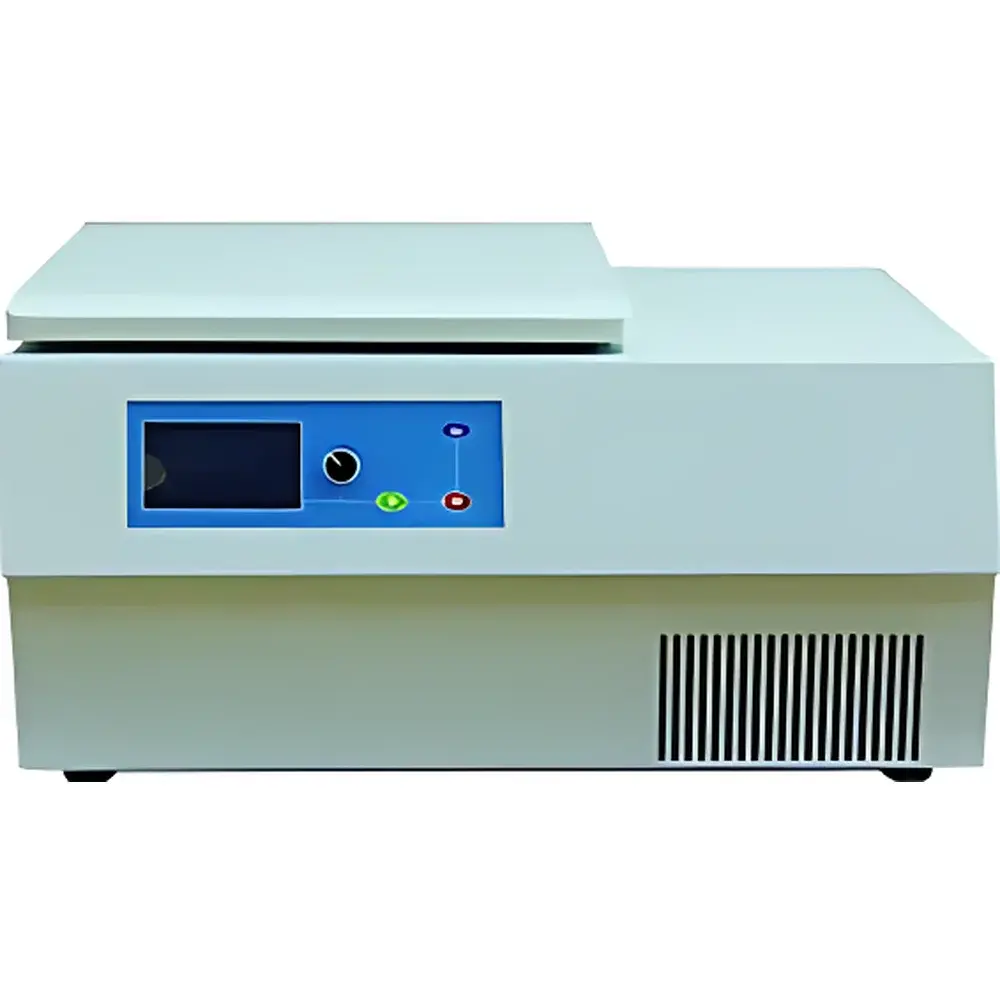
DYYB DH-2400R High-Speed Refrigerated Benchtop Centrifuge
| Brand | DYYB |
|---|---|
| Origin | Shanghai, China |
| Model | DH-2400R |
| Instrument Type | Benchtop Centrifuge |
| Speed Range | 300–24,000 rpm |
| Max RCF | 39,900 ×g |
| Max Capacity | 4 × 100 mL |
| Temperature Range | −20 °C to +40 °C |
| Refrigeration System | CFC-free compressor-based cooling |
| Power Supply | AC 230 V, 50–60 Hz |
| Motor Power | 550 W |
| Cooling Power | 370 W |
| Dimensions (H×W×D) | 370 × 610 × 520 mm |
| Weight (empty) | 62 kg |
| Noise Level (at max speed) | ≤58 dB(A) |
| Acceleration/Deceleration Time | 26 s each |
| Rotor Recognition | Yes |
| Safety Compliance | EN 61326 |
| Display | 5.1″ German-sourced LCD with real-time parameter monitoring |
| Control Interface | Single-knob rotary encoder + dedicated Start/Stop/Lid buttons |
| Programmability | 10 pre-stored protocols, 10-step acceleration/deceleration profiles |
| Rotor Materials | Anodized ultra-hard aluminum alloy, autoclavable (≥121 °C, unlimited cycles) |
| Rotor Types | Fixed-angle (including PCR, microtube, conical, round-bottom), swing-bucket (Biosafe), and microplate carriers |
Overview
The DYYB DH-2400R is a high-performance refrigerated benchtop centrifuge engineered for precision separation of biological macromolecules—including nucleic acids, proteins, subcellular organelles, and viral particles—under strictly controlled thermal conditions. It operates on the principle of sedimentation force generation via rapid rotational motion, where sample components separate based on differences in density, size, and shape under defined relative centrifugal force (RCF). With a maximum speed of 24,000 rpm and an RCF ceiling of 39,900 ×g, the DH-2400R meets the operational demands of molecular biology labs, clinical diagnostics units, and biopharmaceutical QC environments requiring reproducible high-g centrifugation without floor-standing infrastructure. Its integrated CFC-free refrigeration system enables stable temperature maintenance between −20 °C and +40 °C—even during rotor pre-cooling in standby mode—ensuring sample integrity for thermolabile analytes such as RNA or enzyme complexes.
Key Features
- Microprocessor-controlled operation with real-time display of setpoints and actual values (speed, time, temperature, RCF) on a 5.1″ industrial-grade LCD panel
- Brushless frequency-controlled motor delivering precise speed regulation (±20 rpm accuracy) across 300–24,000 rpm range; automatic rotor identification prevents overspeeding and mismatched configuration errors
- Robust stainless-steel chamber with reinforced structural design for continuous-duty operation; gas-spring-assisted lid mechanism ensures ergonomic access and failsafe interlock activation
- Comprehensive safety architecture including mechanical and electronic imbalance detection, lid-over-torque protection, overspeed cutoff, and acoustic/visual fault alerts with automatic shutdown
- Autoclavable anodized aluminum rotors manufactured to ISO 13485-compliant processes; sealed construction resists corrosion and supports repeated sterilization at 121 °C without performance degradation
- Flexible acceleration/deceleration control (10 programmable profiles); timer resolution down to ±1 second with dual operating modes: timed run and hold-until-stop
Sample Compatibility & Compliance
The DH-2400R accommodates a broad spectrum of tube formats and vessel types through eleven interchangeable rotor configurations—including fixed-angle rotors for microtubes (0.5–100 mL), swing-bucket Biosafe rotors for aerosol containment, and specialized carriers for PCR strips and 96-well microplates. All rotors are certified for use with standard polypropylene (PP) conical, round-bottom, and skirted tubes compliant with ISO 7218 and CLSI EP12-A2 guidelines. The instrument conforms to electromagnetic compatibility standards per EN 61326-1:2013 for laboratory environments and supports audit-ready documentation workflows aligned with GLP and GMP requirements. Optional rotor customization is available for non-standard vessel geometries or volume configurations upon engineering review.
Software & Data Management
While the DH-2400R operates as a standalone instrument with embedded firmware, its control logic embeds full traceability features required for regulated laboratories. Each run logs timestamp, rotor ID, speed profile, temperature history, and error events into non-volatile memory. Data export is supported via optional RS-232 or USB interface (firmware upgrade required) for integration into LIMS or ELN platforms. The system supports 21 CFR Part 11-compliant user authentication when paired with external identity management modules, enabling role-based access control and electronic signature capture for critical protocol execution.
Applications
- Isolation of plasmid DNA, genomic DNA, and total RNA from bacterial, mammalian, and plant lysates
- Purification of extracellular vesicles (exosomes) and lipoprotein fractions via differential ultracentrifugation protocols
- Clarification of cell culture supernatants prior to HPLC or mass spectrometry analysis
- Preparative separation of mitochondria, nuclei, and lysosomal fractions using density gradient media
- Routine pelleting of PCR products, enzymatic reaction mixtures, and antibody-conjugated beads
- High-throughput processing of clinical specimens (serum, plasma, CSF) in diagnostic laboratories adhering to CAP and ISO 15189 standards
FAQ
What is the minimum and maximum operating temperature range?
The DH-2400R maintains chamber temperatures from −20 °C to +40 °C, with ±1 °C stability across the full range under load.
Can this centrifuge be used for virus purification protocols requiring ultracentrifugation?
No—it is classified as a high-speed, not ultracentrifuge; maximum RCF of 39,900 ×g falls below the ≥100,000 ×g threshold required for most viral pellet isolation methods.
Are rotors validated for steam sterilization?
Yes—each rotor is rated for unlimited autoclave cycles at 121 °C, 15 psi, 20 minutes, per ISO 17665-1 validation principles.
Does the system support remote monitoring or network connectivity?
Standard configuration includes local control only; Ethernet or Wi-Fi modules are available as OEM add-ons subject to site-specific cybersecurity assessment.
How does the imbalance detection system respond during active runs?
Upon detecting ≥1 g mass asymmetry, the system initiates immediate deceleration, halts rotation, locks the lid, and displays error code with audible alert—no manual intervention required.



