
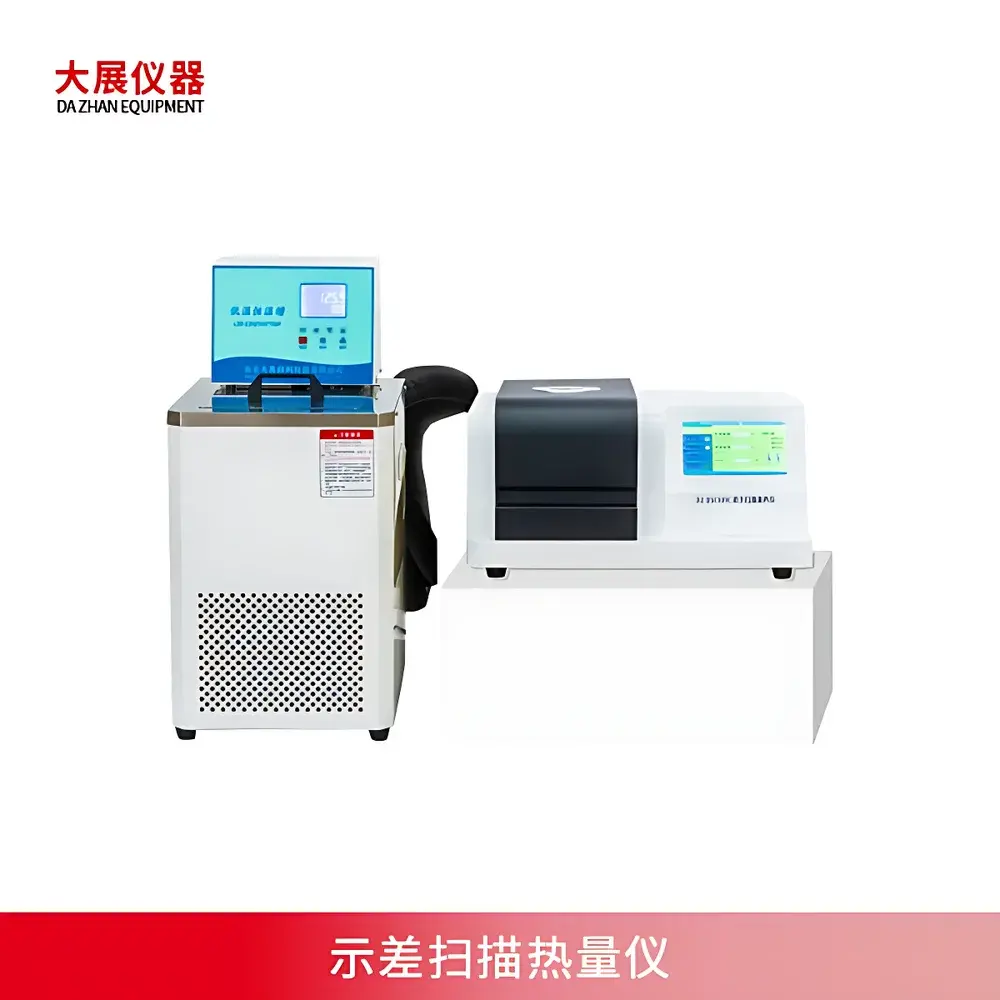
DZ-DSC300C Differential Scanning Calorimeter by DAZHAN
| Brand | DAZHAN |
|---|---|
| Origin | Jiangsu, China |
| Model | DZ-DSC300C |
| Temperature Range | −40 to 600 °C |
| Heating/Cooling Rate | 0.1–100 K/min |
| DSC Signal Range | 0–±800 mW (expandable) |
| Temperature Stability | ±0.01 °C |
| Temperature Resolution | 0.001 °C |
| Atmosphere Control | Dual-gas auto-switching (up to 200 mL/min, ≤0.5 MPa), plus inert purge line |
| Data Interface | USB 2.0 with auto-reconnect |
| Display | 7-inch 24-bit color touchscreen |
| Calibration Standards Included | Indium, Tin, Lead |
| Power Supply | AC 220 V / 50 Hz (customizable) |
Overview
The DZ-DSC300C Differential Scanning Calorimeter (DSC) is a precision thermal analysis instrument engineered for quantitative measurement of heat flow differences between a sample and an inert reference as a function of temperature or time. Based on the heat-flux DSC principle, it employs a high-stability dual-sensor micro-furnace architecture with Peltier-based active cooling to achieve reliable sub-ambient operation down to −40 °C—enabling characterization of low-temperature transitions such as cold crystallization, glass relaxation, and polymer vitrification. Its fully programmable temperature control system supports multi-segment heating, isothermal holding (up to 24 h), and controlled cooling profiles, making it suitable for both routine quality control and advanced research in material thermodynamics.
Key Features
- Integrated Peltier cooling module enabling continuous operation from −40 °C to 600 °C without liquid nitrogen dependency;
- Robust all-metal furnace design with optimized thermal symmetry, delivering superior baseline stability and reduced drift (<±0.01 °C temperature fluctuation);
- High-resolution thermal sensing with 0.001 °C temperature resolution and 0.001 mW DSC signal sensitivity;
- Intuitive 7-inch full-color touchscreen interface supporting dual-mode operation—standalone instrument control and synchronized software-driven acquisition;
- Dual-gas manifold with automatic switching between reactive and inert atmospheres (e.g., N₂/O₂), plus dedicated purge gas inlet for oxidation-sensitive samples;
- USB 2.0 communication with fault-tolerant auto-reconnect functionality, ensuring uninterrupted data streaming during long-duration experiments;
- Pre-calibrated with certified reference materials (Indium, Tin, Lead) traceable to NIST standards; user-performed temperature and enthalpy calibration supported via built-in routines.
Sample Compatibility & Compliance
The DZ-DSC300C accommodates standard aluminum, gold-plated aluminum, and high-pressure stainless-steel crucibles (20–50 µL capacity), supporting solid, semi-crystalline, powder, and thin-film specimens up to 50 mg. It complies with core thermal analysis methodology standards including ASTM E794 (melting point), ASTM E1356 (glass transition), ISO 11357 series (polymer characterization), and USP (pharmaceutical thermal analysis). The instrument’s hardware architecture and firmware support audit-trail-enabled data recording, aligning with GLP and GMP documentation requirements. Optional software modules provide 21 CFR Part 11-compliant electronic signatures and secure user access levels.
Software & Data Management
Bundled with DAZHAN Thermal Analysis Suite (v4.x), the system provides real-time visualization, peak deconvolution, kinetic modeling (Ozawa-Flynn-Wall, Kissinger), and multi-curve comparative analysis. Raw data are stored in vendor-neutral ASCII format (.txt) and industry-standard .q5 format, ensuring compatibility with third-party tools (OriginLab, MATLAB, TA Universal Analysis). All measurement parameters—including gas flow rates, ramp rates, hold times, and sensor gain—are logged with timestamps and operator IDs. Automated report generation includes metadata embedding, statistical summary tables, and customizable templates compliant with internal SOPs or regulatory submissions.
Applications
- Polymers & Composites: Determination of Tg, melting enthalpy (ΔHm), crystallinity index, cold crystallization kinetics, and thermal degradation onset (Td);
- Pharmaceuticals: Polymorph screening, excipient compatibility studies, stability assessment under accelerated conditions, and amorphous content quantification;
- Food Science: Fat crystallization behavior, starch gelatinization, protein denaturation temperatures, and shelf-life prediction models;
- Energy Materials: Phase-change material (PCM) enthalpy validation, battery electrode thermal runaway profiling, and catalyst thermal stability evaluation;
- Environmental & Ceramics: Hydration/dehydration thermodynamics in clays, sintering onset analysis, and decomposition pathways of waste-derived compounds.
FAQ
What is the lowest achievable temperature with the DZ-DSC300C, and does it require cryogenic consumables?
The instrument achieves −40 °C using solid-state Peltier cooling; no liquid nitrogen or external chillers are required.
Can the DZ-DSC300C perform both exothermic and endothermic event quantification in a single run?
Yes—its bidirectional ±800 mW DSC range allows simultaneous detection and integration of both exothermic (e.g., crystallization) and endothermic (e.g., melting) transitions within one thermal program.
Is the software validated for regulated environments such as pharmaceutical QC labs?
The optional 21 CFR Part 11 add-on enables role-based access control, electronic signatures, and immutable audit trails—validated per internal IQ/OQ protocols and compatible with FDA inspection expectations.
How is temperature accuracy verified across the full operating range?
Users perform multi-point calibration using supplied Indium (156.6 °C), Tin (231.9 °C), and Lead (327.5 °C) standards; deviation limits follow ISO 11357-1:2016 (±0.3 °C at melting points).
What maintenance is required to sustain long-term baseline stability?
Annual sensor recalibration and furnace cleaning (using dry nitrogen purge) are recommended; the all-metal furnace design minimizes thermal aging effects compared to ceramic alternatives.



