
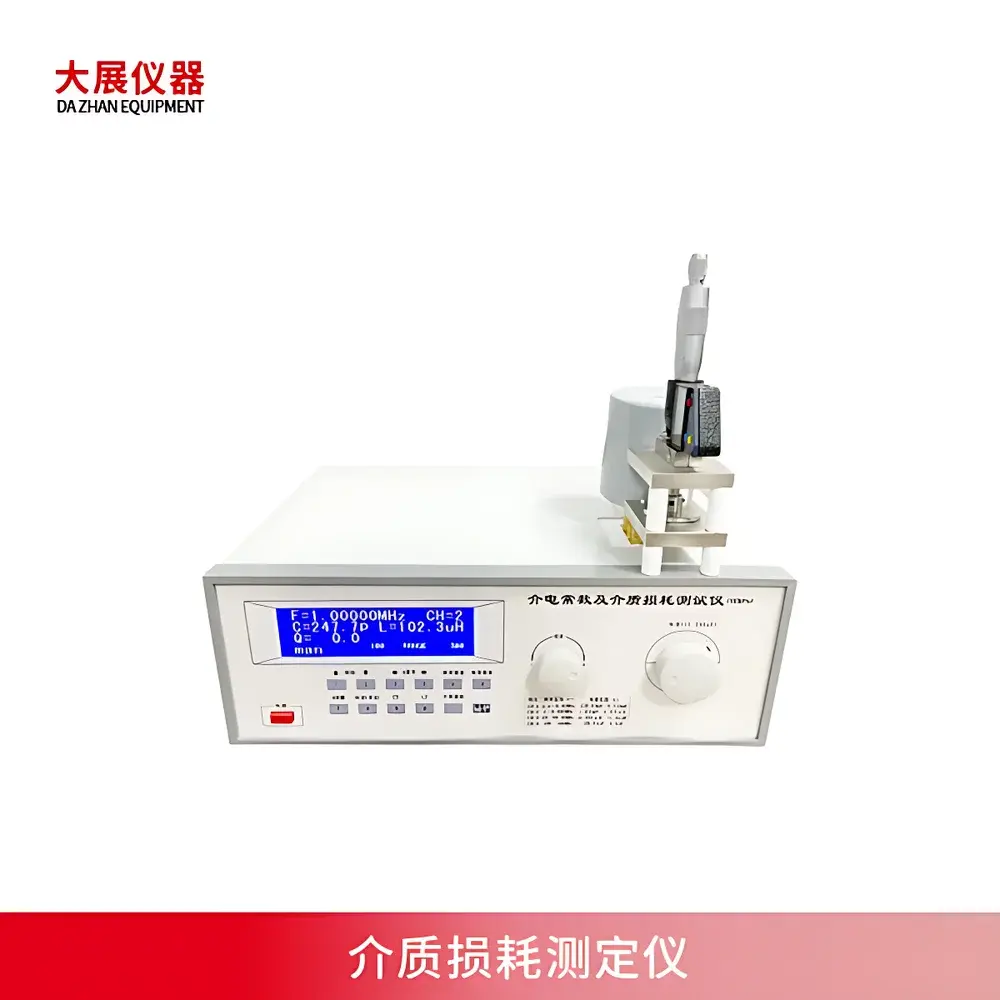
DZ5001 DAZHAN High-Frequency Resonance Dielectric Constant and Dissipation Factor Analyzer
| Brand | DAZHAN |
|---|---|
| Model | DZ5001 |
| Measurement Principle | High-Frequency Resonance Method (Parallel-Plate Capacitor Configuration) |
| Frequency Range | 10 kHz – 100 MHz |
| Frequency Accuracy | ±3×10⁻⁵ (6-digit resolution) |
| Q Factor Range | 1–1000 |
| Q Resolution | 0.1 (4-digit display) |
| Q Measurement Error | <5% |
| Inductance Range | 1 nH – 140 mH |
| Inductance Resolution | 0.1 nH |
| Inductance Error | <3% |
| Main Tuning Capacitance | 17–240 pF (silver-plated monolithic capacitor) |
| Capacitance Direct Measurement Range | 1 pF – 25 nF |
| Capacitance Resolution | 0.1 pF |
| Capacitance Error | ±1 pF or <1% |
| Automatic Capacitance Search | Yes (stepper motor-driven) |
| Residual & Lead Inductance Compensation | Yes |
| Display | LCD showing F, L, C, Q, Lt, Ct, εᵣ, tanδ, Tn |
| Compliance | GB/T 1693–2007, ASTM D150, GB 9622.9–1988 / SJ/T 11043–1996 |
Overview
The DZ5001 DAZHAN High-Frequency Resonance Dielectric Constant and Dissipation Factor Analyzer is a precision instrument engineered for the quantitative characterization of dielectric properties in solid and ceramic insulating materials. It operates on the principle of high-frequency series resonance in a parallel-plate capacitor configuration, where the test specimen serves as the dielectric medium between two precisely aligned electrodes. By exciting the resonant circuit with a digitally synthesized signal (10 kHz to 100 MHz), the system determines complex permittivity (ε* = ε′ − jε″) through real-time measurement of resonant frequency (fr), quality factor (Q), and effective capacitance (Ct). From these primary observables, the relative permittivity (εr) and loss tangent (tan δ = ε″/ε′) — directly proportional to the dielectric loss factor — are derived using standardized physical models defined in ASTM D150 and GB/T 1693–2007. The instrument’s architecture integrates automatic residual inductance compensation and lead inductance nulling, minimizing systematic errors inherent in high-frequency impedance measurements and enabling reliable evaluation of low-loss materials (tan δ < 10⁻⁴) commonly encountered in advanced ceramics, electronic glass substrates, and polymer-based insulators.
Key Features
- DDS-based digital signal source with 10 kHz–100 MHz continuous sweep capability and 6-digit frequency resolution (±3×10⁻⁵ stability)
- Monolithic silver-plated tuning capacitor (17–240 pF) ensuring long-term drift stability and sub-pF repeatability
- Integrated stepper-motor-driven auto-tuning mechanism for rapid, repeatable resonance point detection
- 12-bit high-speed ADC acquisition system optimized for Q-factor stability and low-noise dissipation measurement
- Real-time on-screen display of fundamental parameters: fr, L, C, Q, Lt, Ct, εr, tan δ, and temperature-normalized index (Tn)
- Automatic compensation for residual inductance and test fixture parasitics—critical for traceable measurements per ISO/IEC 17025-compliant laboratories
- Direct large-capacitance readout (up to 25 nF) without external shunt calibration, reducing operator dependency
Sample Compatibility & Compliance
The DZ5001 supports standardized sample geometries compliant with parallel-plate electrode requirements defined in ASTM D150 and GB/T 1693–2007. It is validated for rigid, low-conductivity dielectrics including alumina and zirconia ceramics, borosilicate and soda-lime glasses, epoxy laminates, polyimide films, mica sheets, and porcelain insulators. Sample thickness must be uniform within ±0.02 mm across the electrode contact area; surface flatness ≤0.5 µm Ra is recommended. Electrode diameter options (25 mm and 50 mm) accommodate both R&D-scale specimens and production QA lot sampling. All measurement protocols adhere to GLP-aligned data integrity practices, with timestamped parameter logging and non-editable session records—facilitating audit readiness for ISO 9001, IATF 16949, and FDA-regulated material qualification workflows.
Software & Data Management
While the DZ5001 operates as a stand-alone benchtop analyzer with full local control via front-panel interface, it supports optional RS-232/USB data export for integration into laboratory information management systems (LIMS). Exported datasets include raw resonance traces, calculated εr and tan δ values, measurement uncertainty estimates (based on Type A/B evaluation per GUM), and operator ID metadata. The firmware implements secure parameter locking and audit-trail-enabled configuration changes—aligned with 21 CFR Part 11 principles for electronic records in regulated environments. Calibration certificates (traceable to NIM China) include as-found/as-left data, linearity verification across three frequency decades, and Q-factor reproducibility testing (n ≥ 10 at 1 MHz, 10 MHz, 50 MHz).
Applications
- Quality control of high-purity alumina substrates used in RF/microwave packaging
- Development of low-loss dielectric composites for 5G antenna modules and millimeter-wave PCBs
- Process validation of sintering parameters in ceramic capacitor manufacturing
- Evaluation of moisture absorption effects on epoxy molding compounds (EMCs) via time-resolved tan δ monitoring
- Comparative screening of polymer film formulations for flexible electronics insulation layers
- Research into ferroelectric phase transitions in doped BaTiO₃ systems through temperature-dependent εr profiling
FAQ
What standards does the DZ5001 comply with for dielectric measurements?
It conforms to GB/T 1693–2007, ASTM D150, and GB 9622.9–1988/SJ/T 11043–1996 for high-frequency dielectric constant and loss tangent determination.
Can the instrument measure thin films or powders directly?
No—it requires solid, planar samples with parallel, polished surfaces compatible with parallel-plate electrode geometry; powders must be cold-pressed into discs under controlled pressure and density.
Is firmware upgrade support available?
Yes—DAZHAN provides periodic firmware updates via secure USB delivery, including enhanced noise rejection algorithms and expanded calibration certificate reporting templates.
How is measurement traceability maintained?
Each unit ships with a factory calibration certificate traceable to the National Institute of Metrology (NIM), China, and includes documented uncertainty budgets per ISO/IEC 17025 Annex A.3.
Does the system support automated pass/fail judgment against user-defined εr and tan δ limits?
Yes—Q-value threshold pre-setting (5–1000 range) triggers audible and visual alerts; limit-based classification can be exported for SPC charting in external statistical software.



