
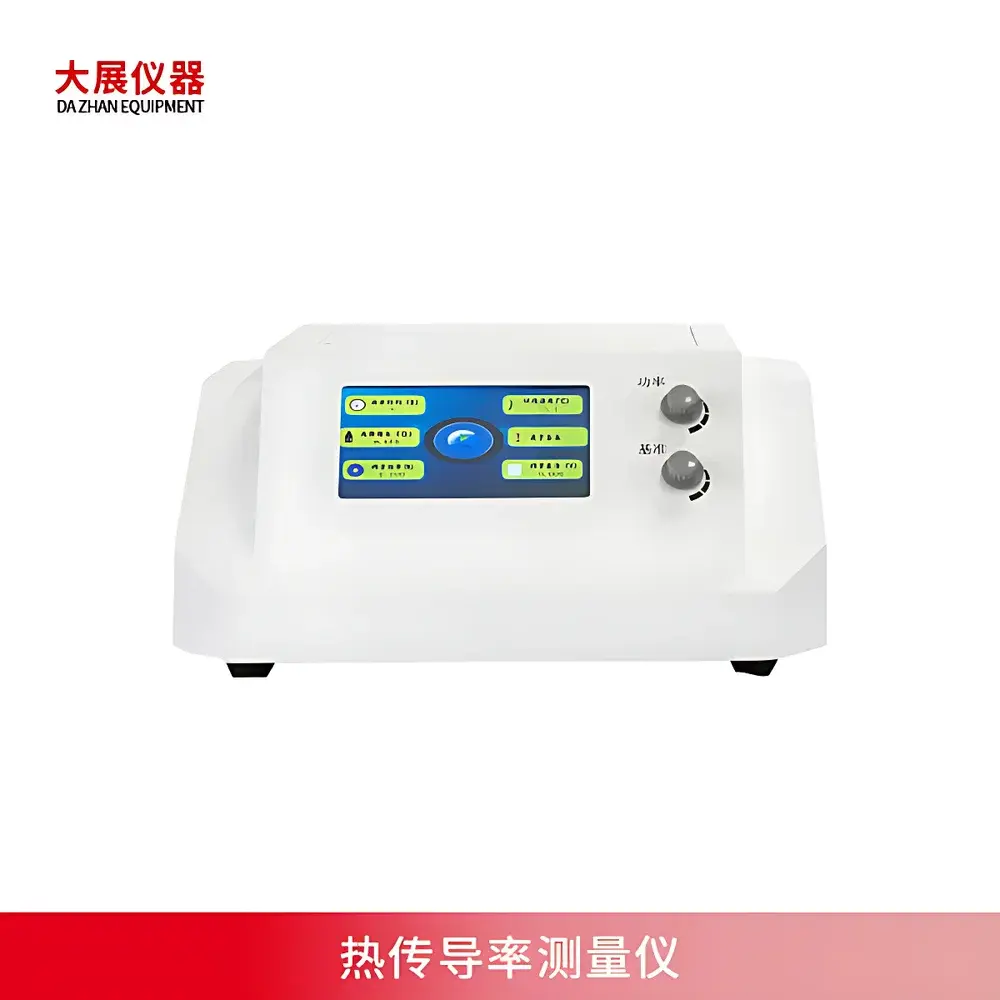
DZDR-S Thermal Conductivity Analyzer by DAZHAN
| Brand | DAZHAN |
|---|---|
| Origin | Jiangsu, China |
| Model | DZDR-S |
| Measurement Principle | Transient Plane Source (TPS) Method |
| Thermal Conductivity Range | 0.0001–300 W/(m·K) |
| Accuracy | ±3% |
| Repeatability | ≤3% |
| Temperature Range | Ambient to 130 °C (extendable to 300 °C) |
| Sample Forms | Solid, Liquid, Gel, Paste, Powder |
| Probe Options | 7.5 mm, 15 mm, 50 mm diameter planar sensors |
| Measurement Time | 5–160 s |
| Dimensions (L×W×H) | 440 × 390 × 220 mm |
| Power Supply | AC 220 V, <500 W |
| Sample Size Requirements | ≥15×15×3.75 mm (for 7.5 mm probe), ≥30×30×7.5 mm (for 15 mm probe), ≥50×50×15 mm (for 50 mm probe) |
| Compliance | ASTM D5334, ISO 22007-2, GB/T 32064–2015 |
Overview
The DZDR-S Thermal Conductivity Analyzer by DAZHAN is a benchtop instrument engineered for precise, rapid determination of thermal conductivity (λ) and thermal diffusivity (α) across heterogeneous material classes. It implements the Transient Plane Source (TPS) method—a well-established non-steady-state technique grounded in heat conduction theory for an infinite medium with a step-heated circular disk source. In this configuration, a thin, double-functioning sensor—fabricated from nickel or platinum foil embedded in a Kapton or polyimide substrate—acts simultaneously as both resistive heater and temperature sensor. Upon application of a constant current pulse, Joule heating initiates transient thermal diffusion into the sample; the resulting time-dependent resistance change of the sensor is recorded with microsecond resolution and converted to thermal conductivity via analytical solutions of Fourier’s heat equation under boundary conditions of infinite medium approximation. This principle enables direct, absolute measurement without calibration standards, delivering traceable results aligned with ISO 22007-2 and ASTM D5334 protocols.
Key Features
- Multi-probe modular design: Interchangeable planar sensors (7.5 mm, 15 mm, 50 mm diameter) optimized for diverse sample geometries and thermal effusivity ranges—from low-conductivity aerogels (0.0001 W/(m·K)) to high-conductivity metals (up to 300 W/(m·K)).
- Controlled transient excitation: Programmable heating duration (5–160 s) and power levels (≤1 W to ≤22 W per probe) minimize thermal perturbation and ensure self-consistent data acquisition across low- and high-effusivity materials.
- Integrated ambient-to-130 °C temperature control stage (optional extension to 300 °C or –40 °C available), enabling thermal conductivity vs. temperature profiling under controlled environmental conditions.
- Touch-enabled 7-inch color LCD interface with intuitive workflow navigation—no external PC required for basic operation; real-time curve visualization and parameter adjustment supported.
- Rugged mechanical architecture: Aluminum alloy chassis with EMI-shielded electronics enclosure ensures long-term stability in shared lab environments and compliance with IEC 61000-4 electromagnetic compatibility standards.
Sample Compatibility & Compliance
The DZDR-S accommodates flat-surface samples—including rigid solids (metals, ceramics, composites), flexible sheets (foams, textiles, laminates), viscous liquids, gels, pastes, and granular powders (with optional containment cell). Minimal surface preparation is required: samples must present ≥95% planar contact over the active sensor area and meet minimum thickness criteria (≥2.5× sensor radius) to satisfy the infinite-medium assumption. The system supports regulatory workflows per GLP and GMP frameworks, with audit-trail-enabled data logging compliant with FDA 21 CFR Part 11 when used with validated software modules. Test reports include full metadata: timestamp, operator ID, probe ID, ambient humidity/temperature, heating parameters, raw resistance-time curves, and uncertainty estimation per ISO/IEC 17025 guidelines.
Software & Data Management
The embedded firmware includes automated baseline correction, noise-filtered curve fitting using Levenberg–Marquardt nonlinear regression, and built-in validation against reference materials (e.g., certified PMMA, Pyrex, copper). Optional PC-based DAZHAN TPS Suite provides advanced features: multi-sample batch processing, statistical comparison (ANOVA, t-test), export to CSV/PDF/XML formats, and integration with LIMS via ODBC. All measurement data are stored with immutable timestamps and checksum-verified integrity; user access levels (operator, supervisor, administrator) support role-based permissions and electronic signature capture.
Applications
This analyzer serves cross-disciplinary R&D and QA/QC applications: thermal interface material (TIM) evaluation in power electronics packaging; insulation performance certification of building materials (aerogel blankets, mineral wool, cementitious composites); process development for polymer nanocomposites and battery electrode slurries; quality control of aerospace-grade carbon-fiber laminates and ceramic matrix composites; and fundamental studies on phonon transport in 2D materials and phase-change compounds. Institutions including Southern University of Science and Technology, Nanjing University of Science and Technology, and Jilin University employ the DZDR-S for peer-reviewed publications and industry-standard test reporting.
FAQ
What standards does the DZDR-S comply with?
It conforms to ISO 22007-2 (Plastics — Determination of thermal conductivity and thermal diffusivity — Part 2: Transient plane source (hot disc) method) and ASTM D5334 (Standard Test Method for Thermal Conductivity of Soil and Soft Rock by Thermal Needle Probe Procedure).
Can it measure anisotropic materials?
Yes—by orienting the sample such that the sensor plane aligns with the desired principal thermal axis (e.g., through-thickness vs. in-plane), though directional resolution requires orthogonal measurements and post-processing.
Is vacuum or inert gas testing possible?
The base unit operates at ambient pressure; optional environmental chambers (N₂-purged or vacuum-rated) can be integrated for controlled-atmosphere measurements.
How is calibration verified?
System verification uses NIST-traceable reference materials (e.g., SRM 1470a fused silica, certified λ = 1.38 W/(m·K) at 25 °C); annual recalibration is recommended per ISO/IEC 17025 accreditation requirements.
Does it support powder measurement without pressing?
Yes—the optional powder test cell applies controlled axial load (0–2 MPa) to achieve reproducible bulk density, minimizing interstitial air voids while preserving native particle morphology.



