
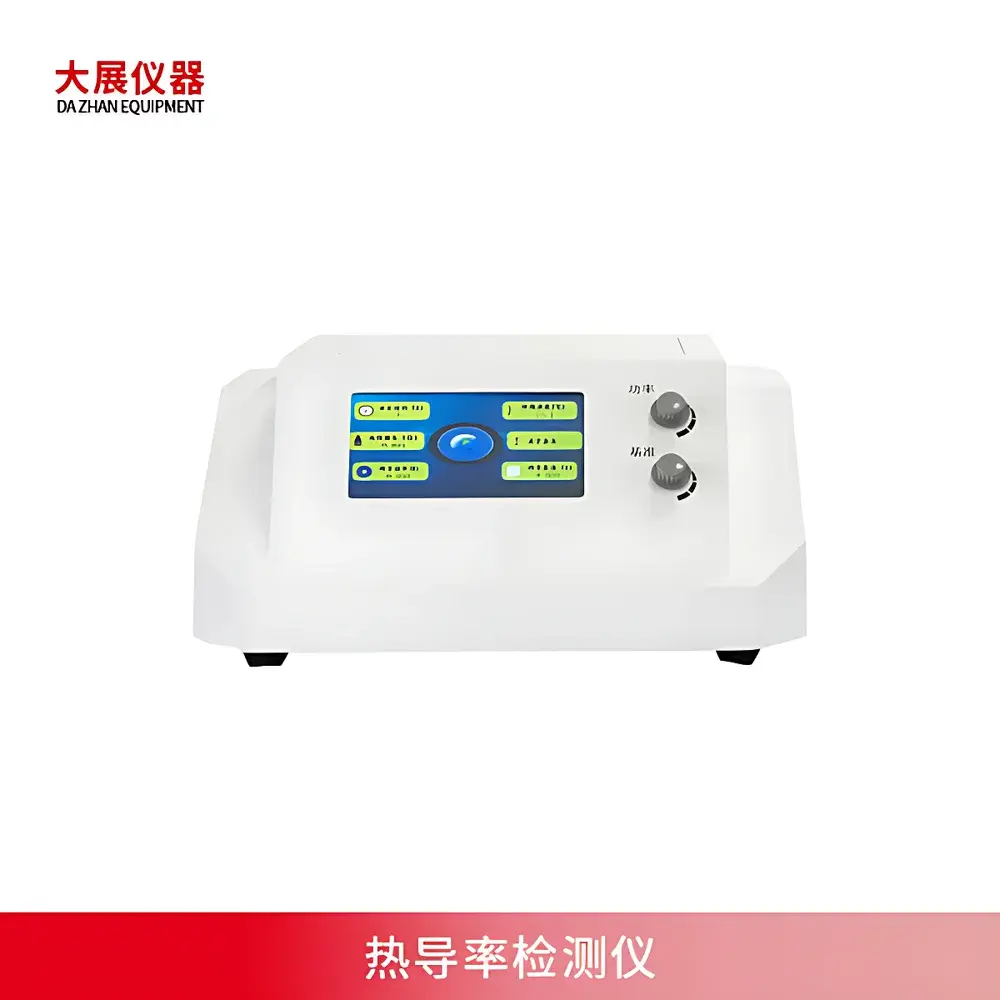
DZDR-S Transient Plane Source (TPS) Thermal Conductivity Analyzer by DAZHAN
| Brand | DAZHAN |
|---|---|
| Origin | Jiangsu, China |
| Model | DZDR-S |
| Measurement Principle | Transient Plane Source (TPS) Method |
| Thermal Conductivity Range | 0.0001–300 W/(m·K) |
| Accuracy | ±3% |
| Repeatability | ≤3% |
| Temperature Range | Ambient to 130 °C (optional extension: −40 °C to 300 °C) |
| Sample Forms | Solids (bulk, granular, coated, thin-film), Liquids, Gels, Pastes, Powders |
| Test Duration | 5–160 s per measurement |
| Probe Options | 7.5 mm, 15 mm, and 50 mm diameter probes |
| Dimensions (L×W×H) | 440 × 390 × 220 mm |
| Power Supply | AC 220 V, <500 W |
| Max. Probe Power | 1 W (7.5 mm), 20 W (15 mm), 22 W (50 mm) |
| Sample Size Requirements | ≥15×15×3.75 mm (7.5 mm probe), ≥30×30×7.5 mm (15 mm probe), ≥50×50×15 mm (50 mm probe) |
| Software | Integrated TPS data acquisition & thermal property calculation module with real-time curve fitting and ASTM/ISO-compliant reporting |
Overview
The DZDR-S Transient Plane Source (TPS) Thermal Conductivity Analyzer is an engineered solution for rapid, non-destructive determination of thermal conductivity (λ), thermal diffusivity (α), and volumetric heat capacity (ρcp) across a broad spectrum of materials. Based on the ISO 22007-2 standard methodology, the instrument employs a symmetric two-sample sandwich configuration where a metallized nickel spiral sensor—acting as both heater and resistance thermometer—is clamped between two identical sample pieces. Upon application of a constant electrical current pulse, the sensor generates transient heat flow into the surrounding material. The resulting time-dependent resistance change of the sensor is recorded at microsecond resolution, yielding a precise temperature rise history at the interface. This raw thermal response is then fitted against analytical solutions of the Fourier heat conduction equation under transient boundary conditions, enabling simultaneous extraction of λ and α without prior knowledge of density or specific heat. Designed for laboratory, QC, and R&D environments, the DZDR-S delivers traceable, high-reproducibility measurements under ambient to elevated temperatures (up to 130 °C standard; extended range available), supporting compliance-driven workflows in polymer science, battery thermal management, building insulation validation, and advanced material development.
Key Features
- Transient Plane Source (TPS) method compliant with ISO 22007-2 and ASTM D5930, ensuring international metrological equivalence
- Three interchangeable probe diameters (7.5 mm, 15 mm, 50 mm) optimized for diverse sample geometries and thermal effusivity ranges
- ARM-based embedded control system enabling real-time signal processing, adaptive pulse duration selection, and on-board curve fitting
- High-resolution analog-to-digital acquisition with integrated temperature-compensated bridge circuitry for sub-millikelvin thermal resolution
- Non-invasive measurement protocol: no sample coating, cutting, or mounting required—ideal for fragile, anisotropic, or low-density materials
- Touchscreen HMI with intuitive workflow navigation, multilingual UI support (English, Chinese, German), and GLP audit trail logging
- Modular sample stage accommodating variable thicknesses (3–50 mm), including optional powder test cell with controlled compaction and thermal contact enhancement
- Energy-efficient operation (<500 W peak power) with probe-specific current limiting to prevent localized overheating or phase transition artifacts
Sample Compatibility & Compliance
The DZDR-S accepts heterogeneous sample forms without preprocessing: rigid solids (metals, ceramics, composites), flexible sheets (foams, elastomers, laminates), viscous fluids (coolants, oils, molten polymers), semi-solids (thermal greases, pastes, gels), granular media (ceramic powders, metal flakes), and thin films (≥10 µm). Minimal surface flatness requirements (Ra < 5 µm) and lateral dimensions ≥2× probe diameter ensure reliable interfacial contact. All measurements adhere to ISO/IEC 17025 documentation standards, with full traceability to NIST-traceable reference materials (e.g., certified Pyroceram, Inconel, glycerol). Optional firmware modules support 21 CFR Part 11 electronic signature and audit trail functionality for regulated pharmaceutical and medical device applications.
Software & Data Management
The proprietary DAZHAN TPS Analysis Suite runs on Windows OS and provides end-to-end data handling—from automated calibration verification and baseline drift correction to multi-parameter regression, uncertainty propagation analysis (GUM-compliant), and customizable report generation. Raw voltage-time datasets are stored in HDF5 format for long-term archival integrity. Export options include CSV, PDF (with embedded metadata), and XML for LIMS integration. Batch processing supports statistical evaluation across sample sets, outlier detection via Grubbs’ test, and comparative trend analysis against historical baselines. All software modules undergo annual validation per IQ/OQ protocols.
Applications
- Thermal interface material (TIM) qualification for EV battery packs and semiconductor packaging
- Quality control of insulating aerogels, vacuum panels, and fire-retardant foams in construction
- R&D of phase-change materials (PCMs) and nanofluids for thermal energy storage
- Characterization of anisotropic composites (CFRP, GFRP) along through-plane and in-plane directions
- Validation of thermal models in multiphysics simulation (ANSYS, COMSOL)
- Regulatory submissions requiring ISO 22007-2–certified thermal property data
FAQ
What standards does the DZDR-S comply with?
The instrument implements the Transient Plane Source method per ISO 22007-2 and ASTM D5930, with full traceability to national metrology institutes.
Can it measure anisotropic materials?
Yes—by orienting the probe normal to the desired thermal axis and using directional sample mounting fixtures (optional accessory).
Is vacuum or inert atmosphere testing supported?
Standard configuration operates in air; environmental chamber integration (−40 °C to 300 °C, N2/Ar purge) is available as a factory option.
How is probe calibration maintained?
Each probe ships with individual calibration certificate referencing NIST-traceable standards; field recalibration is performed using certified reference samples supplied with the system.
Does the software support automated pass/fail criteria for QC release?
Yes—user-defined specification limits can be configured per material grade, triggering visual alerts and auto-flagging of out-of-tolerance results in batch reports.
Related Products



