
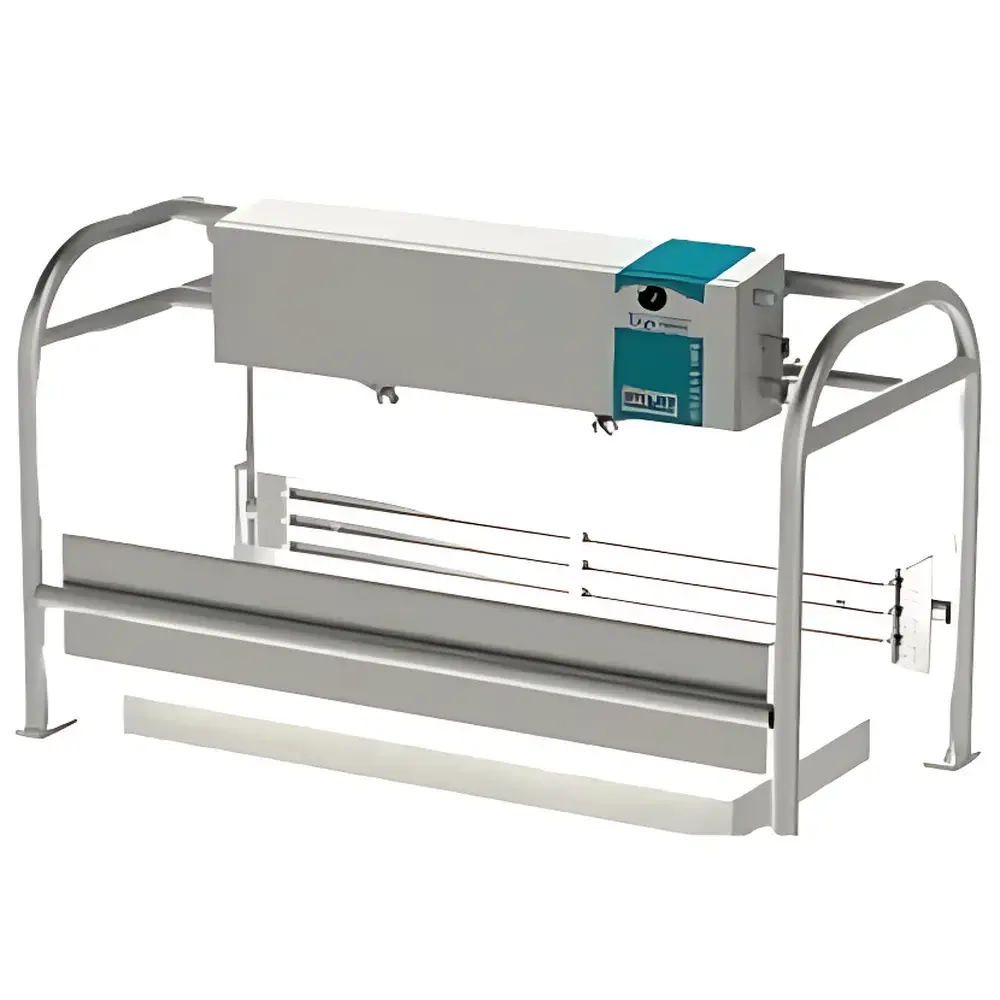
Eagle Vision EV Starch Mold Inspection (SMI) System for Confectionery Production
| Brand | Eagle Vision |
|---|---|
| Origin | Netherlands |
| Manufacturer Type | Authorized Distributor |
| Origin Category | Imported |
| Model | EV Starch Mold Inspection (SMI) System for Confectionery |
| Pricing | Upon Request |
Overview
The Eagle Vision EV Starch Mold Inspection (SMI) System is a purpose-built machine vision platform engineered for high-speed, non-contact quality assurance in starch-based confectionery manufacturing. It operates on the principle of structured illumination combined with high-resolution monochrome CMOS imaging and real-time pixel-level defect classification using embedded deep learning inference engines. The system is deployed at critical control points—typically immediately after starch mold filling and prior to tray storage or downstream coating—where it verifies both geometric integrity and functional fill status of starch cavities. Unlike generic vision systems, the EV SMI is calibrated specifically for the optical properties of food-grade potato or corn starch substrates, including their variable surface reflectivity, moisture-dependent texture, and transient dusting patterns. Its primary engineering objective is to enforce process consistency in starch-molded candy production (e.g., jelly beans, gumdrops, and marshmallow-based products), where incomplete cavity fill, misaligned molds, or foreign particulate contamination directly compromise product weight uniformity, release behavior, and visual acceptability per ISO 22000 and BRCGS Food Safety Standard v9 requirements.
Key Features
- Real-time cavity-level fill verification: Detects underfilled, overfilled, or bridged starch cavities with sub-millimeter spatial resolution at line speeds up to 120 trays/min.
- Multi-attribute mold registration: Validates mold orientation (0°/90°/180°/270°), positional offset (< ±0.3 mm), and color-coded template compliance against pre-registered reference profiles.
- Automated reference acquisition: Captures and stores golden-standard tray images during setup; dynamically updates baseline templates based on statistically validated process drift (±3σ threshold).
- Integrated hardware-triggered stop logic: Outputs TTL-level signals to PLCs within <15 ms latency upon confirmed defect detection, enabling mechanical ejection before tray entry into buffer zones.
- Dust-resistant optical enclosure: IP65-rated housing with anti-static lens coatings and self-cleaning air purge ports for sustained operation in high-humidity, flour-dense environments.
- Zero-touch calibration workflow: Utilizes built-in checkerboard pattern recognition and auto-focus servo for rapid revalidation after mechanical maintenance or mold changeovers.
Sample Compatibility & Compliance
The EV SMI System supports standard industry tray formats—including 48-, 64-, and 96-cavity aluminum or stainless steel molds—as well as custom composite trays used in NID, W&D, Makat, and Fast Track production lines. It accommodates starch layer thicknesses ranging from 8–15 mm and tolerates ambient temperature fluctuations between 15–30°C and relative humidity up to 75% RH without recalibration. The system complies with CE Machinery Directive 2006/42/EC, meets electromagnetic compatibility requirements per EN 61000-6-2 and EN 61000-6-4, and provides full audit trails aligned with FDA 21 CFR Part 11 for electronic records and signatures. All image data retention, user access logs, and decision event timestamps are time-stamped and cryptographically hashed for GLP/GMP traceability.
Software & Data Management
The proprietary Eagle Vision SMI Suite runs on a hardened Linux RT OS and features a browser-accessible interface (HTTPS/TLS 1.2) supporting role-based authentication (admin, operator, QA auditor). It includes integrated statistical process control (SPC) dashboards with real-time OEE calculation, Pareto analysis of defect categories (e.g., “cavity void”, “mold skew”, “starch smudge”), and automated PDF report generation compliant with ISO/IEC 17025 documentation standards. Raw image archives are stored in vendor-agnostic DICOM-compliant format with optional integration into enterprise MES platforms via OPC UA or RESTful API. All configuration changes, model retraining events, and user logins are recorded with immutable timestamps and SHA-256 checksums for regulatory review.
Applications
- Pre-coating inspection of starch-molded confections to prevent ink adhesion failures due to uneven starch surfaces.
- Post-filling validation in continuous starch bed systems to eliminate manual tray sampling and reduce labor-intensive cleaning cycles.
- Root-cause analysis support for batch-level yield loss by correlating defect clusters with upstream parameters (e.g., starch moisture content, mold temperature, fill pressure).
- Validation of mold reusability limits through longitudinal cavity erosion tracking across >500 production cycles.
- Support for customer-facing quality certifications including IFS Food 8.0 and SQF Level 3 audit readiness.
FAQ
What types of defects does the EV SMI System detect?
It identifies cavity fill anomalies (underfill, overflow, bridging), mold misalignment (angular deviation >1.5°, lateral shift >0.4 mm), surface contamination (dust, oil residue, starch clumps), and template mismatch (color code, label position, cavity count deviation).
Is the system compatible with legacy PLCs and HMIs?
Yes—it supports standard industrial protocols including Modbus TCP, EtherNet/IP, and PROFINET, with configurable I/O mapping for seamless integration into existing automation architectures.
How is system accuracy validated during commissioning?
Accuracy is verified using NIST-traceable ceramic test plates with certified cavity depth and edge geometry, followed by Gage R&R studies per AIAG MSA 4th Edition guidelines.
Can the system adapt to new mold designs without software reprogramming?
Yes—new molds are enrolled via guided image capture and geometric feature extraction; no coding or firmware update is required.
What is the typical ROI timeline?
Based on field data from installations across 12+ confectionery facilities, payback occurs within 3–12 months, driven primarily by reduced scrap (avg. 2.3% yield gain), decreased manual inspection labor (1.7 FTEs saved per line), and avoided customer chargebacks.




