
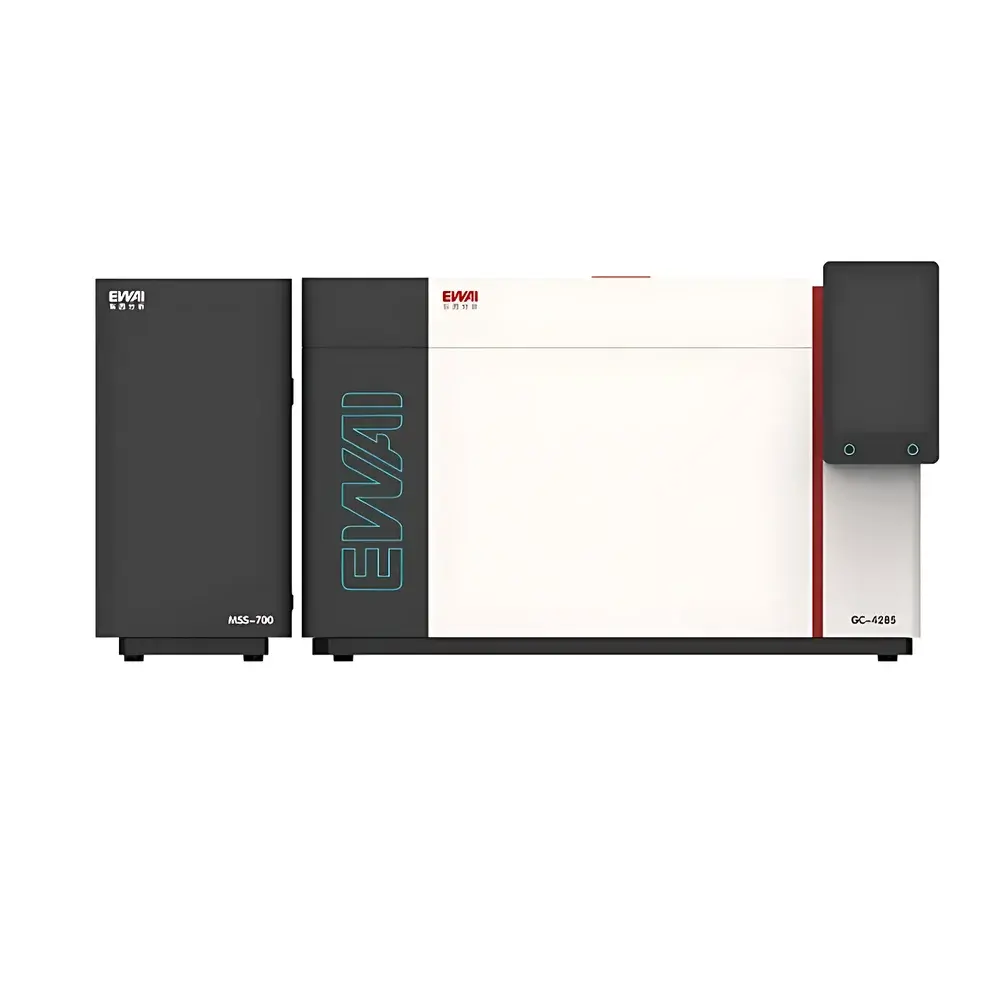
East & West Analysis GC-4285 Fully Automated Gas Chromatograph for Coal Mine Safety Monitoring
| Brand | East & West Analysis |
|---|---|
| Origin | Beijing, China |
| Manufacturer Type | Direct Manufacturer |
| Instrument Type | Laboratory Gas Chromatograph |
| Application Field | Coal Mining Industry (Mine Fire Early Warning & Gas Hazard Monitoring) |
| Touchscreen | 10.1-inch Industrial-Grade Capacitive LCD |
| Operating System | Linux-based Real-Time Embedded OS |
| Column Oven Cooling | Rear-Door Rapid-Cooling System with Dedicated Airflow Channel |
| Carrier Gas Control | Electronic Pressure Control (EPC) with Mass Flow Sensors |
| Diagnostics | Onboard Self-Diagnostic Engine with Fault Code Logging |
| Remote Access | Web-Based Interface + Native Android/iOS Mobile App |
| Sampling Mode | Fully Automated Sequential Analysis from 1 to 32 Sampling Points |
| Dual Independent Column Ovens | Separate Temperature Zones for High-Temp and Low-Temp Columns |
| Backflush Capability | Programmable Carrier Gas Reverse Flow for Column Protection |
| Analysis Time | ≤10 min per injection for 12 Key Gases (CO, CO₂, N₂, O₂, CH₄, C₂H₄, C₂H₆, C₂H₂, C₃H₈, C₃H₆, iC₄H₁₀, nC₄H₁₀) |
| Data Output | Automatic Report Generation & Secure Cloud Upload via Ethernet/Wi-Fi |
| Sample Inlet Options | Flexible Integration with Bundled Tube Systems, Tedlar® Bags, or Polyethylene Sampling Bags |
| Compliance | Designed to Support ASTM D1945, ISO 8573-5, and GB/T 13610–2020 for Mine Gas Analysis |
Overview
The East & West Analysis GC-4285 is a purpose-engineered, fully automated gas chromatograph specifically designed for continuous, unattended monitoring of critical fire-related gases in underground coal mine environments. Built upon a robust dual-column oven architecture and integrated electronic pressure control (EPC), the system employs capillary column separation coupled with thermal conductivity detection (TCD) and/or flame ionization detection (FID) — configurable per operational requirements — to deliver precise, repeatable quantification of low-concentration hydrocarbon and permanent gases. Its core measurement principle relies on differential partitioning of gaseous analytes between a mobile phase (high-purity carrier gas, typically helium or hydrogen) and a stationary phase within fused-silica capillary columns. Retention time alignment, peak integration, and multi-point calibration are managed through deterministic real-time algorithms, ensuring trace-level sensitivity and high reproducibility under variable ambient conditions typical of mine shafts and surface monitoring stations.
Key Features
- 10.1-inch industrial-grade capacitive touchscreen interface with anti-glare coating and glove-compatible responsiveness — optimized for harsh, dust-prone environments.
- Dual independent column ovens with PID-controlled temperature zones (range: 30–250 °C), enabling simultaneous high-resolution separation of light gases (N₂, O₂, CO) and heavier hydrocarbons (C₃H₈, iC₄H₁₀) without column cross-contamination.
- Rapid-cooling rear-door system with dedicated airflow channel reduces oven cooldown time by >60% versus conventional designs, supporting high-throughput cycle analysis every 8–10 minutes.
- Full EPC architecture with mass flow sensors ensures ±0.5% setpoint accuracy across all carrier, make-up, and detector gases — eliminating manual flowmeter adjustments and drift-related calibration drift.
- Programmable backflush functionality automatically reverses carrier gas direction post-analysis to purge non-volatile residues from the analytical column, extending column lifetime beyond 18 months under continuous operation.
- Onboard self-diagnostic engine continuously monitors detector baseline stability, oven temperature uniformity, valve actuation timing, and pressure transducer integrity — logging fault codes with timestamped event history.
- Native web server and mobile application support remote instrument status checks, method uploads, sequence initiation, and real-time chromatogram viewing — compliant with TLS 1.2 encryption and role-based access control.
Sample Compatibility & Compliance
The GC-4285 accepts gaseous samples directly from standardized mine bundle tube networks (up to 32 points), pre-evacuated Tedlar® bags, or polyethylene sampling vessels via its universal pneumatic inlet module. All sample introduction paths incorporate heated transfer lines (60–120 °C) and particulate filtration to prevent moisture condensation and particulate ingress. The system meets mechanical and electrical safety requirements per GB 3836.1–2010 (Explosion-Proof Equipment for Coal Mines) and supports data integrity frameworks aligned with GLP principles. While not FDA 21 CFR Part 11-certified out-of-the-box, audit trail logging, electronic signature capability, and user permission tiers can be enabled to satisfy internal QA/QC and third-party inspection protocols required by Chinese provincial coal safety bureaus and ISO/IEC 17025-accredited laboratories.
Software & Data Management
The embedded chromatography data system (CDS) runs on a Linux-based real-time OS with deterministic scheduling — ensuring sub-millisecond response during valve switching and detector signal acquisition. Method files include retention time locking (RTL), automatic peak identification using spectral libraries (NIST MS Search optional), and configurable integration parameters (tangent skim, valley-to-valley, exponential curve fitting). Reports conform to GB/T 13610–2020 formatting standards and export in PDF, CSV, and XML formats. All raw data, audit logs, and calibration records are stored locally on encrypted SSD storage and synchronized to secure cloud repositories via configurable SFTP or HTTPS endpoints. Network upload intervals, retry logic, and payload compression are programmable to accommodate low-bandwidth mine communication infrastructure.
Applications
The GC-4285 serves as a primary analytical platform for early fire warning systems in active coal mines, delivering quantitative analysis of spontaneous combustion indicators including carbon monoxide (CO), ethylene (C₂H₄), acetylene (C₂H₂), and alkane ratios (CH₄/C₂H₆, C₂H₆/C₃H₈). It is routinely deployed in surface monitoring stations interfaced with distributed bundle tube networks, ventilation shaft sampling nodes, and sealed area surveillance loops. Additional validated use cases include coal stockpile oxidation monitoring, landfill gas composition profiling, and syngas quality assurance in coal-to-chemical facilities. Its rapid turnaround time and automated calibration verification enable compliance with mandatory 2-hour reporting cycles stipulated in AQSIQ Safety Directive No. 128 (2021).
FAQ
What gases can the GC-4285 quantify in a single run?
It simultaneously quantifies CO, CO₂, N₂, O₂, CH₄, C₂H₄, C₂H₆, C₂H₂, C₃H₈, C₃H₆, iC₄H₁₀, and nC₄H₁₀ — covering all key markers referenced in national coal mine fire diagnostic guidelines.
Does the system support external calibration gas standards?
Yes — it accepts certified gas mixtures in aluminum cylinders (CGA-630 or CGA-600 fittings) and features automated calibration sequence execution with drift correction based on internal reference peaks.
Can the GC-4285 operate without network connectivity?
Absolutely — all core functions, including method execution, data acquisition, report generation, and local storage, operate autonomously; network connectivity is required only for remote access and cloud synchronization.
Is preventive maintenance documentation available in English?
Yes — comprehensive bilingual (English/Chinese) service manuals, spare parts catalogs, and OEM-certified technician training modules are provided with each unit shipment.
What is the recommended column configuration for mine gas analysis?
A PLOT Al₂O₃/KCl capillary column (30 m × 0.53 mm × 15 µm) paired with a molecular sieve 5Å column (15 m × 0.32 mm × 25 µm) in series provides optimal resolution for permanent gases and C₁–C₄ hydrocarbons under isothermal or ramped temperature programs.






