
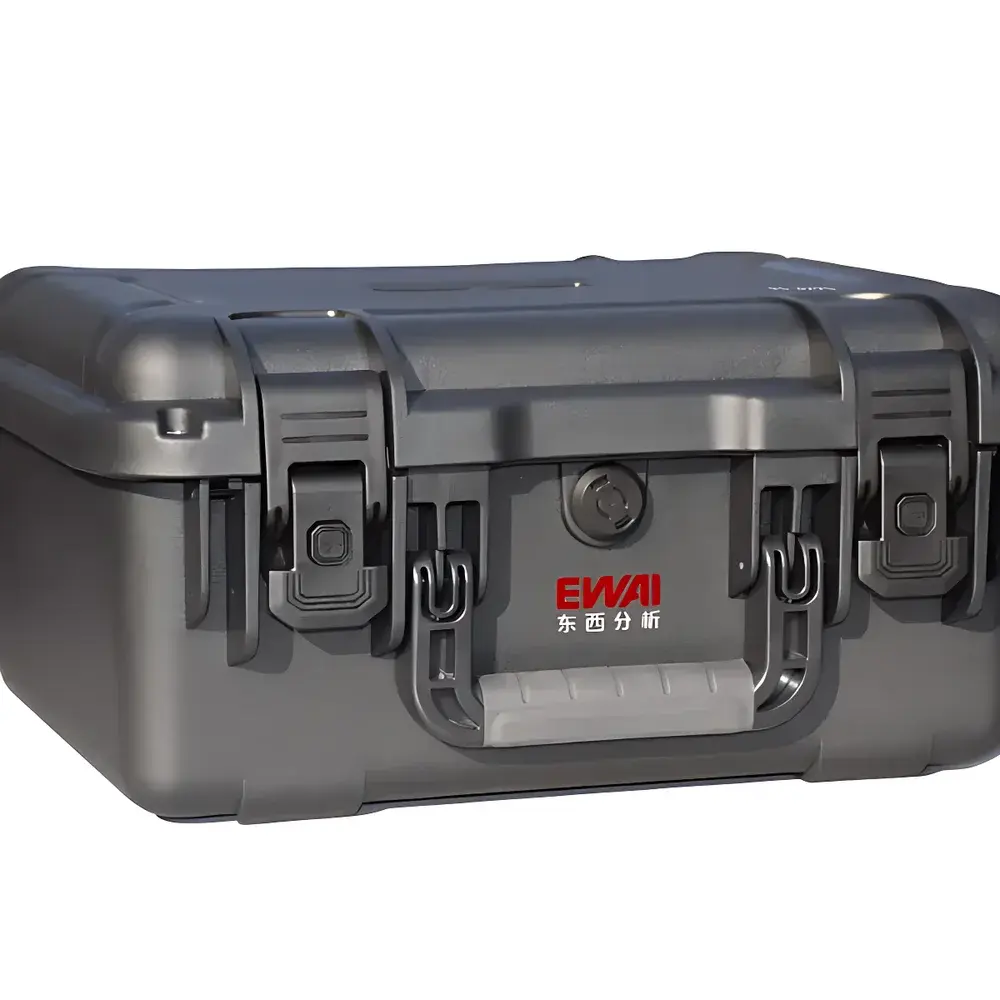
East & West Analysis GC-4295 Portable Mine-Specific Gas Chromatograph for Coal Mine Safety Monitoring
| Brand | East & West Analysis |
|---|---|
| Origin | Beijing, China |
| Manufacturer Type | Direct Manufacturer |
| Instrument Type | Portable Gas Chromatograph |
| Application Field | Coal Mining Industry |
| Detection Channels | 3 Independent Parallel Channels (A/B/C) |
| Channel A | O₂, N₂, CH₄, CO₂ |
| Channel B | C₂H₄, C₂H₆, C₂H₂, C₃H₈, H₂S |
| Channel C | H₂, CO |
| LOD | O₂/N₂/CH₄/CO₂ ≤ 0.1% (v/v) |
| Quantitative Repeatability | ≤ 3% RSD |
| Sample Introduction | Motorized 10-Port Automatic Valve with Precise Retention Time Control |
| Control Interface | Industrial Touchscreen LCD with One-Touch Power-On Sequence |
| Data Output | Real-Time Peak Area and Concentration Calculation per Component |
Overview
The East & West Analysis GC-4295 is a purpose-engineered portable gas chromatograph designed exclusively for real-time, on-site gas analysis in underground coal mine environments. It operates on the fundamental principle of gas-phase separation via capillary or packed column chromatography, coupled with thermal conductivity detection (TCD) and flame ionization detection (FID) — configured across three thermally isolated, independently controlled analytical channels. This architecture enables simultaneous, non-interfering quantification of critical atmospheric and fault-gas species relevant to spontaneous combustion monitoring, ventilation efficiency assessment, and early fire hazard detection. Unlike general-purpose benchtop GC systems, the GC-4295 integrates ruggedized mechanical design, intrinsically safe power management, and field-optimized carrier gas handling to meet the operational constraints of confined, potentially explosive atmospheres (per IEC 60079-0 and GB 3836.1–2010). Its deployment supports continuous compliance with China’s AQ 1029–2019 standard for coal mine gas monitoring and aligns with international best practices for mine safety instrumentation under ISO 8573-1 (compressed air purity) and ASTM D1945 (gas analysis by GC).
Key Features
- Triple-channel parallel detection architecture: Channel A (TCD) for permanent gases (O₂, N₂, CH₄, CO₂); Channel B (FID) for hydrocarbon fault gases (C₂H₄, C₂H₆, C₂H₂, C₃H₈, H₂S); Channel C (TCD/FID hybrid mode) for high-sensitivity H₂ and CO quantification.
- Motor-driven 10-port rotary valve system ensures precise, reproducible sample introduction with retention time stability < ±0.02 min over 24 h — essential for unattended field operation and regulatory traceability.
- Integrated negative-pressure sampling module eliminates need for external vacuum pumps; compatible with standard mine borehole tubing (inner diameter 4–6 mm) and provides flow-controlled aspiration at 20–100 mL/min.
- Industrial-grade 10.1-inch capacitive touchscreen HMI with embedded Linux OS enables one-touch boot sequence, method selection, and real-time chromatogram visualization without external PC dependency.
- Ruggedized aluminum alloy chassis (IP54 rated), shock-absorbing internal mounting, and wide operating temperature range (−10 °C to +50 °C) ensure reliability during transport and extended deployment in shafts, roadways, and return air entries.
Sample Compatibility & Compliance
The GC-4295 accepts gaseous samples directly from mine atmosphere, borehole gas extraction lines, or sealed bag collection (Tedlar® or aluminum laminated). No derivatization or pre-concentration is required for target analytes. All channel-specific calibration curves are stored internally and traceable to NIST-certified gas standards (e.g., Scott Specialty Gases 3000 Series). The instrument complies with mandatory Chinese coal industry standards including MT/T 757–2019 (portable gas chromatographs for mines) and AQ 1073–2009 (technical requirements for spontaneous combustion prediction). Data integrity conforms to GLP principles: audit trail logs capture operator ID, method version, calibration timestamp, and environmental sensor readings (ambient T/P/humidity). Optional 21 CFR Part 11-compliant software extension available for export-controlled deployments.
Software & Data Management
Embedded firmware includes full chromatographic data system (CDS) functionality: automatic peak detection, baseline correction, multi-point external standard calibration, and linear/non-linear response modeling. Quantitative results are output as CSV-compatible reports with ISO/IEC 17025-aligned uncertainty estimation (k = 2). USB 2.0 and RS-485 interfaces support offline data export and integration with mine-wide SCADA platforms (e.g., Siemens Desigo CC, Schneider EcoStruxure). Firmware updates are performed via secure signed package delivery; all configuration changes generate immutable log entries with SHA-256 hash verification.
Applications
- Early-warning monitoring of coal seam spontaneous combustion via C₂H₂/C₂H₄/C₂H₆ ratio trending (Dewar ratio, Graham’s ratio).
- Quantitative assessment of ventilation dilution efficiency using CH₄/N₂ and CO₂/N₂ ratios.
- Post-blast gas composition analysis to verify clearance thresholds prior to re-entry (per GB 50215–2015).
- Longwall face gas emission profiling during advance cycles.
- Validation of degasification system performance through continuous C₁–C₃ hydrocarbon tracking.
FAQ
Is the GC-4295 certified for use in explosive atmospheres?
Yes — it carries MA safety certification (China Mine Product Safety Mark) and meets explosion-proof requirements per GB 3836.1–2010 (equivalent to IEC 60079-0 Ed. 6.0). Intrinsically safe circuitry limits energy in sensor and valve actuation paths.
Can the instrument operate without external power for extended periods?
It supports dual power modes: 24 V DC vehicle battery input (with overvoltage/undervoltage protection) and hot-swappable Li-ion battery pack (rated for ≥4.5 h continuous analysis at 25 °C).
How is calibration maintained during field deployment?
Onboard calibration verification gas (5% CH₄ in N₂) is automatically injected every 8 h; deviation alerts trigger recalibration prompts. Full multi-point calibration requires <15 min and uses factory-provided gas standards.
Does the system support remote diagnostics?
Yes — optional Ethernet/WiFi module enables secure SSH access for firmware diagnostics, log retrieval, and method parameter adjustment under IT-managed network policies.
What maintenance intervals are recommended for underground operation?
Column conditioning every 30 days; detector cleaning every 90 days; 10-port valve lubrication and seal inspection every 180 days — all procedures documented in EN 61000-6-2 compliant service manual.







