
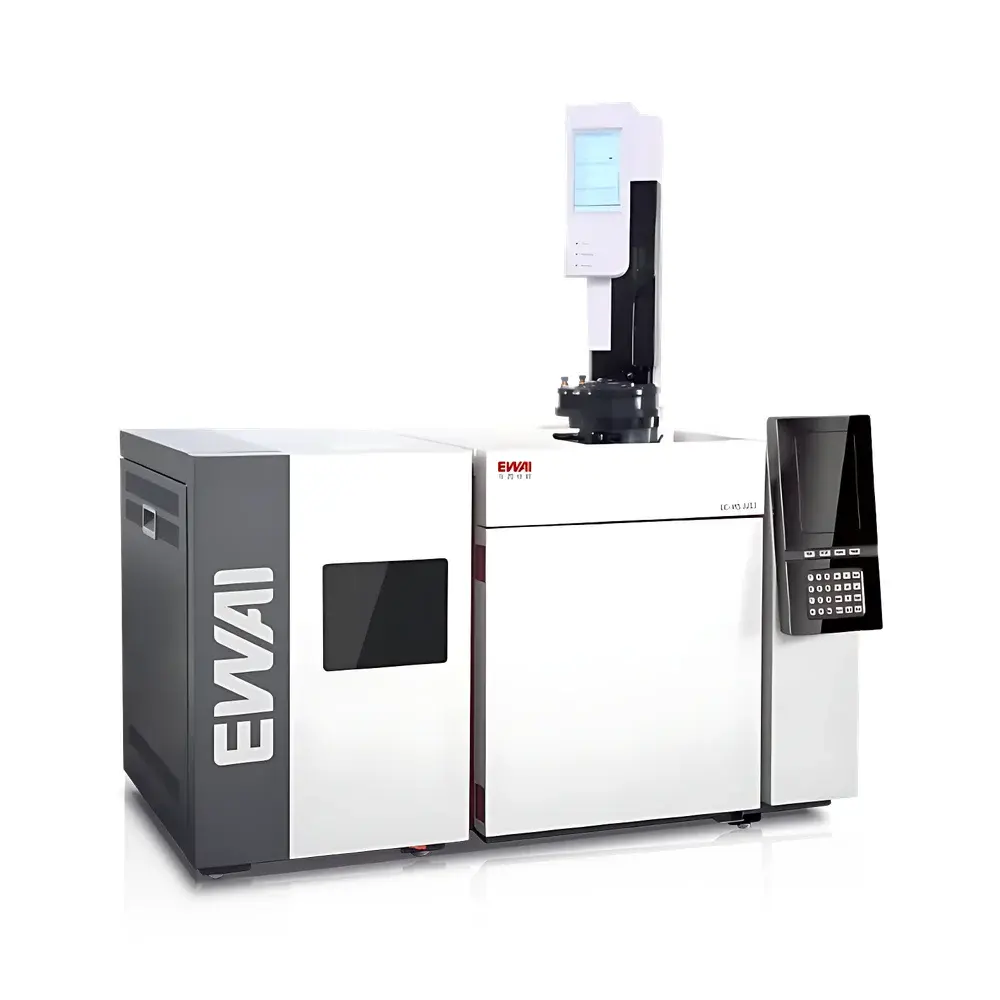
East & West Analysis GC-MS 3250 Gas Chromatography-Mass Spectrometry System
| Brand | East & West Analysis |
|---|---|
| Origin | Beijing, China |
| Manufacturer Type | Original Equipment Manufacturer (OEM) |
| Instrument Type | Single Quadrupole Mass Spectrometer |
| GC Configuration | Conventional Capillary GC-MS |
| Mass Range | 1.5–1100 amu |
| Mass Resolution | Unit Mass Resolution |
| Sensitivity | ≥2000:1 S/N for 1 pg Octafluoronaphthalene (OFN) in Electron Ionization (EI) mode |
| Scan Speed | Up to 10,000 amu/s |
| Detector | Dual-Stage Electron Multiplier with High-Energy Dynode Post-Focusing Assembly |
| Pressure Control Accuracy | ±0.001 psi |
| Column Oven | Air-heated, accommodates up to two capillary columns and three detector modules |
| Ion Source | High-Temperature Inert EI Source with dual long-life inert filaments |
Overview
The East & West Analysis GC-MS 3250 is a robust, single-quadrupole gas chromatography-mass spectrometry system engineered for routine qualitative and quantitative analysis of volatile and semi-volatile organic compounds. It integrates a high-stability air-heated capillary column oven with a thermally stable, low-drift quadrupole mass analyzer and a high-efficiency inert electron ionization (EI) source. The system operates on the fundamental principle of compound separation by gas-phase partitioning in a capillary column, followed by mass-selective detection via quadrupole mass filtering under controlled vacuum conditions. Designed for laboratory environments requiring regulatory compliance—such as environmental testing labs, food safety QA/QC facilities, and pharmaceutical stability studies—the GC-MS 3250 delivers reproducible spectral acquisition, precise retention time alignment, and consistent mass calibration across extended operational cycles.
Key Features
- Air-heated column oven with programmable temperature range from –20 °C (with optional cryo-cooling) to 450 °C, supporting rapid heating (up to 120 °C/min) and active cooling for cycle time reduction.
- Low-temperature-coefficient quadrupole drive electronics ensuring mass accuracy stability ≤ ±0.1 amu over 24-hour continuous operation without recalibration.
- BeamS™ linear ion detection architecture optimized for signal-to-noise ratio enhancement, particularly at trace-level analyte concentrations.
- High-temperature inert EI source (max. 350 °C), constructed entirely from de-activated metal alloys to minimize active surface adsorption and carbon buildup; includes dual independently controllable inert filaments extending total source uptime.
- Modular detector bay accommodating up to three simultaneous detection units—including optional TCD, FID, or ECD—enabling hybrid confirmation workflows.
- Pressure control system with digital pneumatic controllers achieving ±0.001 psi precision across carrier gas (He, H₂, or N₂) and auxiliary gas lines, critical for retention time reproducibility and method transferability.
Sample Compatibility & Compliance
The GC-MS 3250 supports direct analysis of liquid samples via split/splitless injection, headspace vials, solid-phase microextraction (SPME) fibers, and thermal desorption tubes. Optional direct insertion probe (DIP) enables rapid structural elucidation of non-volatile or thermally labile solids without derivatization. The system complies with key analytical standards including ASTM D5845 (gasoline oxygenates), EPA Method 8270D (semivolatiles), and ISO 17025:2017 requirements for method validation and uncertainty estimation. Its data acquisition architecture supports audit-trail-enabled operation per FDA 21 CFR Part 11 when deployed with validated software configurations, facilitating GLP/GMP-aligned reporting in regulated industries.
Software & Data Management
Controlled via GC-MS Navigator™ software (v3.2+), the platform provides intuitive method development, real-time spectral monitoring, and automated calibration verification. It features multi-curve merging functionality—allowing concurrent calibration curves for different analyte groups within a single analytical method—and batch-processed quantitative reporting with integrated internal standard normalization. Raw data files conform to ANDI/NetCDF format for cross-platform compatibility. All processing steps—including peak integration, library search (NIST MS Search 2.7g compatible), and report generation—are timestamped and logged with user ID, instrument state, and parameter history to satisfy traceability requirements. Remote data upload capability enables centralized archive management and cloud-based review workflows.
Applications
The GC-MS 3250 is routinely deployed in environmental laboratories for pesticide residue screening in soil/water matrices, in food testing centers for flavor compound profiling and contaminant identification (e.g., PAHs, mycotoxins), and in forensic toxicology for drug metabolite confirmation. Its high scan speed and unit-resolution performance make it suitable for fast GC applications such as residual solvent analysis in pharmaceutical intermediates (ICH Q3C compliant). The inert source design ensures reliable quantification of reactive species like aldehydes and organic acids, while the dual-filament configuration minimizes downtime during high-throughput clinical urine drug screening workflows.
FAQ
What is the maximum operating temperature of the column oven?
The air-heated column oven operates from –20 °C (with optional cryogenic module) to 450 °C.
Does the system support both EI and CI ionization modes?
The standard configuration includes only a high-temperature inert EI source; chemical ionization (CI) is available as a factory-installed option.
Can the GC-MS 3250 be integrated into an existing LIMS environment?
Yes—via ODBC-compliant database export and HL7/ASTM E1384-compliant result transmission protocols.
Is the quadrupole mass analyzer temperature-controlled?
Yes—the quadrupole rod assembly is housed in a thermostatically stabilized chamber to maintain thermal equilibrium during extended acquisitions.
What file formats are supported for spectral library searching?
NIST MS Search (.msl, .msp), Wiley Registry (.WIL), and user-defined custom libraries in ASCII text format.





