
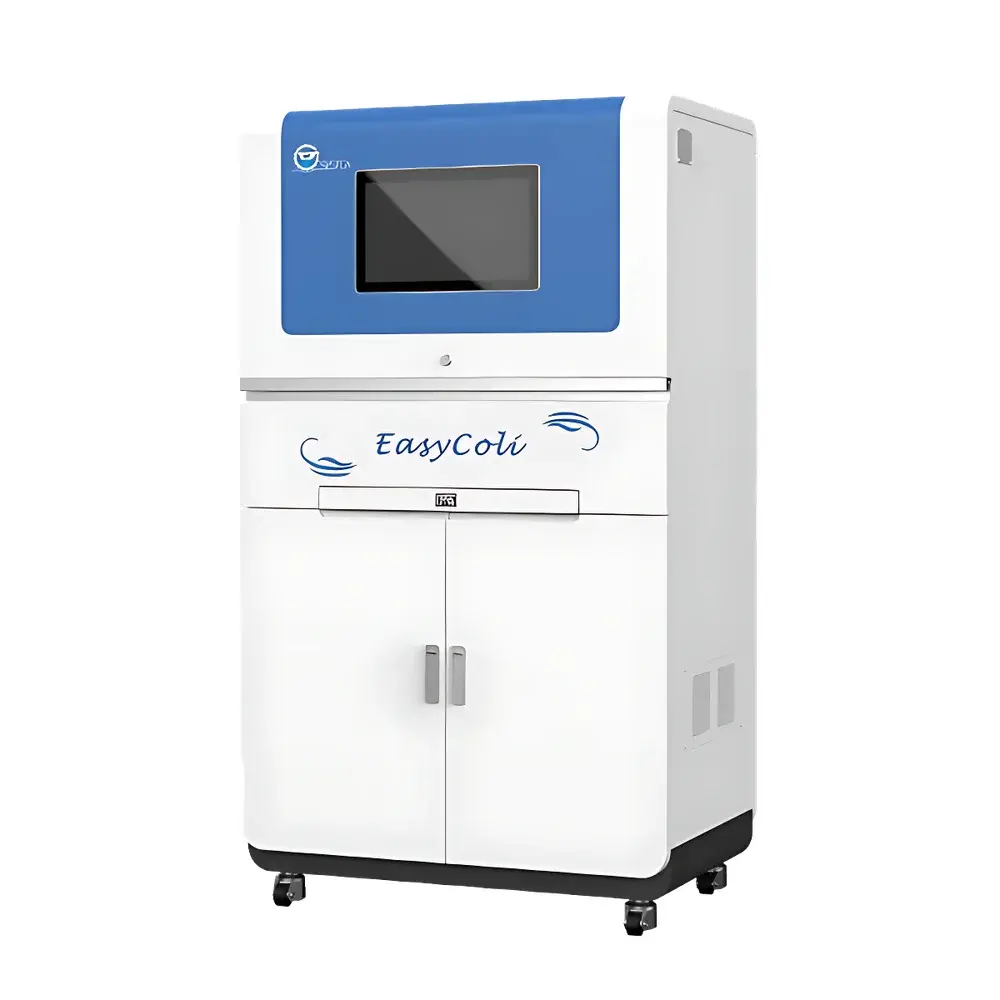
EasyColi Online *E. coli* and Total Coliform Monitor by SYSTEA
| Brand | SYSTEA |
|---|---|
| Model | EasyColi |
| Measurement Principle | Standard Enzyme-Substrate Method (MPN, P/A, TTD) |
| Compliance | HJ 1001-2018, ISO 9308-1:2014 |
| Detection Limit | 1 MPN/100 mL |
| Upper Detection Range | >20,000 MPN/100 mL |
| Sample Throughput | 28 fully automated MPN tests per cycle |
| Sample Independence | Individual incubation chambers per sample |
| Integrated Cleaning Station | Yes |
| Regulatory Support | GLP-compliant data logging, audit trail enabled |
| Software Interface | Touchscreen GUI with real-time assay progress visualization |
| Application Scope | Surface water, drinking water, groundwater, recreational bathing waters, municipal wastewater, industrial effluents |
Overview
The EasyColi Online E. coli and Total Coliform Monitor is a fully automated, laboratory-grade environmental analyzer engineered for continuous, unattended quantification of indicator bacteria in water matrices. It implements the internationally validated enzyme-substrate method—specifically the Most Probable Number (MPN), Presence/Absence (P/A), and Time-to-Detection (TTD) protocols—as defined in ISO 9308-1:2014 and HJ 1001–2018. Unlike optical or immunoassay-based surrogates, the EasyColi relies on enzymatic hydrolysis of chromogenic/fluorogenic substrates (e.g., ONPG and MUG) by β-galactosidase and β-glucuronidase enzymes native to coliforms and Escherichia coli, respectively. This biochemical specificity ensures high taxonomic fidelity and eliminates cross-reactivity with non-target microbes. The system performs quantitative enumeration without culture plating or manual colony counting, delivering regulatory-grade results directly traceable to standard methods.
Key Features
- Triple-method flexibility: Simultaneous support for MPN (quantitative), P/A (compliance screening for potable water), and TTD (semi-quantitative kinetic analysis) within a single instrument platform.
- Regulatory alignment: Fully compliant with Chinese Environmental Monitoring Standard HJ 1001–2018 and ISO 9308-1:2014 for total coliforms, fecal coliforms, and E. coli; uses ISO-recommended dehydrated culture media formulations.
- High-capacity automation: Processes up to 28 independent samples per run using sealed, disposable reaction vessels—each with dedicated thermal control and optical detection.
- Cross-contamination mitigation: Patented fluidic architecture isolates sample pathways; integrated cleaning station performs multi-stage rinsing with sterile water and air purge between cycles.
- Low-maintenance operation: No daily calibration or reagent replenishment required during 28-test sequences; only periodic replacement of pre-sterilized culture media cartridges per manufacturer protocol.
- Real-time assay monitoring: Embedded 7-inch capacitive touchscreen displays optical density kinetics, temperature profiles, and MPN confidence intervals as assays progress—enabling immediate troubleshooting and process validation.
Sample Compatibility & Compliance
The EasyColi accepts raw, filtered, or clarified water samples across a broad physicochemical range: turbidity ≤100 NTU, pH 5.0–9.0, residual chlorine ≤2 mg/L (quenching optional), and suspended solids ≤50 mg/L. It has been verified for use with surface water (rivers, lakes), treated drinking water (post-chlorination), groundwater (well discharge), seawater (bathing zones), municipal secondary effluent, and select industrial discharges (e.g., food processing, pharmaceutical cooling loops). All measurement data are timestamped, digitally signed, and stored with full audit trail per GLP requirements. Optional 21 CFR Part 11-compliant software module supports electronic signatures, role-based access control, and immutable record retention for regulated utilities and certified labs.
Software & Data Management
The embedded firmware runs SYSTEA’s AquaTrack OS v3.x—a deterministic, real-time operating system optimized for microbiological assay timing precision. Data export is supported via USB 2.0, Modbus TCP/IP, and optional 4–20 mA analog output (0–20,000 MPN/100 mL range). Raw absorbance/fluorescence curves, MPN tables (95% confidence limits), and pass/fail flags per sample are exportable in CSV and PDF formats. Remote diagnostics and firmware updates are performed over secure TLS-encrypted Ethernet connection. Historical datasets integrate seamlessly with LIMS platforms through ASTM E1384-compliant HL7 messaging or direct SQL database push.
Applications
- Drinking water safety verification at entry points to distribution networks (P/A mode meets WHO and GB 5749–2022 requirements).
- Real-time compliance monitoring for wastewater treatment plant discharge permits (NPDES, EU Urban Wastewater Directive Annex I).
- Early-warning detection of fecal contamination in source waters feeding intake structures.
- Recreational water quality assessment for beach management programs (EPA BEACH Act reporting).
- Process validation in pharmaceutical water systems (PW, WFI) where microbial load must remain below action limits per USP <1231>.
- Research applications requiring longitudinal tracking of indicator bacteria dynamics under varying disinfection regimes or seasonal loading conditions.
FAQ
What regulatory standards does the EasyColi validate against?
It is designed and verified for conformance with ISO 9308-1:2014, HJ 1001–2018, and supports data integrity practices aligned with GLP and FDA 21 CFR Part 11 when configured with optional compliance software.
Can the system distinguish E. coli from other coliforms automatically?
Yes—via dual-enzyme substrate detection (β-galactosidase + β-glucuronidase) in a single growth medium, enabling simultaneous identification and quantification without manual confirmation steps.
Is sample filtration required prior to analysis?
Filtration is not mandatory but recommended for samples with turbidity >25 NTU or visible particulates to prevent optical interference and ensure vessel sealing integrity.
How frequently must consumables be replaced?
Each 28-test cartridge includes pre-measured, lyophilized media and reagents; replacement is required after completion of one full sequence or every 7 days if idle—whichever occurs first.
Does the instrument support remote monitoring and alarm notifications?
Yes—via configurable email/SMS alerts triggered by threshold exceedance, incubation failure, or maintenance due events; integration with SCADA systems is supported through standard industrial protocols.
Related Products







