
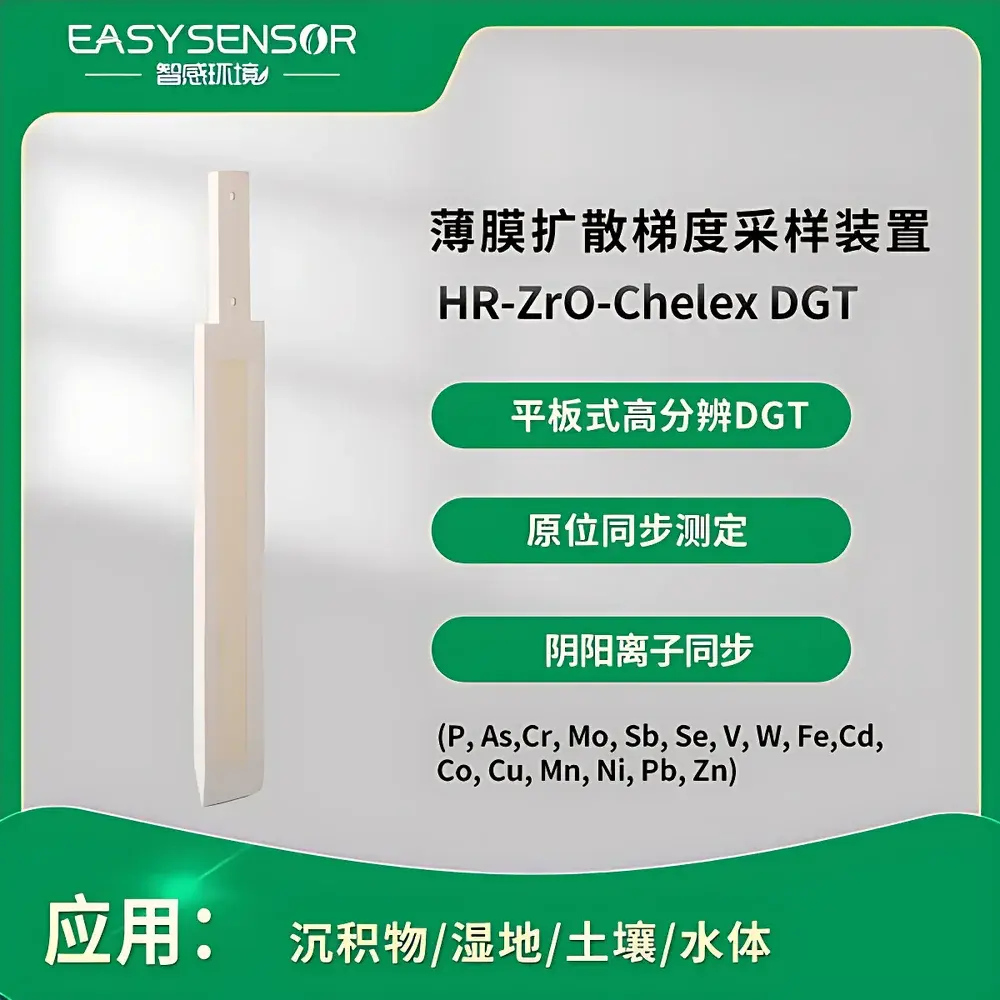
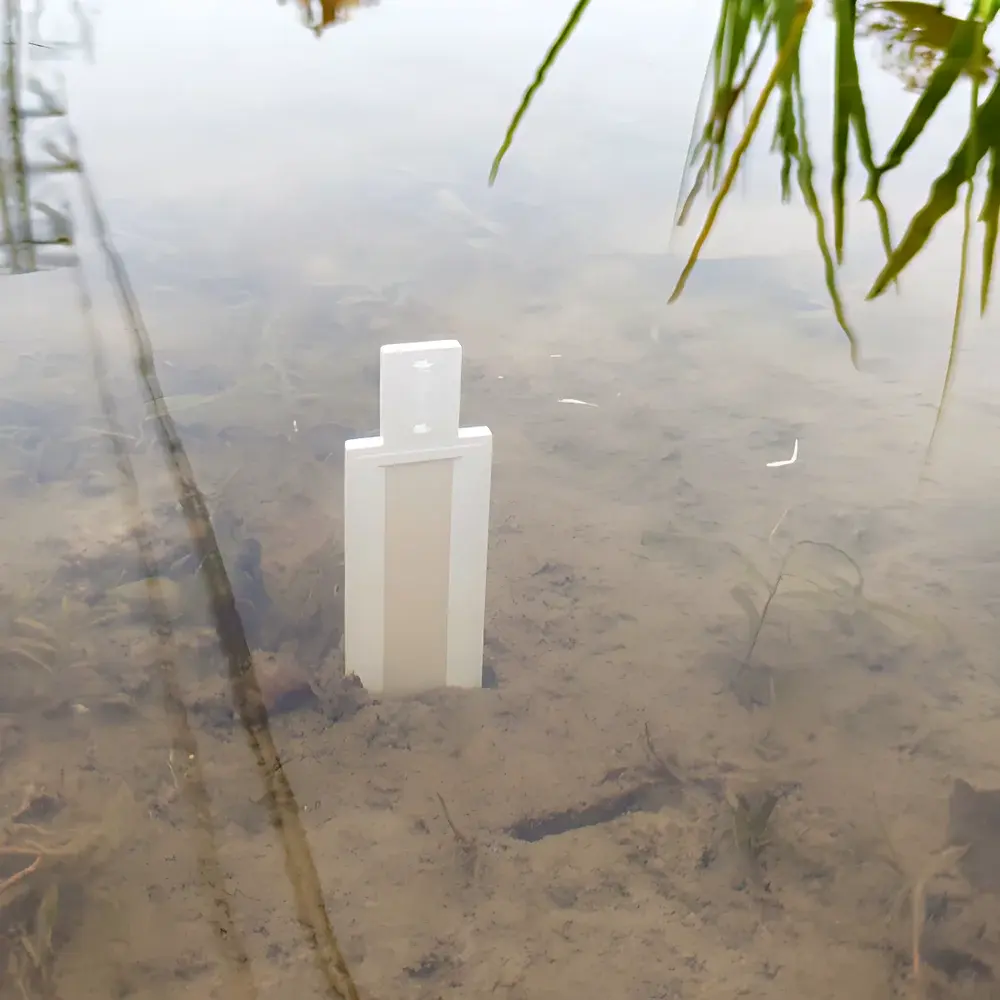
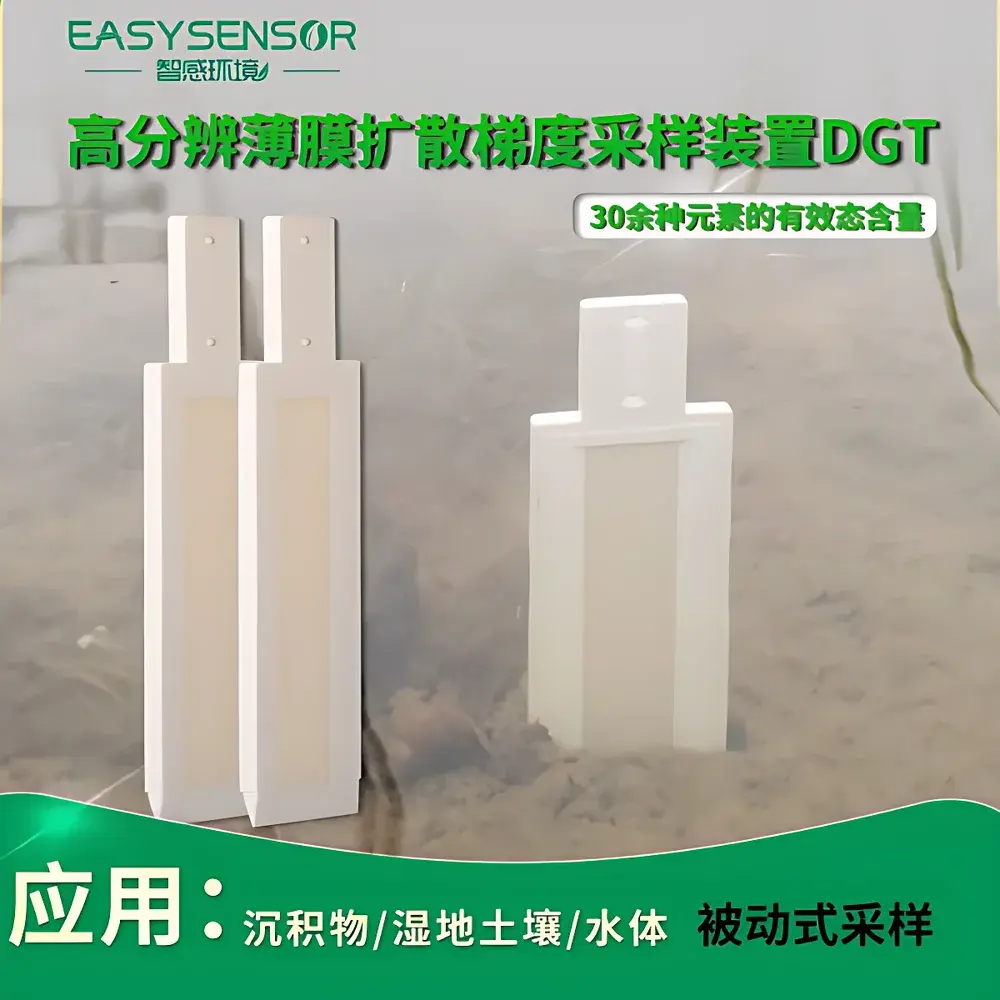
Easysensor HR-ZrO-Chelex High-Resolution Diffusive Gradients in Thin-films (DGT) Device DF-H-05
| Brand | Easysensor |
|---|---|
| Origin | Jiangsu, China |
| Manufacturer Type | Authorized Distributor |
| Country of Origin | China |
| Model | DF-H-05 |
| Price | USD 165 (FOB) |
| Target Analytes | Fe, Cd, Co, Cu, Mn, Zn, Pb, Ni, P, As, Cr, Mo, Sb, Se, V, W |
| Binding Layer | ZrO₂–Chelex composite gel, thickness 0.40 mm, dimensions 150 × 20 mm |
| Filter Membrane | PVDF, 0.10 mm thick, 150 × 20 mm |
| Diffusive Gel | Agarose-based, nominal thickness 0.80 mm |
| Sampling Area | 3000 mm² (150 × 20 mm) |
| Packaging | Individually sealed in sterile, light-blocking aluminum foil pouches under moist conditions |
| Shelf Life | 12 months at room temperature, protected from light and desiccation |
Overview
The Easysensor HR-ZrO-Chelex High-Resolution Diffusive Gradients in Thin-films (DGT) Device (Model DF-H-05) is a purpose-engineered passive sampling tool designed for two-dimensional (2D), in situ quantification of labile metal(loid) species and phosphate in sediment porewaters and wetland soils. Unlike conventional DGT devices optimized for bulk accumulation measurements, the HR-ZrO-Chelex system integrates a nanoscale composite binding layer—comprising ultrafine zirconium oxide (ZrO₂) and Chelex-100 resin particles—within a mechanically robust, non-swelling hydrogel matrix. This architecture enables high spatial fidelity during deployment and subsequent laser ablation inductively coupled plasma mass spectrometry (LA-ICP-MS) analysis. The device operates on Fick’s first law of diffusion: analytes migrate through a defined-thickness diffusive gel (agarose, 0.80 mm) before being irreversibly sequestered by the binding layer. Its design conforms to the theoretical framework established in the DGT literature (Davison & Zhang, 2012; Zhang et al., Environ. Sci. Technol. 2001), with diffusion coefficients validated against standard aqueous calibration protocols per ISO 17402:2006 (Soil quality — Guidance on the application of diffusive gradients in thin-films technique).
Key Features
- Nanoscale Composite Binding Layer: HR-ZrO-Chelex gel combines high-affinity ZrO₂ for oxyanions (e.g., PO₄³⁻, AsO₄³⁻, MoO₄²⁻) and Chelex-100 for cationic metals (e.g., Fe²⁺/³⁺, Cu²⁺, Zn²⁺, Pb²⁺), enabling simultaneous, selective accumulation of 16 target elements without competitive interference.
- Mechanical Stability & Dimensional Integrity: The binding gel exhibits negligible swelling (<0.5% volume change in 0.01 M NaNO₃) and retains structural rigidity post-deployment—critical for maintaining pixel-level registration during LA-ICP-MS rastering.
- Controlled-Drying Protocol: A proprietary ambient-pressure gel drying method preserves membrane flatness and surface topography; dried gels show no cracking or warping, ensuring uniform ablation efficiency across the full 150 × 20 mm active area.
- Standardized Diffusive Geometry: Precisely cast agarose gel (0.80 mm ± 0.02 mm) provides consistent molecular diffusion resistance; batch-certified diffusion coefficients are supplied with each lot, traceable to NIST SRM 1643e reference water.
- Deployment-Ready Packaging: Each unit is pre-assembled, sterilized, and hermetically sealed in light-impermeable aluminum foil pouches containing humidified buffer-saturated air—eliminating field assembly errors and preserving binding capacity during storage.
Sample Compatibility & Compliance
The HR-ZrO-Chelex DGT is validated for use in anoxic and oxic sediments (redox range −200 to +400 mV), peat-rich wetland soils (pH 3.5–7.8), and interstitial waters with ionic strengths up to 0.1 mol L⁻¹ (NaCl equivalent). It complies with the analytical requirements of ISO 17402:2006 for DGT-based speciation and supports GLP-aligned workflows when used with documented calibration, blank control, and QA/QC procedures. For regulatory applications—including sediment quality assessment under EU Water Framework Directive Annex V or US EPA Method 1669—users must validate recovery rates using certified reference materials (e.g., BCR-701 freshwater sediment) and report uncertainty budgets per ISO/IEC 17025:2017.
Software & Data Management
No embedded firmware or proprietary software is required for operation. Raw LA-ICP-MS data (mass-resolved ion counts per pixel) are exported as .csv or .imzML files compatible with open-source platforms including SCiLS Lab, MSiReader, and ImageJ with Bio-Formats plugin. Quantitative imaging relies on internal standardization using co-ablated Y or In spikes applied uniformly across the gel surface prior to drying. Calibration curves derived from solution-phase DGT uptake experiments (n = 6 replicates per concentration level) are applied pixel-wise using linear regression models. All processing steps—including background subtraction, dead-time correction, and isotope ratio normalization—are fully auditable and exportable for 21 CFR Part 11-compliant electronic records when integrated into validated LIMS environments.
Applications
- High-resolution mapping of phosphorus and iron redox microzones in lake and estuarine sediments
- Quantifying bioavailable metal fluxes at plant–sediment interfaces in constructed wetlands
- Validating reactive transport models (e.g., ORCHESTRA, PHREEQC) with sub-millimeter porewater chemistry profiles
- Assessing in situ effectiveness of sediment capping or amendment strategies (e.g., ZVI, lanthanum-modified bentonite)
- Correlative analysis with planar optodes (O₂, pH), DET probes, and enzyme activity imaging (e.g., phosphatase, dehydrogenase)
- Supporting biogeochemical studies of metal(loid) mobilization under climate-induced redox oscillations
FAQ
What is the recommended deployment duration for sediment profiling?
Typical deployments range from 24 to 72 hours under controlled temperature (4–25 °C); longer durations require verification of diffusion layer saturation via edge-effect analysis.
Can HR-ZrO-Chelex DGT be reused after extraction?
No—binding layers are single-use due to irreversible analyte retention and potential gel matrix degradation during acid elution or LA ablation.
Is calibration required for every batch of devices?
Yes; diffusion coefficient variability between agarose lots necessitates batch-specific calibration using standardized ionic strength solutions per ISO 17402 Annex B.
How is blank correction handled in LA-ICP-MS quantification?
Field blanks (deployed in low-analyte artificial porewater) and procedural blanks (non-deployed devices processed identically) are analyzed in parallel; median blank signal is subtracted pixel-wise prior to quantification.
Does the device comply with EPA or ASTM methods?
While not assigned a formal EPA method number, its operational principles align with EPA Draft Method 1669 (DGT for Metals in Sediments) and ASTM D8255-20 (Standard Guide for Passive Sampling in Environmental Media).
Related Products



