
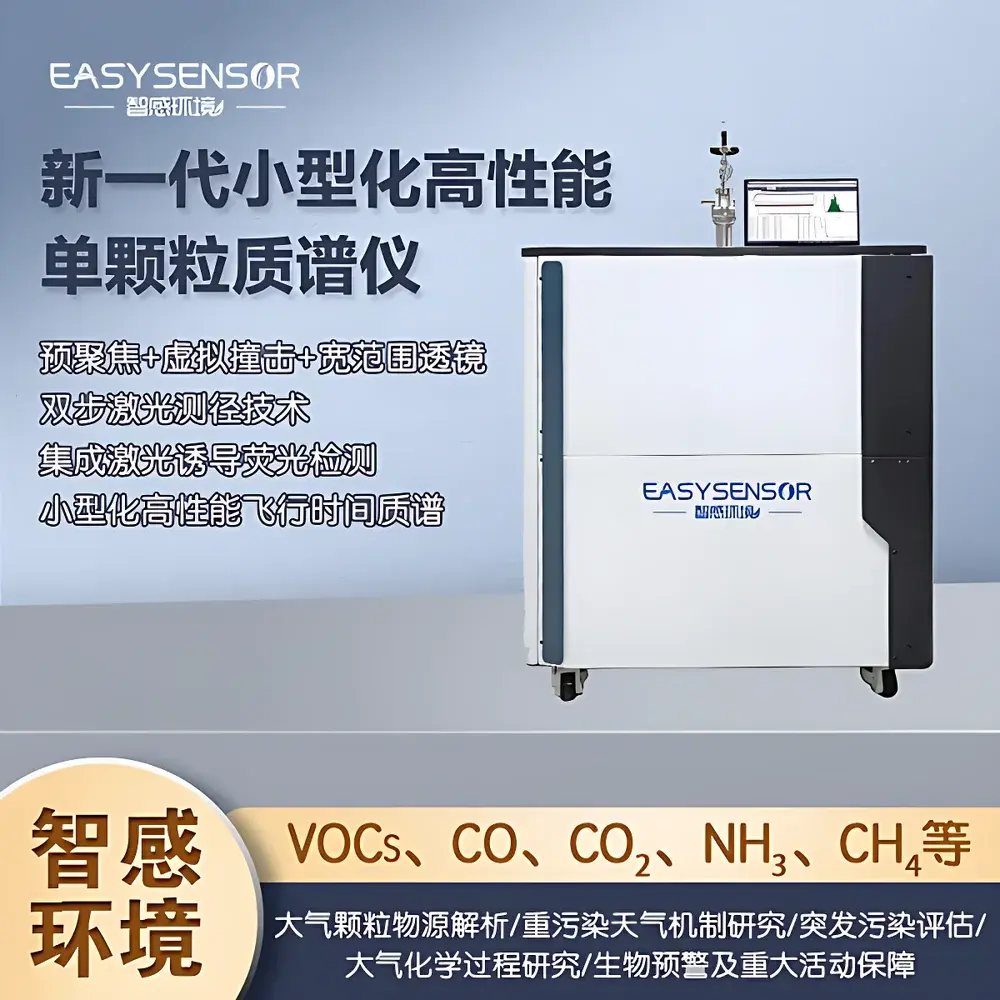
Easysensor ZG-SPAMS 1000 (02) Aerosol Time-of-Flight Mass Spectrometer
| Brand | Easysensor |
|---|---|
| Model | ZG-SPAMS 1000 (02) |
| Origin | Jiangsu, China |
| Particle Size Range | 0.15–9 µm (airborne aerodynamic diameter) |
| Detection Rate | up to 20,000 particles/sec |
| Mass Range | 1–900 amu |
| Mass Resolution | 1000 @ Pb⁺ |
| Laser Wavelengths | 405 nm (size), 266 nm (ionization), optional 355 nm (LIF) |
| Flow Rate Options | 0.1–0.5 L/min |
| Dimensions | 1160 × 780 × 560 mm |
| Weight | 140 kg |
| Minimum Detectable Concentration | 0.001 particles/cm³ |
Overview
The Easysensor ZG-SPAMS 1000 (02) is a single-particle aerosol time-of-flight mass spectrometer engineered for real-time, in-situ characterization of atmospheric particulate matter. It integrates dual-laser aerodynamic sizing, laser-induced fluorescence (LIF) pre-screening, and bipolar time-of-flight mass spectrometry (TOF-MS) into a unified platform. Unlike ensemble-averaging techniques such as filter-based IC-MS or bulk aerosol AMS, this instrument resolves individual particles—measuring both aerodynamic diameter and full positive/negative ion mass spectra on a per-particle basis. Its core measurement principle relies on the coupling of particle velocity (derived from dual-scatter timing at 405 nm) with mass-to-charge ratio (determined via flight time in a field-free drift tube following 266 nm laser desorption/ionization). This enables unambiguous source attribution through simultaneous physicochemical fingerprinting—critical for regulatory monitoring, climate modeling, and bioaerosol threat assessment.
Key Features
- Wide aerodynamic size coverage: Configurable inlet with virtual impactor and pre-focusing aerolens supports two operational modes: 0.15–5 µm and 0.3–9 µm, fully encompassing PM1, PM2.5, PM10, and coarse-mode mineral/sea-salt particles.
- High-throughput single-particle analysis: Capable of >20,000 particles per second detection under ambient concentrations up to 104 cm−3, enabling robust statistical sampling during pollution episodes without signal saturation.
- Integrated LIF pre-screening: Optional 355 nm excitation module detects intrinsic fluorescence from biological macromolecules (e.g., NADH, tryptophan, riboflavin), allowing selective triggering of mass spectral acquisition for microbial, fungal, or pollen particles—reducing data volume and enhancing signal-to-noise for biothreat identification.
- Bipolar TOF-MS architecture: Simultaneous acquisition of positive and negative ion mass spectra per particle improves molecular speciation (e.g., distinguishing sulfate [SO4−] from nitrate [NO3−] and organic fragments), with mass resolution ≥1000 (FWHM at Pb+) across 1–900 amu.
- Pulse-delayed extraction: Enhances dynamic range and mass accuracy by optimizing ion acceleration timing relative to laser pulse, critical for quantifying trace metals (e.g., Pb, Fe, Zn) alongside dominant organic and inorganic ions.
- Field-deployable mechanical design: Compact footprint (1160 × 780 × 560 mm) and 140 kg mass facilitate integration into mobile laboratories, aircraft cabins, or rooftop monitoring stations—validated for continuous operation under temperature fluctuations (−10 °C to +40 °C) and vibration conditions typical of vehicle-mounted platforms.
Sample Compatibility & Compliance
The ZG-SPAMS 1000 (02) accepts ambient air without filtration or dilution, maintaining native particle morphology and chemical integrity. It complies with standard aerosol metrology practices defined in ISO 29463 (high-efficiency filters), ISO 14644 (cleanroom classification), and EPA Method IO-3.1 (real-time particulate source apportionment). While not certified for clinical diagnostics, its LIF-triggered acquisition mode aligns with CDC-recommended bioaerosol surveillance protocols for environmental pathogen screening. Data output formats adhere to netCDF-4 and HDF5 standards, supporting interoperability with EPA’s CMAQ and NOAA’s HYSPLIT modeling frameworks. Audit trails, user authentication, and electronic signature capabilities satisfy GLP-compliant data governance requirements for environmental reporting under ISO/IEC 17025.
Software & Data Management
Two-tier software architecture ensures operational flexibility: the embedded Real-Time Source Apportionment Engine performs on-instrument clustering (k-means + ART-2a neural network) to classify particles into >12 predefined types (e.g., dust, sea salt, biomass burning, secondary organic aerosol, heavy-metal-rich) and outputs time-resolved concentration profiles at 1-minute resolution. The desktop SPAMS-Analyzer Suite handles large-scale batch processing—capable of parsing >107 particle records with customizable feature extraction (e.g., ion ratio thresholds, size-binned mass spectral libraries). All raw TOF waveforms, scatter timing data, and metadata are preserved in open binary format for third-party reprocessing (e.g., using Python-based PySPAMS or MATLAB toolboxes). Software supports 21 CFR Part 11-compliant electronic records when deployed with validated server infrastructure.
Applications
- Atmospheric source apportionment: Quantifies contributions from coal combustion, vehicular exhaust, biomass burning, crustal dust, and marine emissions to PM2.5/PM10 in urban, rural, and transboundary contexts—supporting compliance with WHO Air Quality Guidelines and national emission control strategies.
- Emergency response monitoring: Mounted on mobile platforms, it provides georeferenced, real-time chemical mapping during industrial accidents (e.g., VOC leaks, chlorine releases) or wildfire plume tracking—enabling rapid exposure assessment and evacuation zone delineation.
- Climate-relevant aerosol properties: Correlates single-particle composition with hygroscopic growth factors and cloud condensation nuclei (CCN) activation potential—feeding parameterizations for radiative forcing models in CMIP6 and IPCC AR6 assessments.
- Public health bioaerosol surveillance: Detects airborne bacteria, fungal spores, and virus-like particles via LIF + MS signatures in high-risk settings (hospitals, airports, mass transit hubs), informing infection control policies without culture-dependent delays.
- Industrial hygiene and pharmaceutical QC: Monitors nanoparticle release in battery manufacturing or inhalable drug formulation lines—verifying containment integrity and validating cleanroom performance against ISO 14644-1 Class 5–8 criteria.
FAQ
What particle size range does the ZG-SPAMS 1000 (02) resolve?
It measures aerodynamic diameters from 0.15 µm to 9 µm, with configurable inlet settings optimized for fine (0.15–5 µm) or coarse (0.3–9 µm) mode analysis.
Can it distinguish between viable and non-viable biological particles?
While LIF intensity correlates with metabolic activity, viability confirmation requires orthogonal assays (e.g., culturing, qPCR); the system identifies fluorescent bioparticles—not viability status.
Is calibration traceable to international standards?
Aerodynamic sizing is calibrated using NIST-traceable PSL and ammonium nitrate aerosols; mass scale uses known elemental peaks (e.g., Na+, K+, Pb+) referenced to IUPAC atomic weights.
Does it support remote operation and data telemetry?
Yes—integrated Ethernet and optional 4G/LTE module enable secure SSH access, real-time data streaming to cloud dashboards, and automated report generation via RESTful API.
How is data quality assured during long-term unattended operation?
Automated daily checks include laser energy monitoring, TOF voltage stability verification, and reference particle injection (optional calibrant aerosol generator), with alerts logged to Syslog-compliant servers.




