
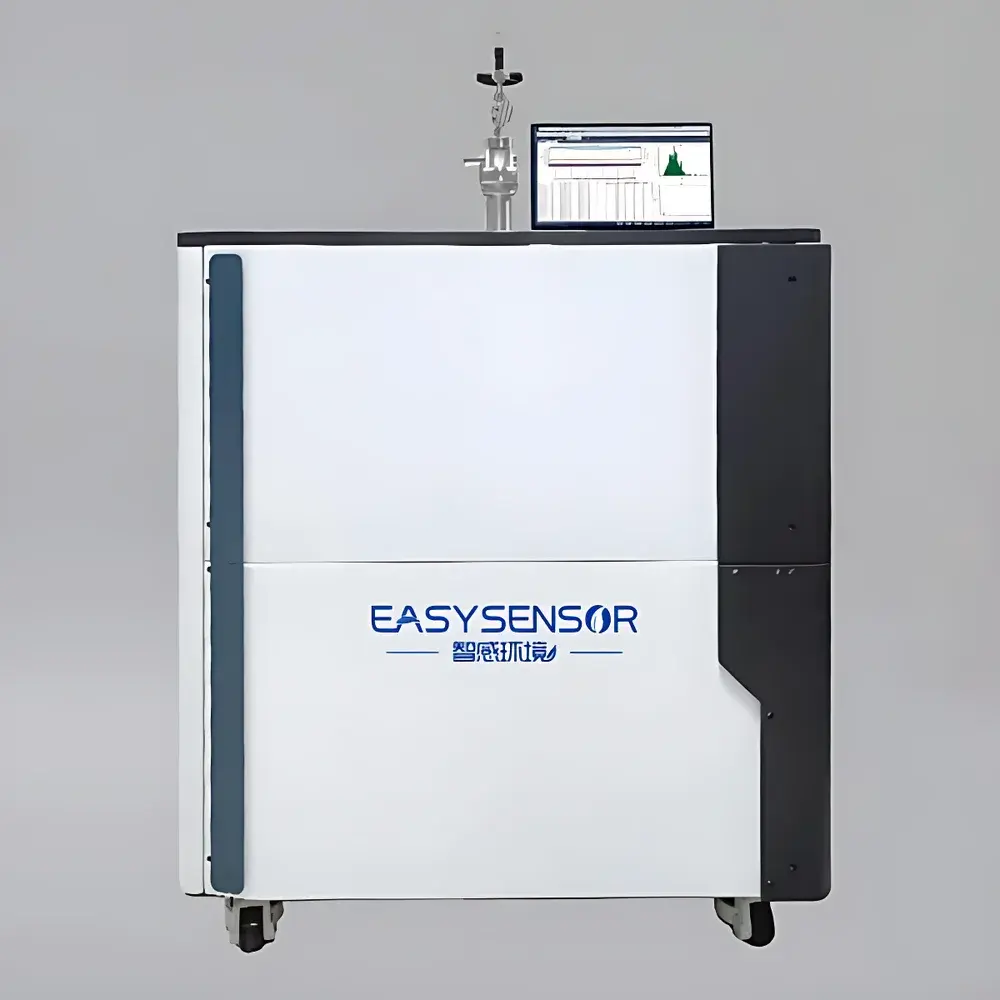
Easysensor ZG-SPAMS 1000 Single-Particle Aerosol Time-of-Flight Mass Spectrometer
| Brand | Easysensor |
|---|---|
| Origin | Jiangsu, China |
| Manufacturer Type | Authorized Distributor |
| Country of Origin | China |
| Model | ZG-SPAMS 1000 |
| Pricing | Upon Request |
Overview
The Easysensor ZG-SPAMS 1000 is a laboratory- and field-deployable single-particle aerosol time-of-flight mass spectrometer engineered for real-time, in-situ chemical and aerodynamic size characterization of individual airborne particles. It operates on the principle of dual-laser single-particle analysis: a 405 nm laser measures particle aerodynamic diameter via two-step light scattering, while a pulsed 266 nm ultraviolet laser induces soft ionization for high-resolution time-of-flight mass spectrometry (TOF-MS). The instrument integrates laser-induced fluorescence (LIF) pre-screening to selectively trigger analysis of bioaerosol-relevant particles—enabling targeted detection of bacteria, fungal spores, pollen, and viral surrogates without offline enrichment. Designed for continuous unattended operation, the ZG-SPAMS 1000 delivers quantitative particle number concentration (down to 0.001 particles/cm³), size-resolved composition (0.15–9 µm aerodynamic diameter), and bipolar mass spectra (1–900 amu) with unit-mass resolution (1000 at Pb⁺). Its architecture supports high-throughput sampling (up to 20,000 particles/sec), making it suitable for both ambient background monitoring and acute pollution event response.
Key Features
- Dual-laser particle sizing: 405 nm dual-scatter configuration for precise aerodynamic diameter determination with sub-micrometer resolution across 0.15–9 µm range.
- Laser-induced fluorescence (LIF) pre-triggering: Integrated 355 nm/445 nm excitation-emission channels enable selective acquisition of bioaerosol-associated particles, reducing data volume and enhancing signal-to-noise ratio in complex matrices.
- High-sensitivity UV laser ionization: 266 nm Nd:YAG laser with pulse-delayed extraction ensures wide dynamic range and reproducible ion yields across organic and inorganic species.
- Wide-flow aerodynamic lens system: Configurable inlet with virtual impactor and pre-focusing stage supports stable sampling at 0.1–0.5 L/min; selectable cutoffs for 0.15–5 µm or 0.3–9 µm size ranges.
- Compact mobile-ready design: Dimensions 1160 × 780 × 560 mm; weight 140 kg—certified for vehicular and aircraft-mounted deployment per ISO 10816-1 vibration standards.
- Real-time source apportionment: Onboard processing engine classifies particles into >12 chemically distinct types (e.g., dust, sea salt, soot, biomass burning, heavy-metal-rich, secondary sulfate/nitrate) with 1-minute temporal resolution.
Sample Compatibility & Compliance
The ZG-SPAMS 1000 analyzes native, unmodified aerosol particles directly from ambient air or controlled chamber environments. It requires no derivatization, filtration, or solvent extraction—preserving intrinsic particle morphology and surface chemistry. The system complies with ASTM D6246–22 (Standard Practice for Real-Time Aerosol Characterization) and supports traceable calibration using NIST-traceable PSL and SRM 1648a urban particulate reference materials. Data acquisition and storage adhere to GLP-compliant audit trail protocols, including user authentication, timestamped metadata logging, and immutable raw-data archiving—fully compatible with FDA 21 CFR Part 11 requirements when deployed in regulated environmental health or pharmaceutical cleanroom monitoring applications.
Software & Data Management
The ZG-SPAMS 1000 ships with two integrated software suites: SPAMS-RT (Real-Time Analysis Platform) and SPAMS-PRO (Advanced Research Suite). SPAMS-RT provides live visualization of particle number concentration, size distribution, chemical class abundance, and hourly source contribution heatmaps—exportable as CSV, NetCDF, or standardized EPA AQS format. SPAMS-PRO enables deep interrogation of multi-million-particle datasets using adaptive resonance theory (ART-2a) neural network classification, customizable spectral library matching, and multidimensional correlation analysis (e.g., m/z vs. size vs. time). All software modules support batch reprocessing, spectral deconvolution of overlapping peaks, and export of MIAME-compliant metadata for publication-ready figures per IUPAC recommendations.
Applications
- Environmental Source Apportionment: Quantitative attribution of PM₂.₅ and PM₁₀ sources—including coal combustion, traffic emissions, industrial metal processing, biomass burning, and long-range transported dust—validated against receptor modeling frameworks (e.g., PMF, UNMIX).
- Climate-Relevant Aerosol Studies: Measurement of hygroscopic growth factors, cloud condensation nuclei (CCN) activation thresholds, and light-absorbing carbon speciation under controlled RH conditions.
- Bioaerosol Surveillance: Operational deployment in public health infrastructure (airports, hospitals, mass transit hubs) for early-warning detection of pathogenic microorganisms based on LIF spectral signatures and characteristic fragment ions (e.g., m/z 84, 126, 168 for bacterial peptidoglycan).
- Industrial Hygiene Monitoring: Real-time assessment of nanoparticle release during material synthesis, pharmaceutical powder handling, and occupational exposure limit (OEL) compliance verification per ISO/TC 229 guidelines.
- Emergency Response: Mobile mapping of chemical plumes (e.g., industrial VOC leaks, wildfire smoke, post-explosion residues) with georeferenced particle-class distribution overlays.
FAQ
What particle size range does the ZG-SPAMS 1000 cover, and how is aerodynamic diameter determined?
The instrument measures particles from 0.15 to 9 µm aerodynamic diameter using dual-angle 405 nm laser scattering. Size is calculated from time-resolved scattering intensity profiles, calibrated against polystyrene latex (PSL) standards traceable to NIST SRM 1963.
Can the system distinguish between viable and non-viable biological particles?
While viability cannot be confirmed without culturing, the integrated LIF module detects autofluorescence from NAD(P)H, riboflavin, and tryptophan—strong indicators of metabolically active cells. Combined with mass spectral biomarkers (e.g., phospholipid fragments), this enables probabilistic viability inference.
Is the ZG-SPAMS 1000 compliant with regulatory reporting standards for air quality monitoring?
Yes—the instrument meets the technical specifications outlined in EU Directive 2008/50/EC Annex IX for advanced aerosol speciation and supports data formatting required by national air quality management systems (e.g., US EPA AirNow, China MEP AQI platforms).
How is mass spectral calibration maintained during extended unattended operation?
Automated daily internal calibration uses thermally desorbed cesium iodide clusters (CsIₙ⁺) generated from a solid-state reference source, ensuring mass accuracy within ±0.05 amu over 30-day intervals.
Does the system support remote diagnostics and firmware updates?
Yes—via secure TLS 1.3-enabled web interface with role-based access control; all diagnostic logs, vacuum status, laser energy metrics, and detector gain parameters are remotely monitorable and configurable.
Related Products







