
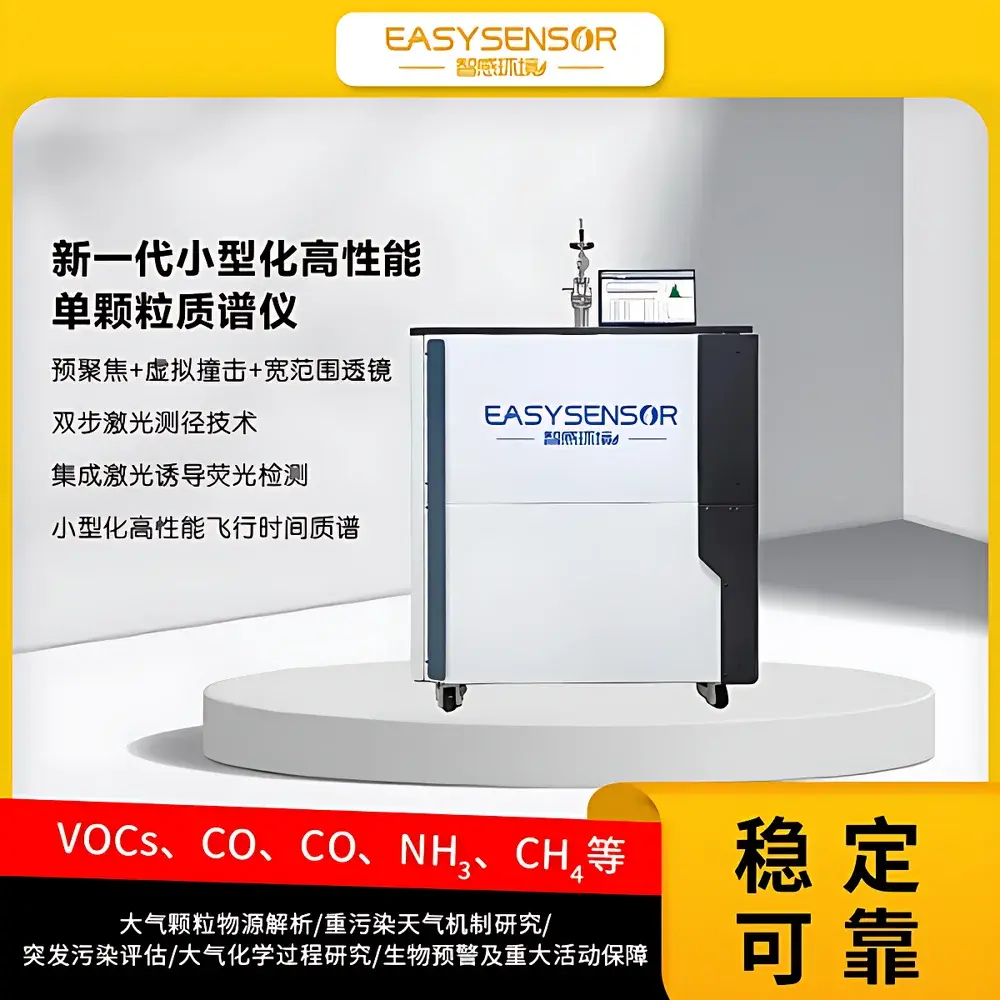
Easysensor ZG-SPAMS 1000(15) Aerosol Single-Particle Time-of-Flight Mass Spectrometer
| Brand | Easysensor |
|---|---|
| Origin | Jiangsu, China |
| Manufacturer Type | Authorized Distributor |
| Country of Origin | China |
| Model | ZG-SPAMS 1000(15) |
| Pricing | Upon Request |
| Particle Size Range | 0.15–9 μm (selectable modes: 0.15–5 μm or 0.3–9 μm) |
| Sample Flow Rate | 0.1–0.5 L/min |
| Particle Throughput | Up to 20,000 particles/sec |
| Sizing Method | Dual-step 405 nm aerodynamic laser scattering |
| Fluorescence Detection | Integrated 266/355 nm LIF module for bio-aerosol pre-screening |
| Ionization | 266 nm Nd:YAG pulsed laser |
| Mass Analyzer | Bipolar reflectron time-of-flight (TOF-MS) |
| Mass Resolution | ≥1000 (FWHM at Pb⁺) |
| Mass Range | 1–900 Da |
| Detection Limit | 0.001 particles/cm³ |
| Data Acquisition Rate | 60 single-particle mass spectra/sec |
| Dimensions | 1160 × 780 × 560 mm |
| Weight | 140 kg |
Overview
The Easysensor ZG-SPAMS 1000(15) is a real-time, online aerosol single-particle time-of-flight mass spectrometer engineered for high-fidelity chemical and morphological characterization of individual airborne particles. It operates on the principle of dual-laser single-particle analysis: a pair of 405 nm lasers perform aerodynamic sizing via light scattering, while a 266 nm Nd:YAG pulsed laser induces soft ionization of each particle in vacuum; resulting ions are separated and detected by a bipolar reflectron time-of-flight mass analyzer. This architecture enables simultaneous measurement of particle aerodynamic diameter (0.15–9 μm), elemental composition, organic fragment patterns, and metal speciation—without ensemble averaging or bulk extraction. Designed for unattended field deployment, the system supports continuous operation under variable ambient conditions and integrates seamlessly into atmospheric observatories, mobile laboratories, and emergency response platforms.
Key Features
- Wide-dynamic-range particle introduction: Aerodynamic lens with virtual impactor and pre-focusing stage ensures stable sampling across flow rates of 0.1–0.5 L/min and selectable size ranges (0.15–5 μm or 0.3–9 μm).
- Dual-step 405 nm laser sizing: Delivers high-resolution aerodynamic diameter quantification with reproducibility <±5% across the full operational range, validated against NIST-traceable PSL standards.
- Laser-induced fluorescence (LIF) pre-screening: Dual-wavelength (266/355 nm) excitation detects intrinsic fluorophores in biological particles—including bacteria, fungal spores, and pollen—enabling selective triggering and reducing data acquisition load in complex matrices.
- Bipolar TOF-MS detection: Simultaneous positive- and negative-ion mass spectra per particle, covering 1–900 Da with mass resolution ≥1000 (FWHM at Pb⁺), enabling robust identification of sulfate, nitrate, ammonium, organics, and transition metals (e.g., Fe, Pb, Zn, V).
- Pulse-delayed extraction: Enhances mass accuracy and dynamic range, supporting quantitative analysis even under high-concentration conditions (>20,000 particles/sec).
- Compact mobile-ready design: Fully integrated optics, vacuum system, and electronics within a 140 kg chassis (1160 × 780 × 560 mm), certified for vehicular and aircraft-mounted operation per MIL-STD-810G shock/vibration requirements.
Sample Compatibility & Compliance
The ZG-SPAMS 1000(15) accepts ambient air, stack emissions, chamber-generated aerosols, and filtered resuspensions without sample preparation. It complies with ISO 21501-4 for particle sizing instrumentation and supports traceable calibration using polystyrene latex (PSL) and dioctyl sebacate (DOS) standards. Data integrity adheres to GLP principles: audit trails, user authentication, electronic signatures, and raw-data immutability are enforced through embedded firmware controls. While not FDA 21 CFR Part 11–certified out-of-the-box, the system architecture permits integration with validated LIMS environments meeting regulatory data governance requirements for environmental monitoring programs under EPA Methods IO-3.2 and EU Directive 2008/50/EC.
Software & Data Management
Two-tier software architecture supports both operational and research workflows. The real-time source apportionment engine performs automated clustering (ART-2a neural network) and classifies particles into >12 predefined categories (e.g., dust, sea salt, biomass burning, traffic-related, secondary sulfate/nitrate) with minute-level temporal resolution. Output includes time-series concentration plots, category-specific size distributions, and exportable CSV/HDF5 datasets. The offline research suite handles multi-gigabyte datasets (>10⁷ particles), supports custom classifier training, ion ratio mapping (e.g., m/z 43/44 for O:C estimation), 3D visualization (size–time–intensity), and batch reprocessing with configurable mass calibration and peak deconvolution algorithms. All software modules run on Windows 10/11 x64 with Intel i7+ CPU and ≥32 GB RAM.
Applications
- Atmospheric source apportionment: Quantitative discrimination of industrial, vehicular, coal combustion, biomass burning, and crustal sources in PM₂.₅ and PM₁₀; deployed in multi-site campaigns for transboundary dust transport modeling (e.g., East Asian dust events).
- Emergency response monitoring: Real-time identification of hazardous aerosols during chemical spills, fire plumes, or industrial accidents—enabling rapid source localization and exposure assessment.
- Climate-relevant aerosol properties: Correlation of single-particle composition with hygroscopic growth factors and cloud condensation nuclei (CCN) activity via co-located supersaturation scanning systems.
- Bio-aerosol surveillance: Discrimination of viable vs. non-viable microbial particles using LIF intensity thresholds and fragmentation patterns; applied in airport biosecurity, hospital HVAC monitoring, and pandemic early-warning networks.
- Industrial hygiene and pharmaceutical QA: Detection of process-related contaminants (e.g., catalyst residues, excipient carryover) in cleanroom air and lyophilization exhaust streams.
FAQ
What particle size ranges can be measured, and how is size selection configured?
The instrument supports two interchangeable size modes: 0.15–5 μm and 0.3–9 μm. Selection is performed mechanically via adjustable virtual impactor cutpoints and verified using calibrated PSL standards prior to deployment.
Is the system capable of distinguishing between anthropogenic and natural mineral dust?
Yes—via characteristic ion ratios (e.g., Ca⁺/Al⁺, Fe⁺/Si⁺, K⁺/Ca⁺) and organic tracer fragments (e.g., levoglucosan, cholesterol), combined with ART-2a supervised classification trained on reference spectra from known source profiles.
How is data quality ensured during long-term unattended operation?
Automated daily mass calibration using ambient NO₂ and HNO₃ peaks, continuous pressure and laser energy monitoring, and built-in diagnostic routines flag drift or vacuum degradation before data integrity is compromised.
Can the ZG-SPAMS 1000(15) interface with external meteorological or gas-phase analyzers?
Yes—via TCP/IP and RS-232 protocols, supporting synchronized timestamping and metadata injection (e.g., RH, T, O₃, NOₓ) for multivariate correlation analysis in post-processing.
What maintenance intervals are recommended for field operation?
Laser optics cleaning every 3 months, TOF detector gain recalibration every 6 months, and vacuum pump oil replacement annually—procedures documented in the ISO 9001–certified service manual provided with each unit.
Related Products




