
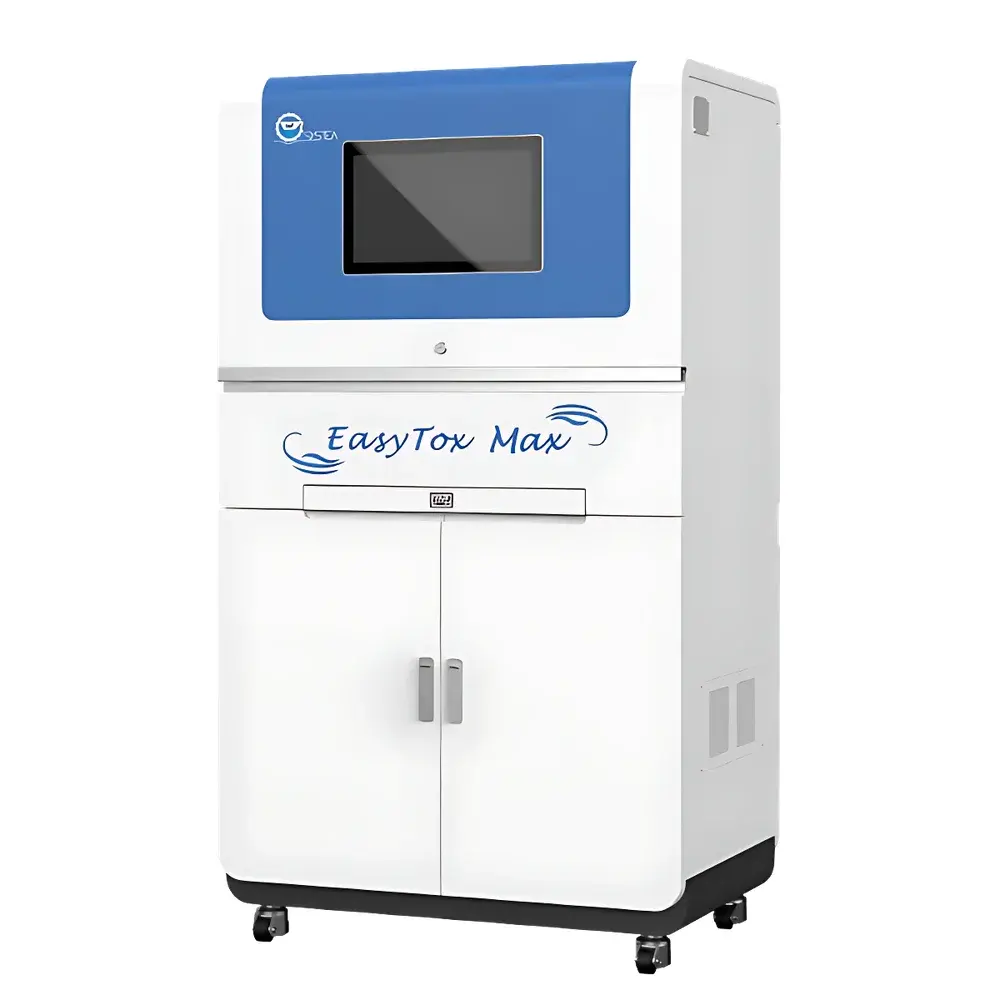
EasyTox Max Online Aquatic Toxicity Monitor by SYSTEA
| Brand | SYSTEA |
|---|---|
| Origin | Zhejiang, China |
| Model | EasyTox Max |
| Detection Principle | Bioluminescent Bacterial Inhibition Assay (using *Aliivibrio fischeri*, *Photobacterium phosphoreum*, or *Vibrio qinghaiensis* Q67) |
| Toxicity Output | % Inhibition (qualitative) and EC50 (quantitative, 160× dilution capability) |
| Measurement Frequency | As fast as 2.5 min/cycle |
| Exposure Time | Programmable from 5 min to 24 h |
| Compliance | ISO 11348-3, GB/T 15441 |
| Reagent Storage | Integrated 4–8 °C refrigerated compartment |
| Cleaning | Automated washing station with dedicated rinse cycles |
| Control Interface | Industrial-grade capacitive touchscreen with full programmability |
| Bacterial Maintenance Interval | 8–16 weeks (with on-board reactivation of lyophilized cultures) |
Overview
The EasyTox Max Online Aquatic Toxicity Monitor is a fully automated, real-time biological early-warning system engineered for continuous assessment of acute toxicity in water matrices. It operates on the internationally standardized bioluminescent inhibition principle defined in ISO 11348-3 and GB/T 15441, utilizing the metabolic light-emission response of luminescent bacteria—including Aliivibrio fischeri, Photobacterium phosphoreum, and Vibrio qinghaiensis Q67—as a sensitive, physiologically relevant endpoint. Upon exposure to toxicants, bacterial respiratory chain disruption leads to rapid, dose-dependent reduction in bioluminescence intensity, enabling quantification of both qualitative inhibition (%) and quantitative EC50 values. Unlike chemical surrogate sensors, the EasyTox Max detects bioavailable, synergistic, and unknown toxic compounds—making it indispensable for source water protection, wastewater discharge compliance, and emergency event response.
Key Features
- On-board lyophilized bacterial reactivation: Supports automatic, scheduled revival of A. fischeri and P. phosphoreum cultures without manual intervention—extending operational uptime to 8–16 weeks between maintenance cycles.
- Dual-mode toxicity reporting: Simultaneous generation of % inhibition (relative to blank-controlled parallel measurements) and EC50 (calculated via logistic regression across up to 160× sample dilution series), ensuring trace-level sensitivity and regulatory-grade quantitation.
- High-temporal-resolution monitoring: Configurable measurement intervals down to 2.5 minutes per cycle, with 60-second signal acquisition windows per reaction cuvette—enabling rapid detection of transient contamination events.
- Programmable exposure kinetics: Toxicity incubation time adjustable from 5 minutes to 24 hours, allowing method optimization for diverse contaminant classes (e.g., heavy metals vs. organic pesticides).
- Integrated quality assurance architecture: Real-time bacterial viability validation prior to each assay, auto-flagging of low-luminescence baselines, and post-run statistical outlier detection—all logged with full audit trail.
- Refrigerated reagent management: Dedicated 4–8 °C storage compartment for lyophilized bacteria, control standards, and calibration solutions, maintaining stability and extending shelf life per ICH Q5C guidelines.
- Contamination-resistant fluidics: Fully automated cleaning station with sequential deionized water, detergent, and air-purge cycles—validated to eliminate carryover between samples and reagents per ISO 8466-1 protocols.
Sample Compatibility & Compliance
The EasyTox Max is validated for direct analysis of raw and filtered surface water, drinking water, groundwater, municipal wastewater effluent, industrial process streams, and marine-influenced estuarine samples. Sample turbidity up to 100 NTU and suspended solids ≤ 50 mg/L are accommodated via integrated filtration options. All operational parameters—including dilution factors, exposure durations, and alarm thresholds—are configurable to align with national and international regulatory frameworks. The system meets ISO/IEC 17025 documentation requirements for routine testing laboratories and supports GLP-compliant data integrity through secure user authentication, electronic signatures, and immutable audit logs compliant with FDA 21 CFR Part 11 Annex 11 principles.
Software & Data Management
Control and data acquisition are managed via an embedded Linux-based HMI with a 10.1-inch industrial capacitive touchscreen. The firmware supports full script-based method programming—including multi-step dilution sequences, timed exposure protocols, and conditional branching logic. Raw luminescence counts, normalized inhibition values, EC50 confidence intervals (95%), and QC flag status are exported in CSV and XML formats compatible with LIMS integration. Remote diagnostics, firmware updates, and secure TLS 1.2 data transmission are supported via Ethernet or optional 4G LTE module—ensuring uninterrupted operation in unstaffed remote stations.
Applications
- Real-time early warning at drinking water intake points for accidental or intentional contamination events.
- Continuous compliance monitoring of industrial effluent prior to discharge into municipal sewers or receiving waters.
- Performance verification of wastewater treatment plant tertiary processes (e.g., ozonation, activated carbon, UV/H2O2).
- Ecotoxicological screening of leachates from landfills, mining runoff, and agricultural drainage.
- Validation of remediation effectiveness during sediment or groundwater cleanup projects.
- Research applications requiring high-frequency biological response profiling under controlled exposure conditions.
FAQ
Which bacterial strains are supported, and how is strain selection implemented?
The EasyTox Max accepts pre-loaded cartridges for Aliivibrio fischeri, Photobacterium phosphoreum, and Vibrio qinghaiensis Q67. Strain selection is configured via software—each cartridge contains strain-specific reactivation media and calibration metadata.
Does the system require daily operator intervention?
No. With on-board bacterial reactivation and refrigerated reagent storage, routine maintenance is required only every 8–16 weeks—limited to cartridge replacement and system verification using certified control standards.
How is data integrity ensured for regulatory reporting?
All measurements are timestamped, digitally signed, and stored with immutable audit trails including user actions, instrument status, environmental conditions (temperature, humidity), and QC pass/fail outcomes—fully traceable per ISO/IEC 17025 and EPA Method 1604 requirements.
Can the EasyTox Max integrate with existing SCADA or telemetry infrastructure?
Yes. It provides Modbus TCP, OPC UA, and HTTP RESTful API interfaces for seamless integration with central monitoring platforms, including compatibility with common water utility SCADA systems and cloud-based environmental dashboards.
What sample volume is required per analysis cycle?
Each complete toxicity assay consumes ≤ 3.5 mL of undiluted sample; total fluidic demand—including rinses, blanks, and controls—is ≤ 12 mL per 2.5-minute cycle.







