
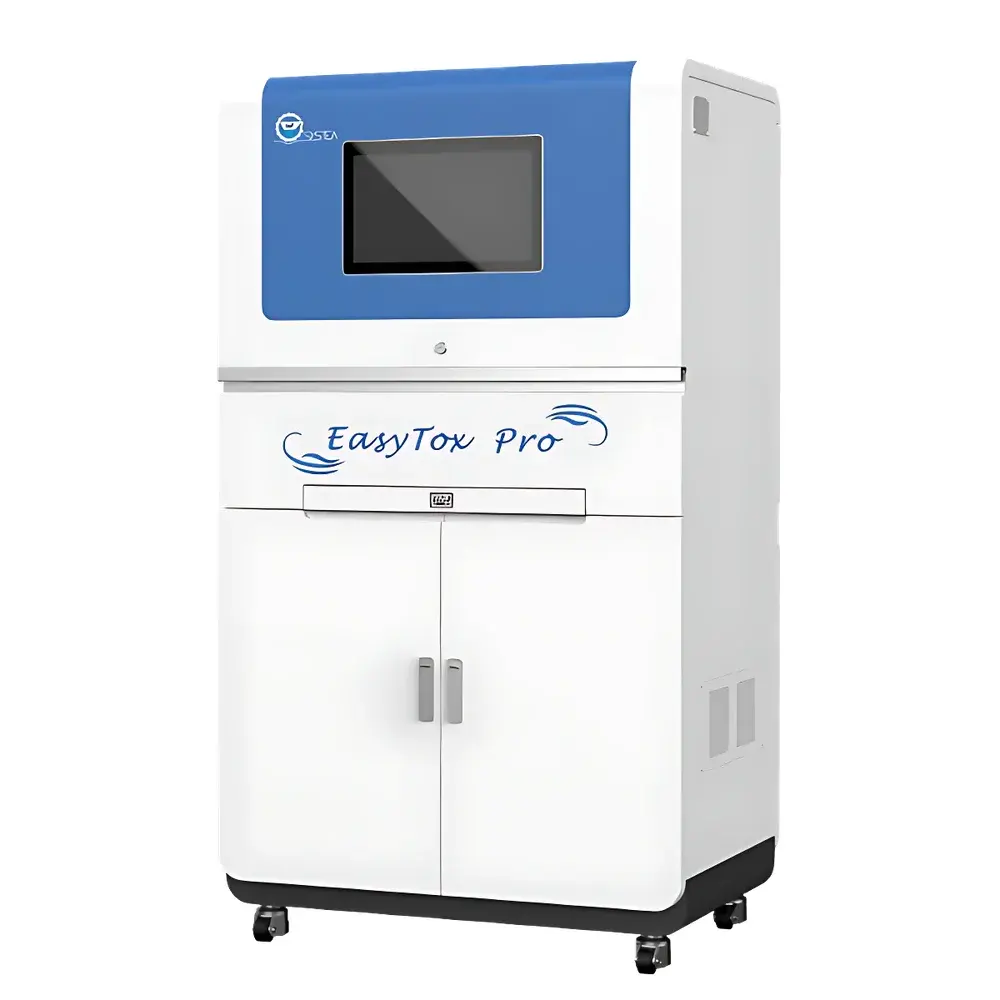
EasyTox Pro Online Aquatic Toxicity Monitor by SYSTEA
| Brand | SYSTEA |
|---|---|
| Origin | Zhejiang, China |
| Model | EasyTox Pro |
| Measurement Principle | Bioluminescent Bacterial Assay (Aliivibrio fischeri) |
| Quantification Output | EC₅₀ (Half-Maximal Effective Concentration) |
| Analysis Platform | Automated Discrete Analyzer with Robotic Arm |
| Sample Throughput | Dual-channel simultaneous analysis |
| Reaction Vessel Capacity | 80-position rotating cuvette carousel |
| Signal Acquisition Interval | 60 s |
| Assay Duration | 2.5–30 min per sample |
| Bacterial Rehydration | Fully automated lyophilized culture reactivation |
| Operational Autonomy | Up to 90 days unattended (with refrigerated reagent/culture storage) |
| Regulatory Compliance | ISO 11348-3:2007 and GB/T 15441–1995 methods programmable |
| Data Integrity | Audit-trail-enabled software compliant with GLP/GMP documentation requirements |
| Refrigerated Storage Compartment | Dedicated 4 °C zone for lyophilized bacteria, controls, and reagents |
| Cross-Contamination Control | Integrated cleaning station with sequential rinse/flush protocols |
| QC Features | Real-time bioluminescence viability monitoring, dual parallel blank/sample measurement, automatic result validation logic |
Overview
The EasyTox Pro Online Aquatic Toxicity Monitor is an engineered solution for continuous, quantitative assessment of acute toxicity in water matrices using standardized bioluminescent bacterial bioassays. Built upon SYSTEA’s proprietary discrete analyzer architecture—featuring a precision robotic arm and modular fluidic handling—it implements the internationally recognized Aliivibrio fischeri (formerly Vibrio fischeri) luminescence inhibition assay. Unlike endpoint-only systems, the EasyTox Pro delivers time-resolved bioluminescence decay kinetics, enabling robust calculation of EC₅₀ values—the concentration at which 50% reduction in light output is observed relative to control. This quantitative metric provides direct insight into the aggregate toxic pressure exerted by complex mixtures of organic pollutants, heavy metals, pesticides, pharmaceutical residues, and unknown contaminants—without requiring prior knowledge of individual analytes. Designed for deployment in regulatory monitoring networks, drinking water treatment plants, industrial effluent outfalls, and coastal observatories, the system operates under ambient or controlled environmental conditions with minimal infrastructure dependency.
Key Features
- Fully automated lyophilized A. fischeri culture rehydration—no manual culturing or viability maintenance required; validated for ≥28 consecutive days of uninterrupted operation.
- 80-position rotating reaction carousel with integrated temperature stabilization, supporting high-throughput batch processing and real-time sequential analysis.
- Dual independent sample inlet channels enable concurrent monitoring of reference and test streams—or comparison of upstream/downstream locations without hardware duplication.
- 60-second luminometric sampling interval ensures rapid detection of transient toxic events (e.g., accidental spills or process upsets), with full dose-response curves generated within 30 minutes.
- Onboard QC engine performs real-time bioluminescence baseline verification, blank drift compensation, and statistical outlier rejection per ISO/IEC 17025-aligned logic.
- Refrigerated 4 °C storage compartment maintains strict thermal integrity for lyophilized bacteria, positive/negative controls, and assay reagents—extending shelf life and reducing service frequency.
- Touchscreen HMI with IEC 61131-3-compliant programming environment allows method customization, alarm threshold configuration, and remote diagnostics via secure Ethernet or optional 4G LTE.
Sample Compatibility & Compliance
The EasyTox Pro accepts raw, filtered (≤0.45 µm), or clarified aqueous samples—including surface water, potable water, municipal wastewater, hospital effluents, industrial discharges, and seawater (with salinity compensation). It accommodates turbidities up to 100 NTU and total suspended solids ≤50 mg/L without pre-filtration. All analytical workflows are configurable to meet ISO 11348-3:2007 (Water quality — Determination of the inhibitory effect of water samples on the light emission of Vibrio fischeri) and GB/T 15441–1995 (Water quality — Determination of acute toxicity using luminescent bacteria). The system supports GLP-compliant data capture, including electronic signatures, version-controlled method files, and immutable audit trails traceable to FDA 21 CFR Part 11 requirements when deployed with validated software packages.
Software & Data Management
Embedded firmware runs SYSTEA’s TOXControl Suite v4.x—a deterministic, multi-threaded application optimized for embedded Linux. Data acquisition, curve fitting (log-logistic 4PL regression), EC₅₀ interpolation, and uncertainty estimation occur locally without cloud dependency. Export formats include CSV, PDF analytical reports, and XML-compatible datasets aligned with WQ-XML and OGC SensorML schemas. Optional integration with SCADA platforms (Modbus TCP, OPC UA) enables direct ingestion into centralized environmental data management systems (EDMS) or digital twin infrastructures. All calibration logs, QC flags, maintenance alerts, and instrument status events are timestamped and archived with SHA-256 hashing for forensic traceability.
Applications
- Early-warning systems for drinking water intake protection zones
- Compliance monitoring of wastewater discharge permits (e.g., EU Urban Wastewater Treatment Directive, US Clean Water Act NPDES)
- Pharmaceutical manufacturing facility effluent screening per ICH Q5C guidelines
- Ecotoxicological assessment of reclaimed water used in agricultural irrigation
- Marine port authority surveillance for antifouling agent leaching and ballast water treatment efficacy
- Research-grade toxicity profiling in mesocosm studies and sediment elutriate testing
FAQ
What biological indicator organism does the EasyTox Pro use?
It employs freeze-dried Aliivibrio fischeri strain NRRL B-11177, certified for reproducible luminescence response and traceable to ATCC standards.
Can the system distinguish between cytotoxic and neurotoxic mechanisms?
No—EC₅₀ reflects net metabolic inhibition; mechanistic differentiation requires complementary assays (e.g., acetylcholinesterase or ATPase activity tests).
Is dilution series generation automated?
Yes—integrated peristaltic dilutors support programmable serial dilution from 1:2 to 1:1000 across the full dynamic range.
How is carryover contamination prevented between samples?
Each channel features dedicated fluidic paths, air-gap segmentation, and a three-stage cleaning cycle (deionized water flush, detergent wash, final air purge) validated per CLSI EP26-A guidelines.
Does the system require daily operator intervention?
No—after initial setup and loading of consumables, it sustains ≥90 days of unattended operation, including automatic recalibration every 24 hours using onboard reference standards.







