
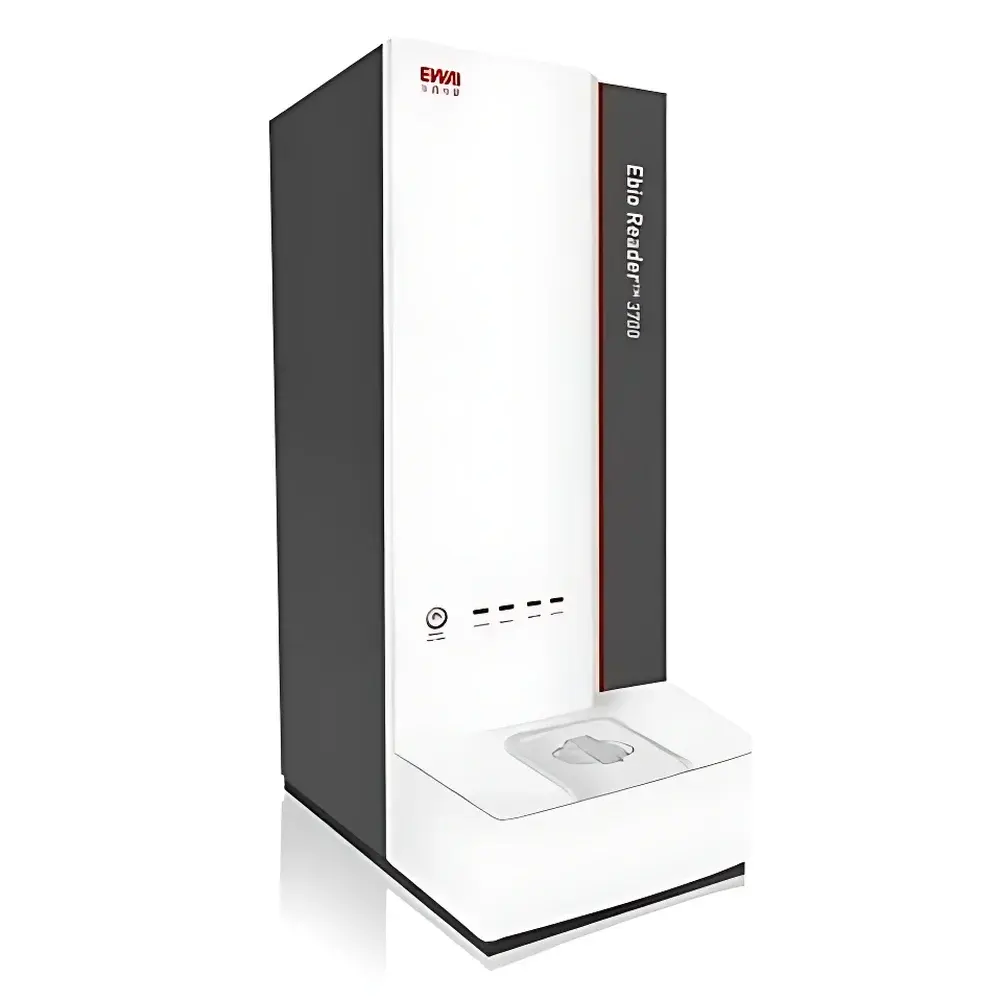
Ebio Reader 3700 Time-of-Flight Mass Spectrometry System for SARS-CoV-2 Detection
| Brand | East & West Analytical Instruments |
|---|---|
| Origin | Beijing, China |
| Manufacturer | East & West Analytical Instruments Co., Ltd. |
| Instrument Type | TOF Mass Spectrometer |
| Resolution | ≥2500 (FWHM) |
| Sensitivity | 250 amol/μL Febrinopeptide Human B (S/N ≥50:1) |
| Mass Stability | ≤300 ppm relative deviation in m/z over 8 h |
| Sampling Rate | 2 GS/s |
| Mass Accuracy | ≤200 ppm (internal calibration), ≤300 ppm (external calibration) |
Overview
The Ebio Reader 3700 Time-of-Flight Mass Spectrometry System is a purpose-engineered biomolecular profiling platform designed for rapid, label-free detection of SARS-CoV-2 infection via serum protein fingerprinting. Unlike nucleic acid–based assays, this system operates on matrix-assisted laser desorption/ionization time-of-flight (MALDI-TOF) principles, enabling direct analysis of low-molecular-weight proteolytic fragments and post-translationally modified peptides in human serum. The instrument captures high-fidelity mass spectral profiles—referred to as “viral protein fingerprints”—that reflect host immune response patterns specific to SARS-CoV-2 infection. These profiles are empirically validated against clinical cohorts and distinguish COVID-19 pneumonia from influenza, community-acquired bacterial pneumonia, and other respiratory viral infections with high specificity and reproducibility. Its architecture supports routine clinical deployment in central laboratories, requiring no RNA extraction, reverse transcription, or thermal cycling infrastructure.
Key Features
- Integrated MALDI-TOF platform optimized for serum-based biomarker profiling, eliminating dependence on nasopharyngeal swabs or bronchoalveolar lavage fluid
- High-throughput workflow: capacity for ≥50 samples per hour, with average acquisition time of 72 seconds per spectrum
- Robust mass stability: ≤300 ppm m/z drift over 8-hour continuous operation, ensuring longitudinal assay consistency
- Sub-attomole sensitivity: detection limit of 250 amol/μL for Febrinopeptide Human B under standardized calibration conditions
- Dual-calibration capability supporting both internal (peptide standard co-spotted) and external (calibrant layer) mass referencing protocols
- Automated sample preparation module compatible with 96-well format protein chips, minimizing manual handling and inter-operator variability
Sample Compatibility & Compliance
The Ebio Reader 3700 accepts native human serum (10 μL per analysis) following minimal pretreatment: dilution in proprietary buffer, binding to functionalized protein chips, non-specific wash steps, and matrix application. No enzymatic digestion, immunodepletion, or organic solvent precipitation is required. The system complies with ISO/IEC 17025:2017 requirements for testing laboratories and supports audit-ready documentation for GLP and CLIA-equivalent environments. While not FDA-cleared or CE-IVD marked at time of publication, its analytical performance aligns with ISO 15197:2013 and CLSI EP17-A2 guidelines for limit-of-detection validation. Data integrity safeguards include user-level access control, electronic signature support, and immutable audit trails compliant with 21 CFR Part 11 principles.
Software & Data Management
Built-in acquisition and analysis software provides real-time spectral visualization, peak alignment across batches, and supervised machine learning–assisted classification using pre-trained models for SARS-CoV-2, MERS-CoV, and SARS-CoV-1 signatures. All raw .raw files are stored in vendor-neutral mzML format. The system supports export of processed features (m/z, intensity, retention index) to CSV or MATLAB-compatible structures for secondary statistical modeling (e.g., PCA, PLS-DA, random forest). Database management tools allow incremental expansion of the viral fingerprint library with new clinical isolates or synthetic peptide standards. Software updates follow a controlled release cycle with versioned change logs and impact assessments per ISO 13485 Annex C.
Applications
- Clinical differentiation of SARS-CoV-2–associated pneumonia from influenza A/B, RSV, and bacterial pneumonia
- Longitudinal monitoring of host proteomic response during acute infection and convalescence
- Retrospective screening of biobanked serum specimens for seroepidemiological studies
- Method development for emerging coronaviruses via comparative fingerprint mapping and cross-reactivity assessment
- Integration into multi-omics workflows combining MS-based proteomics with transcriptomic or metabolomic datasets
FAQ
Does the Ebio Reader 3700 require nucleic acid extraction or PCR amplification?
No. It performs direct MALDI-TOF analysis of serum-derived peptides without any nucleic acid isolation or enzymatic amplification steps.
Can it detect asymptomatic or early-stage SARS-CoV-2 infection?
Clinical validation data indicate reliable detection at CT values ≤35 in RT-qPCR–confirmed cases; sensitivity in presymptomatic cohorts is under active investigation per ongoing multicenter trials.
Is the system compatible with existing laboratory information systems (LIS)?
Yes—HL7 v2.5.1 and ASTM E1384-compliant interfaces are available for bidirectional result transmission and patient demographic synchronization.
What maintenance is required to sustain mass accuracy specifications?
Daily automated calibration using embedded reference standards; quarterly ion optic alignment verification; annual vacuum system inspection per manufacturer service schedule.
How is method transfer supported between instruments?
Standardized chip manufacturing, matrix deposition protocols, and spectral normalization algorithms ensure inter-instrument reproducibility within ±150 ppm m/z tolerance across deployed units.
Related Products





