
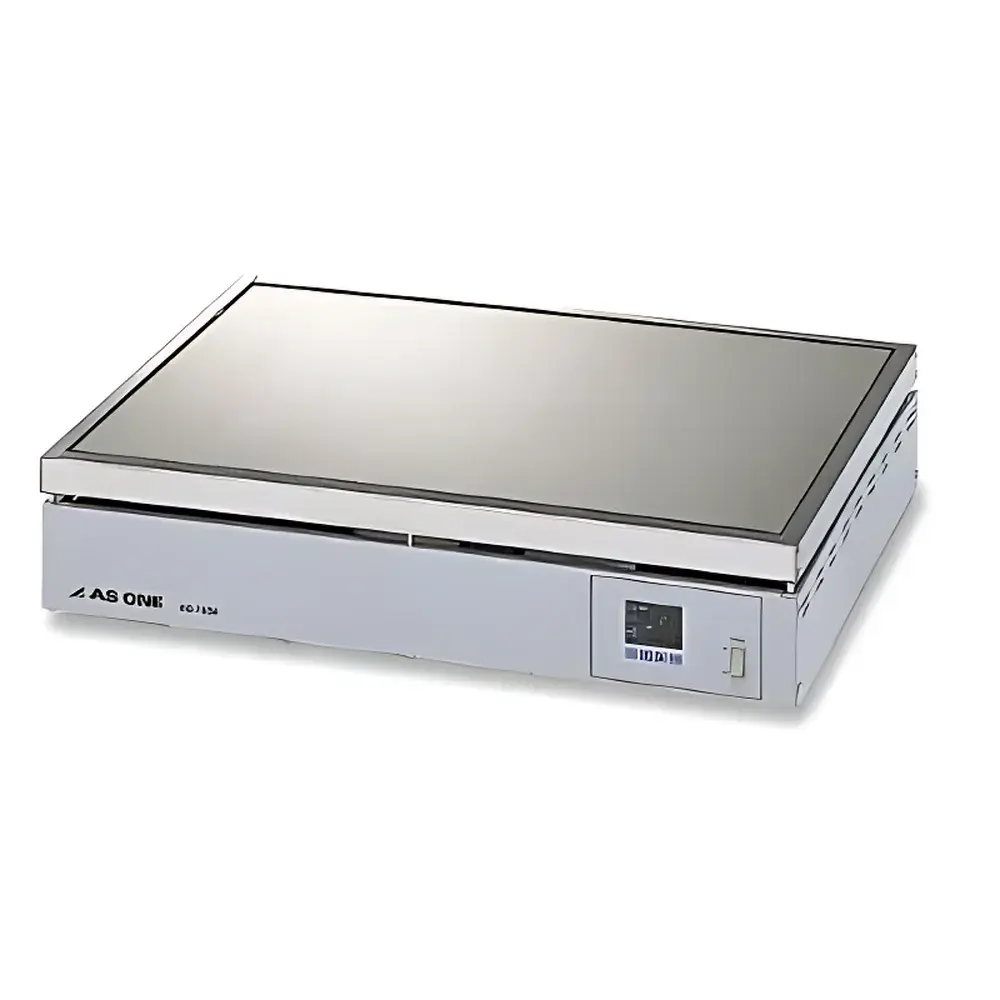
AS ONE EC-7050 Large-Surface Aluminum Heating Plate
| Brand | AS ONE |
|---|---|
| Origin | Japan |
| Manufacturer | AS ONE Corporation |
| Model | 1-5885-01 |
| Power Supply | AC 200 V |
| Temperature Sensor | Type K Thermocouple |
| Max. Operating Temperature | 300 °C |
| Heating Surface Dimensions | 700 × 500 mm |
| Overall Dimensions (W×D×H) | 750 × 550 × 162 mm |
| Heating Power | 2.6 kW (max. 12 A at 220 V) |
| Heating Plate Material | Anodized Aluminum |
| Load Capacity | 25 kg (distributed over ≥80% of plate surface area) |
| Net Weight | ~30 kg |
| Power Cord Length | ~2 m |
| Display | Dual-line LED (setpoint & actual temperature) |
| Timer Modes | Three programmable timing functions (delay start, duration hold, auto-shutdown) |
Overview
The AS ONE EC-7050 Large-Surface Aluminum Heating Plate is an industrial-grade benchtop thermal platform engineered for consistent, uniform heat delivery across expansive sample volumes in research laboratories, quality control environments, and pilot-scale process development. Designed around a robust resistive heating architecture embedded beneath a precision-machined, anodized aluminum top plate, the EC-7050 operates on the principle of conductive heat transfer—enabling stable thermal equilibrium with minimal spatial gradient across its 700 × 500 mm active surface. Its maximum operating temperature of 300 °C supports applications ranging from solvent evaporation and polymer annealing to catalyst activation and reagent preheating. Unlike compact hotplates, the EC-7050’s large footprint accommodates multiple vessels simultaneously—including wide-mouth flasks, crystallization dishes, or custom trays—reducing batch processing time without compromising thermal reproducibility. The unit complies with IEC 61000-6-3 (EMC emission standards) and IEC 61010-1 (safety requirements for laboratory electrical equipment), ensuring safe integration into regulated lab infrastructure.
Key Features
- Large-format heating surface (700 × 500 mm) optimized for high-throughput thermal treatment of distributed or multi-vessel samples
- Anodized aluminum top plate offering excellent thermal conductivity, corrosion resistance, mechanical durability, and ease of cleaning
- Dual-line LED display showing real-time setpoint and actual surface temperature—enabling immediate verification of thermal stability
- Three independent timer modes: delay-start (for scheduled activation), fixed-duration operation (for controlled exposure), and auto-shutdown (for unattended safety)
- High-power 2.6 kW heating system with fast thermal response and tight temperature regulation (±3 °C typical accuracy at steady state)
- Integrated Type K thermocouple feedback loop with PID-based temperature control algorithm for minimized overshoot and drift
- Structural load rating of 25 kg, specified for loads distributed over ≥80% of the heating surface—ensuring mechanical integrity under routine use
Sample Compatibility & Compliance
The EC-7050 accommodates a broad range of container types and materials—including borosilicate glass, stainless steel, ceramic crucibles, and polypropylene trays—provided they maintain full contact with the heated surface and remain within the specified load distribution envelope. It is not intended for direct use with volatile organic solvents under open conditions without additional ventilation safeguards. From a regulatory standpoint, the device meets CE marking requirements per the Low Voltage Directive (2014/35/EU) and EMC Directive (2014/30/EU). While not classified as a GLP/GMP-critical instrument per se, its stable thermal output, traceable calibration capability (via external reference thermometers), and programmable timers support documentation workflows aligned with ISO/IEC 17025 and ASTM E2251-21 (Standard Practice for Calibration of Laboratory Equipment). Routine verification using NIST-traceable surface thermometers is recommended for audit readiness.
Software & Data Management
The EC-7050 operates as a standalone analog-digital hybrid controller with no built-in data logging or PC interface. However, its dual-display readout and discrete timer outputs facilitate manual recordkeeping in laboratory notebooks or LIMS-integrated electronic logs. For automated data capture, users may integrate third-party USB or RS-485 temperature loggers (e.g., Omega OM-DAQPRO-5300 series) via the exposed thermocouple junction terminals—enabling time-stamped temperature profiles compliant with FDA 21 CFR Part 11 when paired with validated software. All timer events are non-volatile and retained after power cycling, supporting continuity in multi-shift operations.
Applications
- Controlled evaporation of aqueous and organic solutions in analytical sample preparation
- Preheating of reaction blocks, metal molds, or casting plates prior to material deposition
- Thermal conditioning of polymers, composites, or battery electrode coatings during R&D
- Stabilization of incubation platforms in microbiology and cell culture support workflows
- Calibration reference surface for infrared thermography validation and thermal camera drift assessment
- Support heating for vacuum desiccators, glovebox entry ports, or custom-built environmental chambers
FAQ
Can the EC-7050 be used under inert atmosphere or inside a glovebox?
Yes—provided adequate ventilation pathways exist for heat dissipation and the internal ambient remains within the unit’s operational temperature and humidity limits (5–40 °C, <80% RH non-condensing). Electrical feedthroughs must comply with glovebox safety specifications.
Is the aluminum surface compatible with acidic or basic solutions if spilled?
The anodized layer provides moderate resistance to mild acids and alkalis; however, prolonged exposure to concentrated HCl, HF, or >10% NaOH will degrade the oxide layer. Immediate wipe-down with deionized water is required after incidental contact.
Does the EC-7050 support external temperature probes for chamber or vessel monitoring?
No—the internal Type K sensor measures only the plate’s surface temperature. External probe integration requires auxiliary instrumentation and is not natively supported.
What maintenance is required for long-term reliability?
Annual inspection of power cord integrity, cleaning of ventilation grilles, and verification of thermal uniformity using a grid of calibrated surface thermometers are recommended. No user-serviceable components exist within the sealed heating module.
Related Products



