
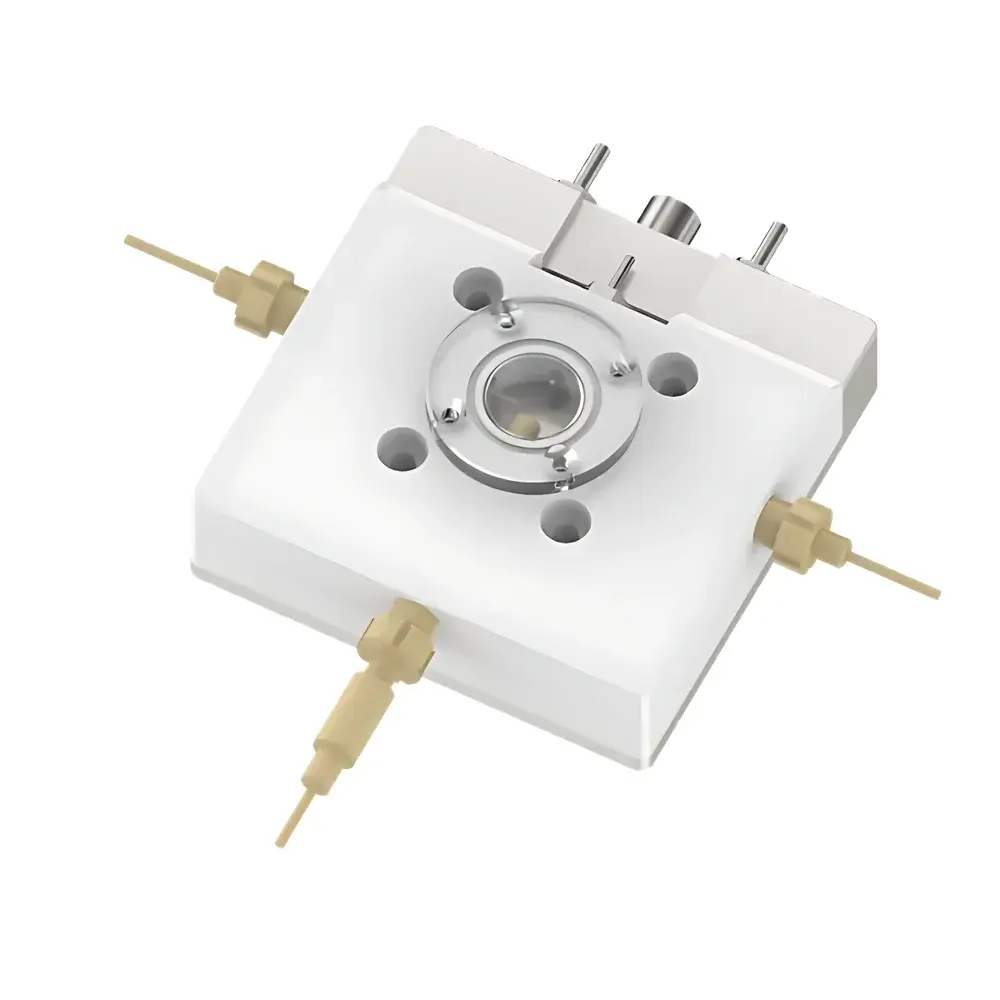
EC120 Electrochemical Liquid Cell Heating-Cooling Stage
| Brand | GKINST |
|---|---|
| Model | EC120 |
| Temperature Range | –50 °C to +120 °C |
| Max. Heating/Cooling Rate | 30 °C/min |
| Temp. Stability | < 0.05 °C |
| Temp. Resolution | 0.01 °C |
| Sensor | PT100 Platinum Resistance Thermometer |
| Control Algorithm | PID Dynamic Regulation |
| Compatibility | Liquid-phase electrochemical cells (e.g., coin-cell, pouch-cell, fuel cell configurations) |
| Compliance | Designed for integration with X-ray diffractometers (XRD), synchrotron beamlines, and in situ/operando electrochemical characterization platforms |
Overview
The GKINST EC120 Electrochemical Liquid Cell Heating-Cooling Stage is an engineered thermal control platform designed specifically for in situ and operando electrochemical characterization under controlled temperature conditions. It operates on a closed-loop thermoelectric (Peltier-based) architecture coupled with high-precision liquid circulation management, enabling stable, bidirectional thermal regulation of electrochemical liquid cells during real-time analytical measurements. The stage is mechanically and thermally optimized for seamless integration into X-ray diffraction (XRD), X-ray absorption spectroscopy (XAS), and small-angle X-ray scattering (SAXS) systems—particularly where spatial constraints, thermal drift mitigation, and electrical isolation are critical. Its core function is to maintain precise, reproducible thermal environments for electrochemical interfaces while preserving signal integrity during synchrotron or laboratory-source X-ray experiments.
Key Features
- Wide operational temperature range from –50 °C to +120 °C, supporting low-temperature solid-electrolyte interphase (SEI) formation studies and high-temperature cathode degradation analysis.
- Symmetric heating and cooling rates up to 30 °C/min, facilitating rapid thermal cycling protocols required for kinetic studies of phase transitions and reaction intermediates.
- Temperature stability better than ±0.05 °C over 24 hours at setpoint, achieved via dual-stage PID feedback control incorporating both PT100 resistance measurements and real-time thermal load compensation.
- 0.01 °C temperature resolution ensures fine-grained control for investigating subtle thermodynamic thresholds in battery electrode materials and catalytic surfaces.
- Electrically isolated thermal deck with non-magnetic, X-ray-transparent mounting interface (compatible with Kapton, beryllium, or polyimide windows) minimizes background scattering and electromagnetic interference during concurrent electrochemical impedance spectroscopy (EIS) or potentiostatic hold experiments.
- Modular liquid cell adapter design supports standardized electrochemical configurations including CR2032-type coin cells, Swagelok-style flow cells, and custom-designed membrane-electrode assemblies (MEAs) for PEM fuel cell research.
Sample Compatibility & Compliance
The EC120 stage accommodates liquid- or gel-based electrochemical cells with active electrolyte volumes ranging from 5 µL to 200 µL. It is compatible with common battery electrolytes (e.g., LiPF6 in EC/DMC, KOH aqueous solutions, Nafion dispersions) and inert atmosphere glovebox integration (O2/H2O < 0.1 ppm). All wetted materials—including fluidic seals, thermal interface gaskets, and cell clamping hardware—are chemically resistant to organic carbonates, strong acids/bases, and halogenated solvents. The system complies with ISO 17025 calibration traceability requirements for temperature measurement subsystems and meets mechanical safety specifications outlined in IEC 61010-1 for laboratory equipment. When operated within certified XRD/XAS enclosures, it satisfies radiation safety interlock compatibility standards per ANSI N43.3.
Software & Data Management
The EC120 is controlled via RS-485 or Ethernet (TCP/IP) using GKINST’s StageControl Suite v3.2—a platform-independent application supporting Windows, Linux, and macOS. The software provides synchronized logging of temperature, voltage, current, and time stamps at user-defined intervals (down to 100 ms), with export formats compliant with HDF5 and NeXus standards for synchrotron data archival. Audit trails record all parameter changes, operator IDs, and system events in accordance with FDA 21 CFR Part 11 requirements when configured with optional digital signature authentication. Integration with third-party electrochemical workstations (e.g., BioLogic SP-300, Metrohm Autolab PGSTAT302N) is supported through ASCII command protocols and LabVIEW/VISA drivers.
Applications
- In situ XRD monitoring of lithium intercalation/deintercalation in layered oxide cathodes across –20 °C to 85 °C.
- Operando SAXS investigation of polymer electrolyte membrane swelling behavior under variable thermal-hygric stress in PEM fuel cells.
- Time-resolved XANES tracking of Ni oxidation state evolution in Ni-rich NMC during low-temperature charge/discharge cycles.
- Thermally resolved EIS mapping of solid-electrolyte interface growth kinetics on silicon anodes.
- Phase diagram construction of ionic liquid–salt binary systems relevant to next-generation solid-state battery electrolytes.
- Corrosion product nucleation studies on copper and aluminum current collectors under simulated battery operating conditions.
FAQ
Is the EC120 compatible with vacuum environments?
No—the stage is rated for ambient pressure operation only and requires external purge gas (N2 or Ar) for moisture-sensitive electrochemical measurements.
Can it be used with rotating disk electrodes (RDE)?
Yes, provided the RDE shaft is thermally insulated and the rotation mechanism is decoupled from the stage’s thermal mass; optional vibration-damping mounts are available.
Does it support multi-zone temperature gradients?
Not natively—the EC120 maintains uniform temperature across its 25 mm × 25 mm active area; gradient capability requires external auxiliary modules.
What calibration documentation is supplied?
Each unit ships with NIST-traceable PT100 calibration certificate (per ISO/IEC 17025), stage thermal uniformity map, and thermal response curve report.
Is firmware update capability included?
Yes—over-the-air (OTA) updates are supported via secure HTTPS endpoint, with version rollback and checksum verification enabled.





