
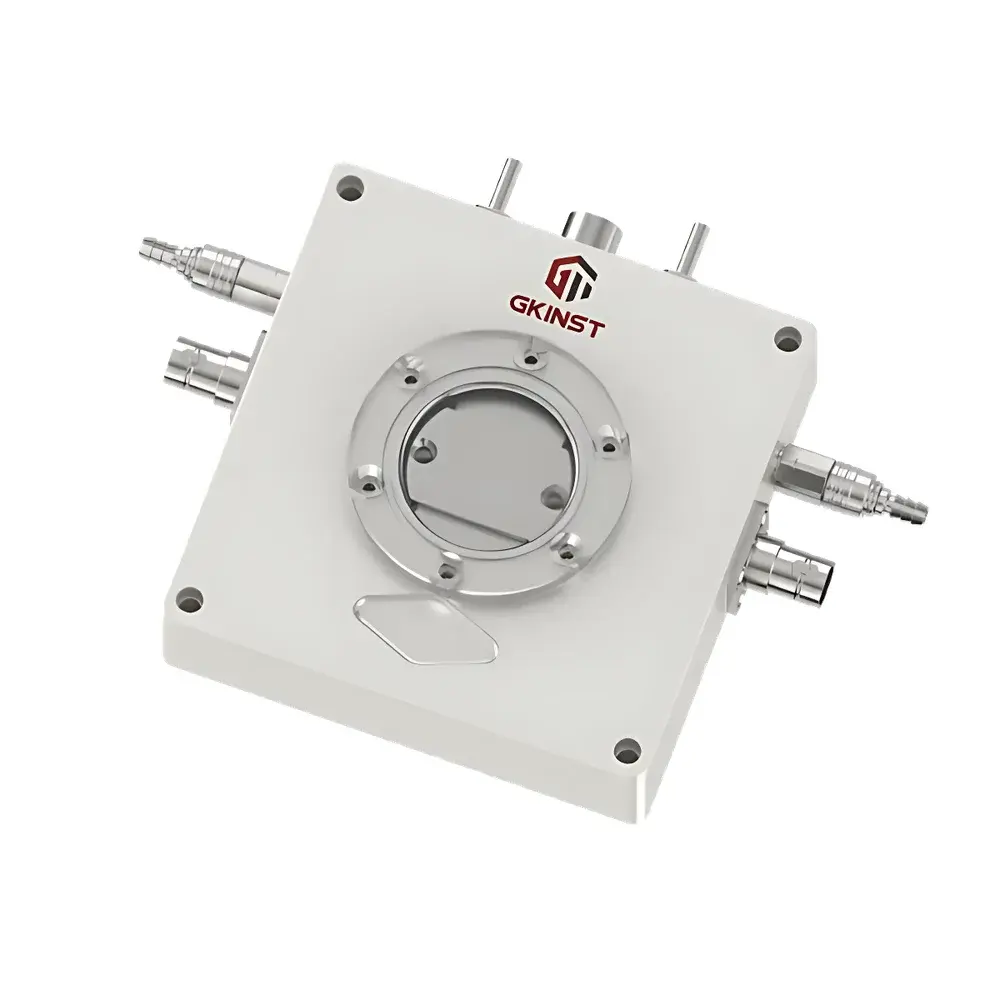
EC150 Electrochemical Environmental Stage
| Brand | GKInst |
|---|---|
| Origin | Anhui, China |
| Model | EC150 |
| Temperature Range | −50 °C to +150 °C |
| Max. Heating/Cooling Rate | 30 °C/min |
| Temp. Stability | < 0.05 °C |
| Temp. Resolution | 0.01 °C |
| Sensor | PT100 Platinum Resistance Thermometer |
| Control Algorithm | PID Dynamic Regulation |
| Compliance | Designed for ASTM D3418, ISO 11357, and IEC 62660-2 thermal cycling protocols in electrochemical cell characterization |
Overview
The EC150 Electrochemical Environmental Stage is a precision temperature-controlled stage engineered for in situ and operando electrochemical characterization under tightly regulated thermal conditions. Unlike generic hot/cold stages, the EC150 integrates a thermally isolated chamber with integrated electrical feedthroughs, enabling simultaneous application of electrochemical bias (via standard potentiostat/galvanostat interfaces) and high-fidelity thermal control. Its core architecture leverages Peltier-based thermoelectric modules combined with liquid-assisted heat exchange for bidirectional thermal actuation—supporting both rapid heating and active sub-ambient cooling down to −50 °C. The stage operates on a closed-loop PID control system calibrated against traceable PT100 sensors, ensuring reproducible thermal profiles required for kinetic studies, phase transition analysis, and degradation mechanism investigations in battery and fuel cell research.
Key Features
- Wide operational temperature range from −50 °C to +150 °C, validated per IEC 60068-3-5 thermal shock testing methodology
- Symmetric maximum heating and cooling rates of 30 °C/min—enabling dynamic thermal ramping for Arrhenius-based activation energy determination
- Temperature stability better than ±0.05 °C over 24-hour continuous operation, critical for long-duration impedance spectroscopy (EIS) measurements
- 0.01 °C digital resolution with NIST-traceable PT100 sensor embedded directly beneath the sample mounting surface
- Electrically isolated sample platform with gold-plated copper electrodes and vacuum-compatible feedthroughs (M3 threaded ports) for integration into glovebox or vacuum chambers
- Modular design compatible with standard three-electrode electrochemical cells, coin-cell holders (CR2032/CR2430), and custom microfluidic flow cells
Sample Compatibility & Compliance
The EC150 accommodates solid-state and semi-solid electrochemical samples including lithium-ion battery electrodes (cathode/anode laminates), proton exchange membrane (PEM) fuel cell membrane electrode assemblies (MEAs), solid oxide cell (SOC) half-cells, and electrochromic thin films. Its mechanical interface conforms to standard optical microscope stages (e.g., Leica, Zeiss, Olympus) and X-ray diffractometers (Bruker D8, Rigaku SmartLab) when used in synchrotron or lab-source XRD/XAS experiments. All thermal control firmware adheres to GLP-compliant logging requirements: time-stamped temperature history is recorded at 100 Hz with audit-trail enabled metadata (user ID, session ID, calibration certificate ID). The unit meets electromagnetic compatibility standards per EN 61326-1 and is CE-marked for laboratory use within the EU.
Software & Data Management
The EC150 communicates via USB 2.0 and RS-485 serial interface, supporting native integration with BioLogic SP-300, Gamry Interface 5000, and Metrohm Autolab PGSTAT302N potentiostats through vendor-provided SDKs. GKInst’s proprietary ThermalControl Suite v2.4 provides synchronized acquisition of temperature, voltage, current, and impedance data—with configurable trigger logic for EIS start-on-temperature-reach or hold-at-target protocols. Raw data exports comply with ASTM E2927-21 (Standard Practice for Data Exchange in Electrochemical Testing) in .csv and HDF5 formats. Audit trails include electronic signatures, calibration logs, and change history—fully compliant with FDA 21 CFR Part 11 requirements for regulated environments.
Applications
- Thermal-dependent Li-ion intercalation kinetics in NMC, LFP, and silicon-anode materials
- In situ XRD monitoring of phase evolution during charge/discharge cycles across −20 °C to 60 °C
- Proton conductivity mapping of Nafion membranes under controlled RH and temperature gradients
- Accelerated aging studies per IEEE 1625 and UL 1642 standards using programmed thermal stress profiles
- Electrochemical quartz crystal microbalance (EQCM) measurements with simultaneous thermal perturbation
- Corrosion potential shift analysis of metal anodes (e.g., Zn, Mg) in aqueous electrolytes across sub-zero conditions
FAQ
Is the EC150 compatible with synchrotron beamlines?
Yes—the stage features low-Z aluminum housing, minimal scattering cross-section, and non-magnetic construction, certified for use at APS Sector 11-BM and ESRF ID22.
Can it be operated inside an argon-filled glovebox?
Yes—rated IP54 for dust resistance and equipped with CF-35 vacuum feedthroughs; optional dry-gas purge port available for inert atmosphere stabilization.
Does it support automated temperature ramping during EIS acquisition?
Yes—via TTL-triggered synchronization with frequency response analyzers; ramp rate, dwell time, and target temperature are programmable per step in multi-segment thermal protocols.
What calibration documentation is provided?
Each unit ships with a factory calibration certificate traceable to NIM (China National Institute of Metrology), including as-found/as-left data at −50 °C, 25 °C, and +150 °C points.
Is remote monitoring possible over Ethernet?
Not natively—but optional Ethernet-to-RS485 gateway modules (e.g., Moxa EDS-205A) enable networked supervision and integration into LabVIEW or Python-based control frameworks.




