
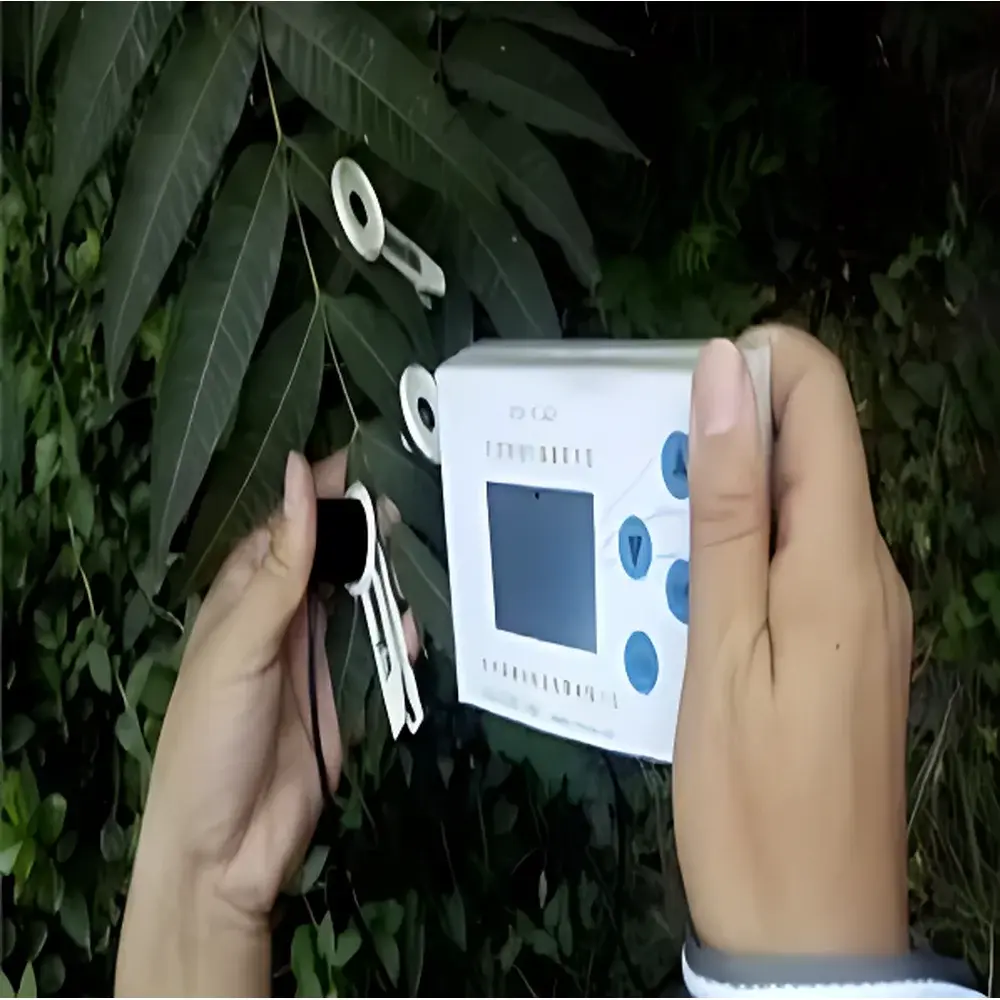
ECA-YLS01 DianJiang Fast Induction Chlorophyll Fluorescence Analyzer
| Brand | DianJiang |
|---|---|
| Origin | Shanghai, China |
| Manufacturer Type | Authorized Distributor |
| Country of Origin | China |
| Model | ECA-YLS01 |
| Price Range | USD 7,000 – 14,000 |
| Light Source | 470 nm Blue LED |
| Photosynthetic Photon Flux Density (PPFD) | 0–5000 μmol·m⁻²·s⁻¹ (adjustable) |
| Minimum Sampling Interval | 2 μs |
| Data Acquisition Rate | Up to 500,000 points per second |
| Onboard Storage | 4 GB microSD card |
| Interface | USB 2.0 |
| Display | 128 × 64 monochrome LCD |
| Power Supply | Rechargeable Li-ion battery (7.6 V, 2.6 Ah) |
| Weight | 400 g |
| Dimensions | 12.5 × 8.0 × 3.3 cm |
| Dark Adaptation Clip | Integrated, leaf-compatible design |
Overview
The ECA-YLS01 DianJiang Fast Induction Chlorophyll Fluorescence Analyzer is a high-temporal-resolution instrument engineered for quantitative analysis of chlorophyll a fluorescence induction kinetics in intact plant leaves. It operates on the principle of pulse-amplitude-modulated (PAM) fluorometry combined with ultra-fast transient capture, enabling precise resolution of the O–J–I–P polyphasic fluorescence rise — a signature response reflecting sequential electron transport events across Photosystem II (PSII) reaction centers. With a minimum sampling interval of 2 microseconds and sustained acquisition at up to 500,000 data points per second, the system captures the entire fast-phase fluorescence transient within a single second under standardized dark-adapted conditions. This capability supports rigorous biophysical interpretation of PSII photochemical efficiency, energy dissipation pathways, and stress-induced alterations in thylakoid electron transport — critical for plant phenotyping, abiotic/biotic stress physiology, and photosynthetic acclimation studies.
Key Features
- Ultra-high-speed fluorescence acquisition: Real-time capture of OJIP transients at 2 µs resolution, ensuring fidelity in kinetic modeling of PSII charge separation and recombination dynamics.
- Programmable blue LED excitation source (470 nm): Spectrally optimized for maximal absorption by chlorophyll a, with continuous PPFD control from 0 to 5000 µmol·m⁻²·s⁻¹ to support both minimal actinic illumination and saturating pulse protocols.
- Integrated dark-adaptation clip: Ergonomically designed aluminum alloy clamp with light-tight sealing, compatible with broadleaf and narrow-leaf species (e.g., Arabidopsis, wheat, maize, soybean), enabling standardized 20–30 min dark adaptation prior to measurement.
- Embedded 4 GB microSD storage: Local non-volatile data logging eliminates dependency on real-time PC connection; raw time-series and processed parameter files are saved in CSV and binary formats for traceability.
- USB 2.0 interface with vendor-neutral data export: Facilitates seamless integration into laboratory workflows using third-party analysis platforms (e.g., R, Python, MATLAB) or proprietary software compliant with FAIR data principles.
- Portable architecture: Compact form factor (12.5 × 8.0 × 3.3 cm), lightweight (400 g), and field-deployable via rechargeable Li-ion battery (7.6 V, 2.6 Ah), supporting both greenhouse and outdoor canopy-level measurements.
Sample Compatibility & Compliance
The ECA-YLS01 is validated for use with intact, attached, or excised leaves from angiosperms, gymnosperms, and ferns exhibiting typical chlorophyll a/b pigment composition. Its optical geometry and clip design accommodate leaf thicknesses ranging from 0.1 mm (Arabidopsis) to 0.8 mm (mature Zea mays). All firmware and data handling routines adhere to GLP-aligned metadata tagging: each dataset includes timestamp, battery voltage, ambient temperature (via internal sensor), PPFD setting, sampling interval, and dark-adaptation duration. While not certified to ISO/IEC 17025, the system’s calibration traceability follows manufacturer-specified LED intensity verification protocols using NIST-traceable photodiode standards. Output parameters conform to widely accepted nomenclature defined in the International Workshop on Chlorophyll Fluorescence (Strasser et al., 2004; Schansker et al., 2006) and are compatible with peer-reviewed modeling frameworks such as JIP-test and QA/QB-based electron transport chain analysis.
Software & Data Management
The analyzer ships with cross-platform desktop software (Windows/macOS/Linux) supporting automated OJIP curve fitting, parameter derivation, and batch statistical reporting. Raw fluorescence traces are stored with full precision (16-bit ADC resolution); derived parameters include FO, Fm, Fv/Fm, ψO, φEo, φDo, VJ, VI, WK, PIABS, ABS/RC, TRO/RC, ETO/RC, DIO/RC, RC/CSO, and RC/CSM — totaling over 50 biophysically grounded indices. Software enforces audit-trail functionality: all user-initiated changes to analysis settings (e.g., J-step threshold, P-level baseline correction) are logged with timestamps and operator IDs. Export options include CSV, Excel (.xlsx), and HDF5 for long-term archival and interoperability with LIMS or ELN systems. No cloud upload or telemetry is enabled by default; data sovereignty remains fully under user control.
Applications
- Early detection of photosynthetic impairment under drought, salinity, heavy metal exposure, or pathogen infection — leveraging sensitivity of OJIP shape parameters (e.g., K-band amplitude, I-P phase delay) to PSII donor-side limitations.
- High-throughput screening of crop germplasm for intrinsic photochemical efficiency (Fv/Fm > 0.83) and stress resilience phenotypes in breeding programs.
- Quantification of herbicide mode-of-action (e.g., DCMU, diuron) via inhibition kinetics of electron transfer beyond QA−.
- Ecophysiological assessment of forest understory species under variable light environments using dynamic light-response curves.
- Validation of transgenic lines with modified PSII subunit expression (e.g., PsbA, PsbO) through comparative JIP-test parameter profiling.
FAQ
What is the minimum detectable change in fluorescence yield that the ECA-YLS01 can resolve?
The system achieves a signal-to-noise ratio (SNR) > 60 dB under standard measurement conditions (FO level, 2 µs sampling), corresponding to ~0.1% relative fluorescence change resolution.
Can the instrument perform multipoint kinetic measurements on the same leaf without repositioning?
Yes — the integrated clip maintains consistent leaf positioning and pressure during sequential measurements; users may define custom time-series protocols (e.g., pre-stress baseline → post-stress recovery at 5-min intervals).
Is firmware upgrade supported in the field?
Yes — firmware updates are delivered via signed .bin files through the USB interface; version history and checksum validation are embedded in the update utility.
Does the device meet FDA 21 CFR Part 11 requirements for electronic records?
While not formally validated for regulated GxP environments, the software provides optional audit-trail logging, electronic signatures, and data integrity controls that align with foundational Part 11 expectations for research-grade instrumentation.
How is calibration verified between measurement sessions?
Users perform daily verification using the built-in reference LED check routine, which compares measured intensity against factory-stored calibration coefficients; deviation alerts trigger recalibration recommendations.
Related Products




