
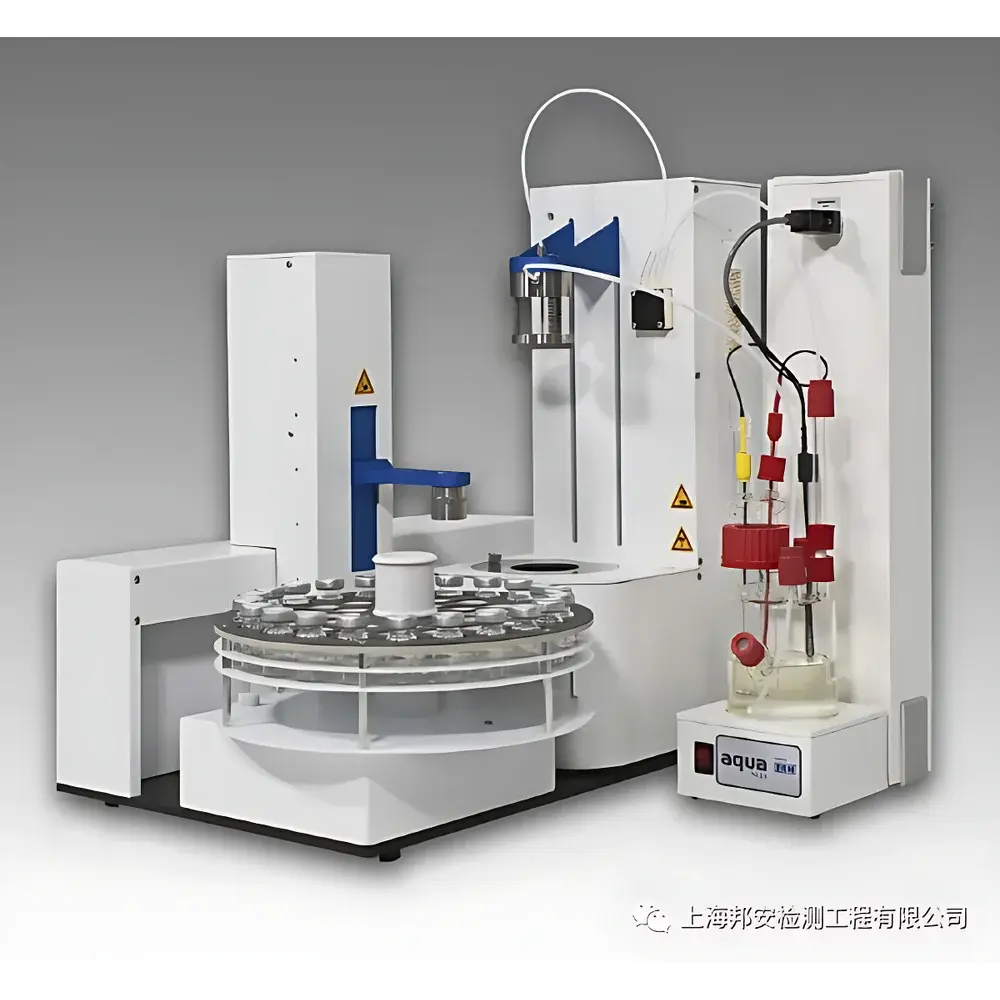
ECH aqua 40.00 Carrier-Gas-Free Automated Karl Fischer Moisture Analyzer
| Brand | ECH |
|---|---|
| Origin | Germany |
| Model | aqua 40.00 |
| Measurement Range | 1 µg – 100 mg |
| Resolution | 0.1 µg |
| Repeatability | ±3 µg (for 10–1000 µg water) |
| Temperature Control Range | 35 °C – 300 °C |
| Power Supply | 230 V |
| Sample Introduction | Optional automated sample changer |
| Gas System | Closed-loop, carrier-gas-free dynamic headspace |
| Compliance | Designed for GLP/GMP environments with audit-trail-capable software support |
Overview
The ECH aqua 40.00 is a carrier-gas-free automated Karl Fischer (KF) moisture analyzer engineered for precise, trace-level water quantification in thermally labile and low-volatility petroleum matrices—particularly lubricating oils, base stocks, and additive packages. Unlike conventional KF coulometric or volumetric systems requiring continuous external dry gas supply, the aqua 40.00 employs a patented dynamic headspace sampling principle within a fully sealed, recirculating gas loop. A precisely temperature-controlled heating furnace volatilizes bound water from the sample without decomposition, while inert carrier gas—generated internally and continuously dried via integrated desiccant—transports liberated moisture quantitatively to the electrochemical KF titration cell. This architecture eliminates reliance on external compressed gas cylinders, reduces reagent consumption by up to 40% compared to open-loop systems, and prevents methanol evaporation artifacts common in traditional oven-KF interfaces. The instrument operates under strict adherence to ASTM D6304, ISO 15512, and IP 386 for petroleum product moisture analysis, supporting validated workflows in QC laboratories subject to ISO/IEC 17025 accreditation.
Key Features
- Carrier-gas-free dynamic headspace sampling: Eliminates need for external nitrogen or dry air supply; integrated closed-loop gas circulation ensures consistent moisture transfer efficiency.
- User-definable multi-step temperature programming: Enables differentiation between free, adsorbed, and chemically bound water fractions via controlled thermal desorption profiles (35–300 °C, ±0.5 °C stability).
- High-resolution coulometric detection: Capable of quantifying water mass from 1 µg to 100 mg with 0.1 µg resolution and repeatability of ±3 µg across the 10–1000 µg range.
- Methanol-free reagent compatibility: Supports non-methanolic KF electrolytes, mitigating solvent volatility issues during high-temperature oil analysis and improving long-term system stability.
- Modular hardware design: Interchangeable sample vials (2–20 mL), heated sample racks, and furnace inserts allow method adaptation for viscous, particulate-laden, or high-boiling-point lubricants.
- Optional 48-position automated sample changer: Enables unattended batch analysis with programmable sequence logic, including blank correction, calibration verification, and sample dilution handling.
Sample Compatibility & Compliance
The aqua 40.00 is validated for direct analysis of undiluted lubricating oils—including mineral, synthetic PAO, and ester-based formulations—as well as greases, hydraulic fluids, transformer oils, and used engine oils containing oxidation by-products or suspended contaminants. Its sealed headspace approach avoids cross-contamination and minimizes exposure of hygroscopic reagents to ambient humidity. Instrument firmware and data management software comply with FDA 21 CFR Part 11 requirements for electronic records and signatures, including role-based access control, full audit trail logging, and immutable raw data archiving. All measurement protocols align with ISO/IEC 17025 method validation criteria, supporting uncertainty estimation per EURACHEM/CITAC guidelines. Routine operation meets ASTM D6304 Type III (oven extraction) and ISO 15512 Annex B specifications for precision and recovery performance.
Software & Data Management
ECH AquaControl™ software provides intuitive method development, real-time reaction monitoring, and automated report generation in PDF and CSV formats. Each analysis session logs complete metadata—including furnace temperature profile, gas flow dynamics, titration curve kinetics, and endpoint confirmation parameters. Software supports IQ/OQ/PQ documentation templates compliant with pharmaceutical and petrochemical quality systems. Data integrity safeguards include electronic signature capture, automatic backup to network drives, and tamper-evident file hashing. Integration with LIMS via ASTM E1384-compliant interface enables seamless data exchange in regulated environments.
Applications
- Quantification of residual moisture in new and in-service lubricants per OEM specifications (e.g., API RP 505, Siemens TLV 9013)
- Stability assessment of grease thickeners and additive packages during accelerated aging studies
- Moisture screening in turbine oils prior to commissioning or after maintenance interventions
- Root-cause analysis of hydrolytic degradation in ester-based synthetic lubricants
- Batch release testing in lubricant manufacturing under ISO 9001 and IATF 16949 quality frameworks
FAQ
Does the aqua 40.00 require external compressed gas?
No. It utilizes an internal, self-regenerating closed-loop gas circuit with integrated desiccant and pressure-balanced recirculation—no external nitrogen or dry air source is needed.
Can it analyze highly viscous or solid-laden samples?
Yes. The modular furnace and vial system accommodates samples up to 20 mL volume and >1000 cSt viscosity; optional ultrasonic pre-treatment modules are available for homogenization.
Is methanol elimination mandatory?
No. While optimized for methanol-free reagents, the system is compatible with standard two-component KF reagents when required for specific matrix interferences.
How is method validation supported?
Preconfigured validation protocols for accuracy, precision, linearity, LOD/LOQ, and robustness are embedded in AquaControl™, aligned with ICH Q2(R2) and ISO/IEC 17025 Annex A.3.
What regulatory standards does the software meet?
Full 21 CFR Part 11 compliance with electronic signatures, audit trails, and data retention policies configurable per laboratory SOPs and regional GxP requirements.
Related Products




