
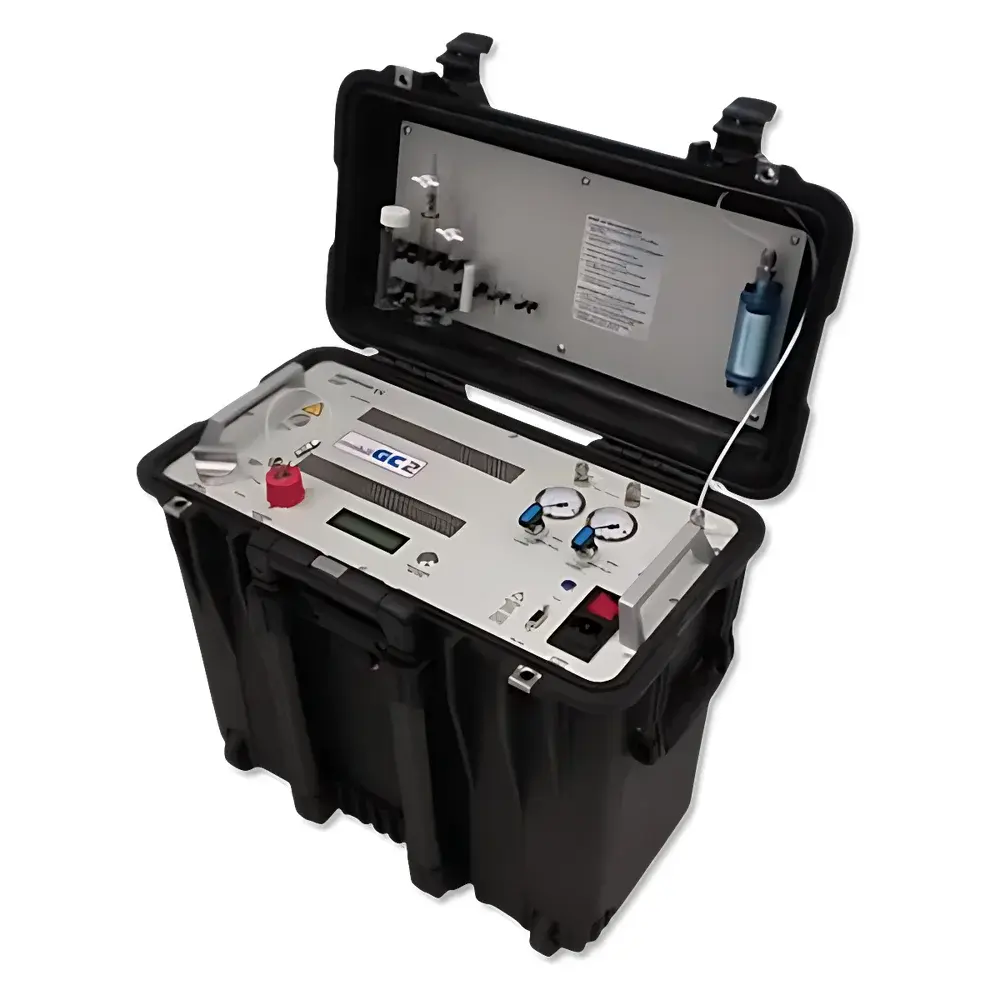
ECH MobilGC 2 Portable Gas Chromatograph
| Brand | ECH |
|---|---|
| Origin | Germany |
| Model | MobilGC 2 |
| Detection Range | 1 ppm to 100 % |
| Repeatability | ±0.1 ppm |
| Weight | 23 kg |
| Dimensions | 500 × 457 × 305 mm (W × H × D) |
| Detectors | FID and TCD/WLD |
| Column Support | Capillary, packed, and micro-packed columns |
| Column Heating | Independent, programmable up to 250 °C (isothermal or temperature gradient) |
| Carrier Gases | Argon, nitrogen, helium, or hydrogen |
| Integrated Gas Supply | Sufficient for ~40 hours of continuous operation |
| Methanizer | Optional CO/CO₂-to-CH₄ conversion module |
| Data Acquisition | Digital, real-time |
| Software | Integrated control, automated peak integration (single & total), application-specific expert evaluation routines |
| Compliance | Designed for GLP-compliant workflows |
Overview
The ECH MobilGC 2 Portable Gas Chromatograph is a field-deployable, benchtop-capable analytical platform engineered for high-fidelity separation and quantification of volatile and semi-volatile organic compounds across diverse operational environments. Based on classical gas chromatographic principles—where analytes are partitioned between a mobile gas phase and a stationary liquid or polymer phase inside a thermally controlled column—the MobilGC 2 delivers laboratory-grade resolution and reproducibility in non-laboratory settings. Its modular architecture integrates carrier gas generation, dual-detector capability, independently programmable column ovens, and embedded digital signal processing into a single ruggedized chassis. Unlike fixed-installation GC systems, the MobilGC 2 is purpose-built for transient deployment: it operates autonomously without external gas cylinders or power conditioning, making it suitable for environmental monitoring at remediation sites, real-time process stream analysis in chemical manufacturing, and rapid verification testing in quality control laboratories.
Key Features
- Self-contained gas supply system with integrated pressure regulation and purification—supports up to 40 hours of uninterrupted operation using argon, nitrogen, helium, or hydrogen as carrier gas.
- Dual-detector configuration: Flame Ionization Detector (FID) for hydrocarbon-selective detection down to sub-ppm levels, and Thermal Conductivity Detector / Wide-Linearity Detector (TCD/WLD) for universal, non-destructive detection of permanent gases and light organics.
- Independent column oven modules enabling simultaneous or sequential analysis using two distinct separation chemistries—e.g., one capillary column for VOC profiling and one packed column for permanent gas analysis.
- Programmable column heating from ambient to 250 °C with ramp rates up to 30 °C/min; supports both isothermal hold and multi-step temperature gradients optimized for complex mixtures.
- Integrated sample introduction via manual loop injection or automated syringeless aspiration pump—compatible with gas bags, canisters, and direct process line taps.
- Built-in methanizer for selective catalytic conversion of CO and CO₂ to CH₄ prior to FID detection, enabling accurate quantification in syngas, biogas, and combustion exhaust applications.
Sample Compatibility & Compliance
The MobilGC 2 accepts gaseous samples across a broad compositional spectrum—including ambient air, stack emissions, refinery off-gas, landfill leachate headspace, transformer oil headspace (with optional vacuum-assisted degassing), and purified synthesis streams. It complies with core analytical standards governing portable GC use, including ASTM D6420 (standard test method for determination of volatile organic compounds in ambient air by GC/FID), ISO 16017-1 (indoor air—determination of volatile organic compounds), and USP (residual solvents). Hardware and software architecture support GLP and GMP-aligned workflows: electronic signatures, user access levels, method locking, and full audit trail logging meet FDA 21 CFR Part 11 requirements for regulated environments.
Software & Data Management
The embedded GC Control Suite provides intuitive instrument control, method development, and real-time chromatogram visualization. All acquisition parameters—including oven programs, detector settings, valve timing, and data sampling rate—are stored in encrypted method files with version history. Peak integration employs adaptive baseline algorithms with configurable retention time windows, supporting both single-peak and summed-area quantification. Application-specific evaluation modules include biogas composition calculators, transformer oil DGA (Dissolved Gas Analysis) interpreters, and VOC emission reporting templates aligned with EPA Method TO-15 and EN 14662. Raw data is exported in standard formats (CSV, CDF, AIA) and integrates natively with LIMS platforms via OPC UA or HTTP REST API.
Applications
- Environmental field screening: benzene, toluene, ethylbenzene, xylene (BTEX), chlorinated solvents, and methane in soil vapor and groundwater headspace.
- Industrial process analytics: real-time monitoring of reactor effluent purity, solvent recovery efficiency, and catalyst deactivation indicators in petrochemical units.
- Energy sector QA/QC: biogas upgrading validation, natural gas odorant concentration checks, and dissolved gas analysis (DGA) in insulating oils for predictive maintenance of power transformers.
- Emergency response: rapid identification and quantification of hazardous airborne releases during chemical spills or industrial accidents.
- Research & development: method scouting for novel column chemistries, temperature programming optimization, and detector response characterization under variable flow conditions.
FAQ
Can the MobilGC 2 operate unattended for extended periods in remote locations?
Yes—its integrated gas reservoirs, sealed electronics, and wide-temperature operating range (−10 °C to +50 °C) enable fully autonomous 24/7 operation when paired with an external power source or solar-charged battery bank.
Is calibration traceable to NIST standards?
All factory calibrations are performed using certified reference materials traceable to NIST SRMs; users may perform field calibration with commercially available gas standards compliant with ISO 6141.
Does the system support regulatory reporting for EPA or EU compliance?
Yes—the software includes preconfigured report templates for EPA Method TO-15, EN 14662, and ISO 16017-1, with metadata fields required for regulatory submission.
What maintenance intervals are recommended for field deployments?
Detector cleaning and column trimming are advised every 200–300 injections; gas filters require replacement every 6 months under continuous operation or after 500 hours of cumulative runtime.
Can the MobilGC 2 be integrated into existing SCADA or DCS infrastructure?
Yes—via Modbus TCP or OPC UA protocols, the instrument exposes real-time chromatographic parameters (retention times, peak areas, detector baselines) for direct ingestion into industrial automation systems.




