
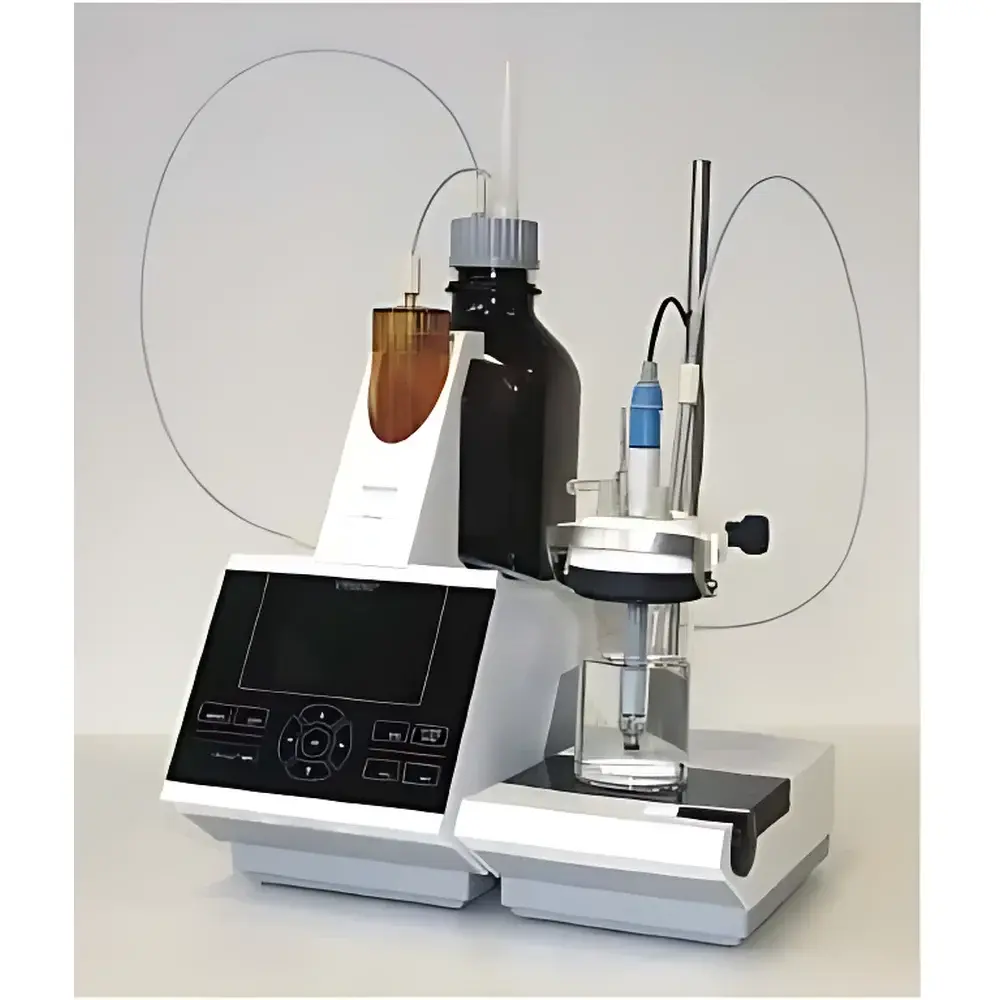
ECH Sulfur Titrator Sulfur Titrator
| Brand | ECH |
|---|---|
| Origin | Germany |
| Manufacturer Type | Authorized Distributor |
| Origin Category | Imported Instrument |
| Model | Sulfur Titrator |
| Pricing | Upon Request |
Overview
The ECH Sulfur Titrator is a fully automated volumetric titration system engineered for the selective and simultaneous quantification of hydrogen sulfide (H₂S) and mercaptan sulfur (R–SH) in liquid hydrocarbons, petroleum distillates, and edible oils. It operates on the principle of argentometric titration in anhydrous media, utilizing standardized silver nitrate (AgNO₃) solution as the titrant. In this reaction, H₂S forms insoluble silver sulfide (Ag₂S), while mercaptans yield stoichiometric silver thiolate complexes (AgSR). The instrument employs real-time electrochemical endpoint detection via dual silver indicator electrodes and integrates adaptive control algorithms that dynamically modulate titrant addition rate to match the kinetics of each analyte’s reaction—ensuring high reproducibility and minimizing overshoot. Designed for compliance with internationally recognized standard test methods—including ISO 3012, ASTM D3227, UOP 163, and UOP 212—the system delivers trace-level sulfur speciation data essential for refining process control, fuel quality assurance, and regulatory conformance.
Key Features
- Fully automated volumetric titration platform with integrated peristaltic dosing pump, precision burette, and dual silver reference/indicator electrodes
- Adaptive titration algorithm that continuously adjusts delivery rate based on real-time potential gradient, enabling accurate distinction between fast-reacting H₂S and slower mercaptan oxidation steps
- Preset method library compliant with ISO 3012, ASTM D3227, UOP 163, and UOP 212—allowing immediate initiation of validated protocols without manual configuration
- Onboard formula generator supporting user-defined unit conversions (e.g., mg/kg → µg/g → wt% → ppmv) and custom calculation templates for derived parameters such as total reactive sulfur or sulfur-to-carbon ratios
- Integrated magnetic stirrer with 12 V DC output (500 mA) and speed regulation optimized for homogeneous mixing in low-viscosity non-aqueous matrices
- Compact benchtop architecture (30 × 45 × 30 cm W × H × D, including exchange module height) with lightweight aluminum chassis (approx. 3.5 kg with empty reagent bottles and exchange unit)
Sample Compatibility & Compliance
The ECH Sulfur Titrator is validated for use with light and middle distillates (e.g., naphtha, kerosene, diesel), crude oil fractions, biodiesel blends, and refined vegetable oils. It requires samples to be dissolved in anhydrous solvent mixtures—typically acetic acid/pyridine or isopropanol-based media—to suppress water interference and ensure stoichiometric Ag⁺–sulfur binding. All operational parameters, electrode calibration routines, and endpoint criteria align with the procedural rigor defined in ISO 3012 (petroleum products), ASTM D3227 (mercaptan sulfur in gasoline), UOP 163 (H₂S in liquefied petroleum gas), and UOP 212 (total sulfur in reformulated gasoline). The system supports GLP-compliant documentation through audit-trail-enabled software logging, including timestamped electrode potentials, titrant volume increments, and manual intervention flags.
Software & Data Management
The embedded firmware provides intuitive touchscreen navigation and stores up to 200 test records locally. Data export is supported via USB interface in CSV format for integration into LIMS or QA/QC reporting systems. Each result includes dual quantitative outputs: H₂S concentration (mg/kg) and mercaptan sulfur concentration (mg/kg), both reported with 0.01 ppm resolution. The software enforces method versioning, user access levels (operator/administrator), and electronic signature capability compatible with FDA 21 CFR Part 11 requirements when deployed with validated networked PC software. Calibration logs, electrode stability checks, and reagent lot tracking are automatically appended to each analytical record.
Applications
- Refinery quality control: Monitoring H₂S breakthrough in amine treaters and mercaptan removal efficiency in Merox units
- Fuel certification: Verifying compliance with ultra-low-sulfur diesel (ULSD) specifications (<10 mg/kg total sulfur) and gasoline sulfur limits per EN 228 or ASTM D4814
- Biodiesel production: Quantifying residual catalyst-bound sulfur and feedstock-derived mercaptans prior to transesterification
- Edible oil refining: Assessing sulfur-containing contaminants introduced during deodorization or bleaching processes
- R&D laboratories: Kinetic studies of sulfur scavenger efficacy and development of alternative desulfurization pathways
FAQ
What sample preparation is required before analysis?
Samples must be homogenized and introduced into the titration cell using a calibrated syringe. No derivatization or extraction is needed; however, moisture content must remain below 50 ppm to prevent AgNO₃ hydrolysis and false endpoints.
Can the instrument differentiate between other sulfur species besides H₂S and mercaptans?
No—it is specifically optimized for H₂S and aliphatic/aromatic thiols under the cited standards. Disulfides, sulfoxides, and thiophenes do not react quantitatively under these conditions and require complementary techniques such as GC-SCD or XRF.
Is routine maintenance limited to electrode cleaning and reagent replacement?
Yes. Daily operation requires only periodic polishing of silver electrodes with alumina slurry and verification of AgNO₃ solution stability. The system includes built-in diagnostics for electrode offset, drift, and titrant line integrity.
Does the titrator support external data acquisition or SCADA integration?
It offers RS-232 and USB virtual COM port interfaces, enabling programmable control via LabVIEW, Python, or PLC-based automation systems for inline QC deployment.
How is method validation performed for laboratory accreditation?
The instrument meets ISO/IEC 17025 requirements when operated with certified reference materials (CRMs) such as NIST SRM 2722 (gasoline sulfur) or custom-matched spiked matrices; full validation reports include repeatability (n ≥ 6), intermediate precision, and spike recovery (95–105%).
Related Products





